
Instant Coffee Reference Matching: Choosing Between Spray Powder, Agglomeration, and Freeze Drying
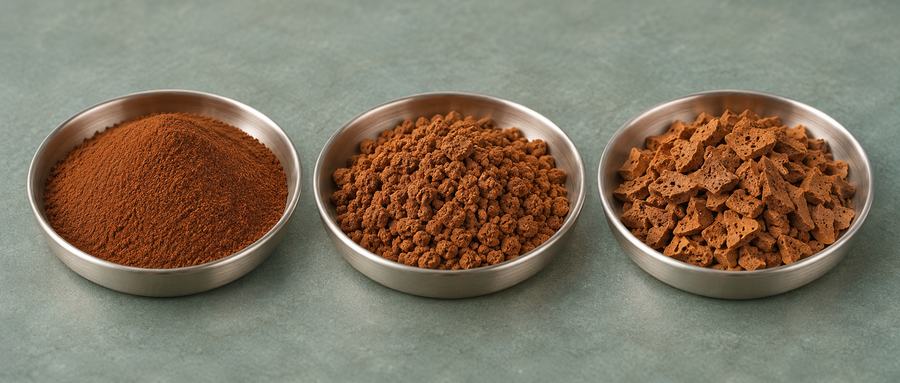
When an established soluble coffee plant evaluates a customer’s reference granule for a new SKU, matching visual appearance alone can mislead production teams. A dark, coarse granule inside a benchmark jar may look like a freeze-dried product, yet it could just as easily be an agglomerated spray-dried powder. An apparent visual match can conceal major operational and sensory discrepancies: the resulting dry product can fill containers unevenly, generate unexpected fines during handling, or deliver an unacceptable cup profile. To settle whether to use an existing spray route, add secondary steam agglomeration, or pilot an industrial food batch freeze-drying line, process development managers must compare how each dehydration route shapes particle structure, aroma retention, reconstitution, and packed line output.
Particle Formation: Spray Drying, Steam Agglomeration, and Freeze Drying
Commercial soluble coffee manufacturing begins with a common starting material: concentrated aqueous extract prepared from roasted and ground coffee beans. Processing this common feed in experimental trials allows a direct comparison between spray drying and freeze drying. In a spray drying system, the concentrated liquid is atomized into droplets inside a tower of heated drying air. As moisture evaporates, evaporative cooling keeps droplet temperatures lower than the hot inlet air, while overall thermal exposure depends on droplet residence time and dryer dynamics. Typical droplet drying history produces fine powder consisting of predominantly rounded particles, offering a standard dry format whenever the target customer specification accepts fine powder.
When an SKU specifies a coarse granule rather than fine powder, processors frequently employ secondary agglomeration. In one conventional agglomeration route described by the soluble coffee producer Cia. Iguaçu de Café Solúvel, steam rewets already dried spray particles so they join into larger clusters, followed by redrying and classification to grade finished particle size. By contrast, a commercial freeze-dried coffee process relies on low-temperature phase change. Liquid extract is frozen solid and mechanically sized while frozen before entering a vacuum drying chamber. Controlled heating supplies heat under vacuum for sublimation—where ice transitions directly into vapor without becoming liquid—and a cold condenser traps the water vapor as ice. Removing ice crystals directly from the frozen matrix can leave behind an open network of pores, though finished particle dimensions, structural porosity, rigidity, and shrinkage depend on actual physical preparation, freezing rates, equipment design, and drying conditions.
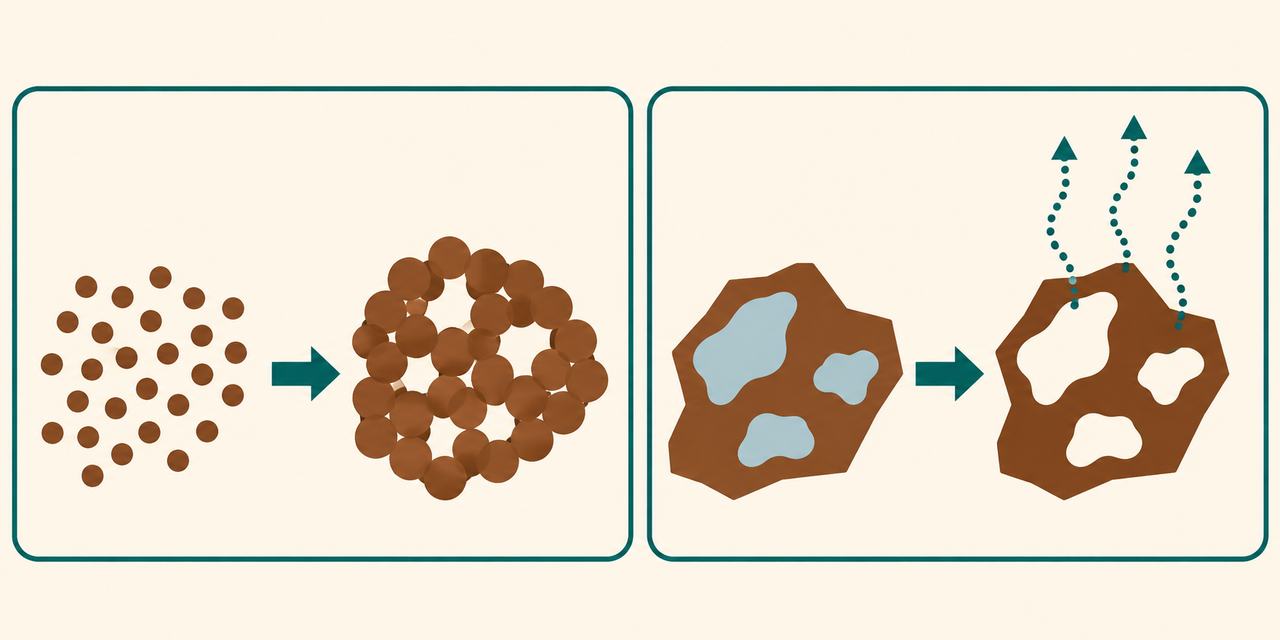
Because coarse grains can be produced either by steam agglomeration after spray drying or by sizing frozen extract before sublimation, outward appearance cannot verify process ancestry. Standardized procurement baselines reflect these separate classes: the USDA Commercial Item Description A-A-20184C (Coffee, Soluble) provides one procurement example with distinct classifications for spray-dried powder, spray-dried agglomerated, and freeze-dried soluble coffee, evaluating dry appearance separately from prepared beverage criteria. In laboratory comparisons, Ghirișan and Miclăuș (2017) observed that laboratory spray-dried coffee particles were finer and rounded, whereas laboratory freeze-dried particles exhibited a mixture of rounded and irregular flaky geometries. Evaluating loose bulk density and dissolution behavior serves to assess commercial product applicability for the client’s brief, rather than attempting to reverse-engineer process history from visual appearance alone.
Volatile Aroma Retention: Concentration History and Pilot Trials
Can a pilot trial reliably determine whether aroma differences stem from the drying route or upstream processing? Volatile aroma compounds can change both during thermal extract concentration and across subsequent dehydration methods, shifting both the total quantity and the relative mix of volatiles. Because measurable volatile changes occur across both concentration and drying in controlled studies, quantifying aroma differences requires establishing a comparable baseline across incoming concentrate, feed adjustments, and aroma handling rather than attributing volatile profiles to drying alone.
In a comparative study, Chindapan and Puangngoen (2024) evaluated volatile aroma retention across industrial freeze-dried and spray-dried soluble coffees produced from a matched Robusta batch and concentrated brew containing 48% to 50% total soluble solids by weight. Using headspace solid-phase microextraction and gas chromatography-mass spectrometry (HS-SPME/GC-MS) on samples diluted to 2% total soluble solids, the researchers quantified the sum of 53 odor-active compounds on a soluble-solids basis. Relative to the concentrated brew, the industrial freeze-dried sample retained 73.39% of the measured odor-active sum, while the industrial spray-dried sample retained 45.13%. However, the concentrated brew itself retained only 43.94% of the measured chemical sum relative to the original unconcentrated brew, a difference that reflects thermal concentration history and may also be affected by analytical matrix interactions during extraction. Because operating temperatures, dryer settings, and final moisture levels differed between the two industrial routes, these values represent specific factory observations rather than universal constants; moreover, measured chemical volatile concentrations do not directly equal perceived sensory aroma, and the authors highlighted that analytical volatile sums must be corroborated by direct sensory cup testing.
When designing trials, technical teams should separate two distinct questions: isolating drying physics versus choosing a commercially viable production process. If testing drying itself, incoming concentrate, any feed adjustments, and aroma treatment must be held comparable between routes; documenting any differences remains essential, though recording a difference does not remove it as an experimental confounder. To choose between commercially feasible production processes, teams should evaluate each realistic route using its applicable settings and established aroma recovery treatment—specifically tracking whether aroma capture is used, at what stage, and at what dosage—and assess each route as a complete commercial process against the customer reference.
Reconstitution and Sensory Evaluation in the Cup
Reconstitution behavior in the cup involves four distinct physical observations: initial surface wetting upon contact with liquid, particulate dispersion throughout the volume, elapsed time to dissolve completely, and any remaining visible residue. Reconstitution kinetics depend on the basic physical mechanisms of water penetrating between primary particles or entering internal pores. In spray powders, surface hydration can cause particles to stick together or form un-wetted clumps before water penetrates between primary particles. Agglomerated clusters provide pathways for water to penetrate between constituent particles, while freeze-dried granules contain internal pores left by sublimated ice crystals that facilitate liquid ingress. Because wetting, dispersion, and dissolution vary with particle dimensions and pore geometry, process type alone cannot determine a universal wetting, dispersal, or dissolution result.
Benchmarking trial samples against the customer reference requires standardized reconstitution protocols to limit experimental variability, though a protocol can never prevent variability entirely. Evaluators must measure identical soluble coffee dry solids per serving, calculate the required sample mass based on measured moisture content, and add identical volumes of a common serving liquid (such as water or milk) at the intended actual serving temperature. Standardized mixing intensity and a predetermined observation time help reduce this source of variability, limiting agitation differences from skewing timed dissolution behavior. If the customer reference is targeted for cold-water or cold-milk beverages, dissolution performance must be tested directly under the intended actual liquid temperatures, as hot dissolution results alone are insufficient to predict cold reconstitution behavior.
Sensory profiling should rely on blind, coded serving to reduce expectation bias regarding drying technologies. Dry jar aroma and prepared beverage flavor should be evaluated as separate observations, scoring coded cups directly against the customer reference’s specified sensory attributes rather than assuming an inherent flavor profile based on drying technology. If observable differences remain in green coffee sourcing, extraction yields, thermal concentration, or aroma add-back systems, sensory variations cannot be attributed solely to the dehydration step.
Bulk Density, Mechanical Breakage, and Moisture Barrier Packaging
Even when a pilot batch matches the sensory profile of a customer reference, differences in physical packing behavior can disrupt commercial viability. At equal net weight, a soluble coffee with lower loose bulk density—defined as powder mass per unit volume under a standardized fill procedure—generally occupies more container volume. If an agglomerated or freeze-dried trial batch exhibits a lower loose bulk density than the customer reference, spillage is possible whenever available container fill volume or headspace is insufficient, although exhibiting a lower density than the benchmark alone is not definitive proof of failure. Packaging engineers must evaluate actual container geometry, filler dosing settings, and settling behavior before committing to a commercial run.
Downstream of drying, particle size distribution can shift due to mechanical breakage and separate environmental moisture uptake. Both steam-agglomerated clusters and porous freeze-dried granules can fracture during conveying, hopper feeding, and container dosing, where mechanical breakage generates mechanical fines that can impair powder flowability, alter particle size distribution, and contaminate package heat seal areas. Measuring particle size distributions immediately after drying and again after actual packaging and handling tests allows engineers to detect particle breakdown, though before-and-after tests cannot positively diagnose every handling issue. Because ambient humidity can independently cause particles to absorb moisture, soften, or cake if exposed, ambient humidity must be held strictly comparable as an experimental control across handling evaluations.
Soluble coffee is highly hygroscopic, making moisture barrier protection essential for preserving physical stability. In an environmental study, Lopriore et al. (2025) exposed an unpackaged commercial instant coffee sample taken out of its retail packaging from a single lot to 11%, 32%, and 65% relative humidity at 20 °C. The authors observed that under these specific test conditions, exposure of this unpackaged sample to 65% RH caused noticeable visual deterioration and slower or impaired hot-water solubilization. To maintain stability, processors should consult established freeze-dried food packaging guidelines, validating actual packed storage across shelf life—including seal integrity, barrier properties, cup retesting after storage, and repeated container opening cycles where multi-serve packaging is used—without assuming universal barrier performance across packaging formats.
Line Output Reconciliation: Mass Balance, Accepted Yield, and Pilot Economics
When plant managers evaluate whether to produce a new SKU on an existing spray drying line, add a steam agglomeration loop, or invest in an industrial batch freeze dryer, financial viability hinges on accepted saleable yield rather than theoretical capacity. Comparing technologies requires tracking dry solids across every stage of the manufacturing boundary over a planned operating interval.
Evaluating complete commercial routes requires comparing incoming extract concentrate through accepted packed units over the same matched time boundary for both routes, ending at accepted packed units and taking into account real process step overlap and operational boundaries. In a spray drying route with secondary agglomeration, dry solids must be tracked through spray atomization and drying, cyclone or filter collection, steam agglomeration re-wetting, fluid-bed re-drying, cooling, screening, and container filling, recording wall deposits, dust collector fines, screening rejects, rework streams where rework occurs, and filling losses without assuming that every spray route includes an agglomeration loop. In an industrial batch freeze-drying route, the process boundary spans extract freezing, cold mechanical sizing, tray loading, vacuum chamber pump-down, sublimation, secondary desorption, ice condenser defrosting, chamber turnaround, unloading, final screening, rework of off-spec particles where rework occurs, and container filling losses. Accounting for screening, rework where it occurs, rejects, and losses at filling across each route allows realistic comparisons; tracking or counting rework is not a prescription to rework off-spec material, nor does it prescribe fixed recycle loops or assume deposit-free operation.
The fundamental metric for economic evaluation is the comparative cost per accepted packed kilogram over a defined operating period, calculated as same-period comparable total costs divided by kilograms of accepted, packed, saleable product meeting all customer specifications. Technical teams must decide whether capital costs are included alongside operating expenses, allocating both consistently on the same period and production basis:
Cost per Accepted Packed Kilogram = Same-Period Comparable Total Costs / Accepted Packed Saleable Output (kg)
To illustrate how mass balance discrepancies affect output, consider a hypothetical pilot trial starting with 1,000 kg of liquid coffee extract at 40% total soluble solids by weight. This extract contains exactly 400 kg of dry soluble solids:
| Process Parameter | Theoretical Baseline | Trial Route A | Trial Route B |
|---|---|---|---|
| Input Extract Mass | 1,000 kg | 1,000 kg | 1,000 kg |
| Extract Soluble Solids Content | 40.0% | 40.0% | 40.0% |
| Total Starting Dry Solids | 400.0 kg | 400.0 kg | 400.0 kg |
| Target Final Moisture Content (wet basis) | 2.5% | 2.5% | 2.5% |
| Theoretical 100% Yield Product Mass | 410.3 kg | 410.3 kg | 410.3 kg |
| Accepted Packed Saleable Mass | 410.3 kg | 390.0 kg | 370.0 kg |
| Accepted Output Variance | Baseline | -20.3 kg | -40.3 kg (-20.0 kg vs Route A) |
At a target final product moisture content of 2.5% on a wet basis (assuming no added solids and zero physical loss), the 400 kg of dry solids yields a theoretical maximum product mass of 410.3 kg (calculated as 400 kg / (1 - 0.025)). In this hypothetical calculation, if Route A yields 390.0 kg of accepted packed product while Route B yields 370.0 kg over the matched operating period at identical moisture, Route A achieves a 20.0 kg advantage in accepted saleable output. Rather than treating these hypothetical outlet weights as actual factory measurements, plant managers should relate accepted kilograms and same-period comparable costs to product decisions whenever both routes meet the applicable customer specification. Unreconciled solids may reside in recyclable filter fines, non-recoverable purge streams, oversized lumps, or packaging trim rejects. Process engineers must reconcile fines, rework, and reject streams separately; if trial routes finish at differing moisture levels, dry solids recovery must be evaluated on an absolute dry-matter basis to ensure accurate operational comparisons.
Deciding Your Soluble Coffee Processing Route
Selecting between spray powder, agglomerated granules, and batch freeze drying depends on aligning customer specifications with packaging economics and sensory performance. When both commercial routes pass the customer specification, engineering managers can compare them directly on accepted output and production cost per accepted kilogram. When only one commercial route—whether freeze drying or agglomerated spray—passes all granule structure, dissolution, and aroma criteria, plant teams can qualify that specific route against capital and line operating limits. When neither route passes the target specification, troubleshooting must connect directly to the observed physical or sensory failure—such as particle attrition, seal contamination, or volatile imbalance—without assuming that any single technology is universally superior.
When customer product specifications point toward an industrial batch freeze-drying route, our technical specialists can review your starting extract solids content, target granule specification, and planned accepted packed output. You can contact our engineering team for project enquiries to assess equipment configurations, chamber capacities, and operational requirements for industrial food batch freeze dryers.
References
- USDA Agricultural Marketing Service. Commercial Item Description A-A-20184C: Coffee, Soluble. May 2013.
- Marubeni. Companhia Iguaçu: Instant Coffee for the Global Market.
- Ghirișan A, Miclăuș V. Comparative Study of Spray-Drying and Freeze-Drying on the Soluble Coffee Properties. Studia UBB Chemia. 2017;62(4 Tome II):309–316.
- Chindapan N, Puangngoen C. Comparative Evaluation of Volatile Aroma Compounds Content of Freeze-Dried and Spray-Dried Instant Coffees. Burapha Science Journal. 2024;29(2):647–671.
- Lopriore M, et al. Impact of Environmental Humidity on Instant Coffee Stability: Defining Moisture Thresholds for Quality Degradation and Shelf Life Prediction. Foods. 2025;14(10):1826.

About the Author: Zheng Wei
Founder & Freeze-Drying System Engineer
Fuzhou Xing Shun Da Refrigeration Facility Project Co., Ltd.
Zheng Wei participates in food freeze-drying trials, equipment selection, vacuum-system configuration, refrigeration planning, installation guidance, process optimization, and project handover. The project experience covers fruit, vegetables, cooked foods, seafood, meat, dairy products, herbs, and extracts.