
Food processing & packaging
Freeze Drying vs Vacuum Sealing: Food Process and Packaging
Start with the food you want to sell. Decide whether it needs drying, packaging or both before asking suppliers to quote equipment.
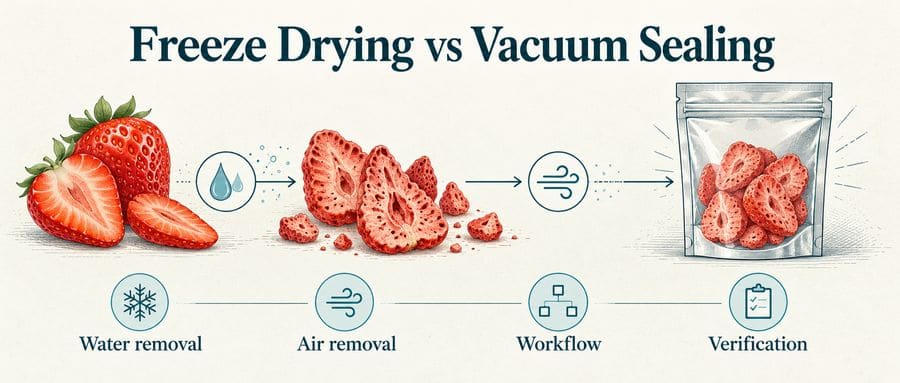
Freeze drying removes water from food. Vacuum sealing removes air from its package. Sealing moist food in a tight pouch does not dry it, and packaging vacuum alone does not establish product preservation or shelf life. When a production line needs both operations, the dryer alters the food itself, while the packing station protects the finished pieces.
First decide which step is missing from your product route. Then ask equipment suppliers to show how their machinery handles your specific food, how the drying and packing stages connect, and what separate evidence each trial will produce.
What does each operation actually do?
Start by asking where the moisture goes, rather than whether equipment pulls a vacuum. A freeze dryer extracts water directly from the food structure. A vacuum sealer evacuates air from the package and seals the opening, without performing the product drying duty.
The term “vacuum” indicates only an operating pressure, not what the machine achieves. Evaluating a freeze dryer requires looking beyond the vacuum pump to verify product freezing, controlled heat input, and the vapor-capture route.
In freeze drying, the product is frozen, heat is supplied under controlled conditions, and ice is removed by sublimation during primary drying. Secondary drying removes additional sorbed water. The system therefore needs coordinated freezing, heat transfer, vapor removal and water-vapor capture—not simply a pump connected to a bag. Ratti’s food freeze-drying chapter describes these process and equipment functions.[1]
| Decision point | Freeze drying | Vacuum sealing |
|---|---|---|
| Main task | Remove product water through a controlled drying process. | Remove air from a package and make a seal. |
| Where the change occurs | Within the food and along the water-vapor path. | In the package atmosphere and closure. |
| Product entering the operation | A defined formulation and prepared load suitable for the chosen freeze-drying process. | A product already suitable for its intended preservation and storage route. |
| What it does not establish alone | Finished-package protection or validated shelf life. | A dried product, microbial safety or room-temperature stability. |
| Useful purchasing basis | Prepared wet load, water duty, loading geometry, endpoint and full turnaround. | Pack format, product behavior, pack rate and verified seal performance. |
OSU Extension explains that vacuum packaging removes air around the food and notes that some dehydrated and freeze-dried foods can benefit from vacuum packaging. [2] Treat vacuum packaging as an option for protecting food after drying, not as a shortcut to remove water.
Which step is missing from your product route?
Specify what product enters the facility and what finished item reaches the buyer. A moist food kept chilled or frozen, a newly developed dry snack, and a product that is already dry raise different equipment questions. Asking vendors for “Longer storage” without defining the food format does not give them enough information to quote.
| Situation | Decision to resolve | Evidence to request |
|---|---|---|
| Moist food will stay chilled or frozen | Whether vacuum packaging fits the existing preservation route. A freeze dryer is a different process investment. | Product-specific food controls, required cold chain, package suitability and seal checks. |
| A new dried snack or ingredient is planned | Whether freeze drying produces the required structure, rehydration behavior and quality. | A representative product trial, defined drying endpoint and a compatible packaging plan. |
| The product is already dry | How to protect it during transfer, packing and distribution. | Dry-product acceptance, package integrity and tests on the intended product–pack combination. |
If you plan to produce a dried snack or food ingredient, run a representative drying trial before committing to freeze drying. Confirm that the finished structure, rehydration behavior, and product quality suit the intended use. If the food will remain moist, evaluate packaging options strictly inside its established preservation route instead.
A tight package is not a food-safety release test. OSU Extension warns that vacuum packaging does not replace refrigeration or freezing where those controls are required, and that reduced oxygen can favor certain pathogens.[3] A food business must retain its applicable, validated preservation and storage controls. This comparison is not a processing schedule.
Freeze drying also does not establish pathogen destruction. USU Extension notes that microbes can survive the process; food businesses must define applicable safety controls separately from dry-product and package checks.[6]
For food that already meets its intended dry-product specification, evaluate the missing packaging protection before considering further drying. The dry-product branch does not mean that every snack needs to be freeze-dried again.
State required preservation controls clearly in the purchasing brief whichever equipment path you take. The food preservation guide traces those controls across drying, packaging, and storage. Keep the project decision clear: select the exact step needed without treating a sealed bag or completed drying cycle as proof of food safety.
Illustrative calculation · not a machine rating
A water-duty example: 100 kg of prepared food
Assume a prepared food load weighs 100 kg and contains 80% water by mass. It therefore contains 20 kg of dry solids. For this arithmetic example only, choose a final moisture content of 2% on a wet basis.
Dry solids = 100 × (1 − 0.80) = 20 kg
Finished mass = 20 ÷ (1 − 0.02) = 20.408 kg
Water remaining = 20.408 − 20 = 0.408 kg
Water removed = 80 − 0.408 = 79.592 kg
The drying process would need to remove approximately 79.6 kg of water under these assumptions. Vacuum sealing the original load does not perform that water-removal duty. A sealer’s package size or vacuum figure cannot replace a dryer’s defined process specification.
Assumptions: no dry-solids loss, no added ingredients and no packaging mass included. The selected 2% value is hypothetical; it is not a food release criterion, water-activity limit, achievable specification or safety guarantee. Actual yield, endpoint and cycle require product testing. This calculation specifies water duty only; it does not size a freeze dryer or its condenser.
How will food move from the dryer to the packer?
Design unloading and packaging procedures together before purchasing machines. An approved dry batch must reach its package under agreed transfer conditions to protect product quality, especially when handling whole fruit slices or other fragile pieces.
Review the handover steps in operational sequence:
- Define the load. Set recipe ingredients, preparation methods, and loading geometry, then select how the team will confirm the drying endpoint.
- Check the food. Verify that endpoint before transferring food to packaging. Chamber vacuum levels do not reveal residual moisture or product water activity.
- Prepare the transfer. Ensure the packaging line, staging materials, and unloading staff are ready before product is unloaded. Designate who checks transfer conditions and who decides what happens if packing stops during an interruption.
- Check the finished pack. Choose packaging materials and internal atmosphere to suit the specific food, piece fragility, and actual storage conditions. Inspect the sealed package and food together rather than assuming higher vacuum guarantees better preservation.
A fruit-and-vegetable freeze-drying review by Wang Bai’ou and Cui Chunhong describes two relevant vulnerabilities: exposed freeze-dried food can interact with oxygen and absorb moisture, and its porous structure can be easily broken during handling and distribution.[4] These are reasons to test protection and compression on the intended product, not reasons to apply maximum package vacuum to every food.
The FDA’s technical guide explains water activity as a property of available water in the food.[5] A package vacuum reading does not measure that property. Specify the appropriate product tests separately from seal and package checks.
Determine exposure and handling limits from physical trials and workflow tests on your specific food and packaging setup, because generic comparisons cannot provide reliable boundaries. The freeze-dried food packaging guide discusses barrier materials, atmosphere choices, compression risks, and packaging line integration to help decide suitable packaging protection.
Share this transfer plan with both equipment suppliers early. The freeze-dryer supplier needs to know the batch sizes and discharge schedules the packaging station can handle, and the packaging vendor needs the physical shape, moisture state, and amount of discharged product. Agree on supplier boundaries and responsibilities in formal proposals rather than sorting them out on the packing floor.
How can quotations be compared fairly?
Establish the final saleable product format before comparing equipment prices. Chilled wet foods, frozen cuts, and dry snacks represent distinct manufacturing routes. A vacuum sealer quotation and a freeze-dryer proposal cannot be compared as alternative costs for the same job; each vendor proposal must be evaluated against the complete product route.
Specify the prepared food, packaging format, output basis, and actual storage route at the top of your request. Separate drying requirements from packaging tasks so each supplier can bid strictly on its portion of the process.
Ask the dryer supplier to connect the load to the full schedule
Detail food ingredients, preparation methods, and loading geometry. State the prepared wet mass per batch, along with initial and final moisture basis. Ask the vendor to demonstrate that drying endpoint using a representative loaded trial.
Require quotes to specify the full turnaround time, accounting for loading, freezing, drying, unloading, defrosting, and cleaning. Reviewing drying time alone ignores the rest of the operational cycle. Alongside that schedule, clarify what installation and support scope the agreed offer includes, together with required utilities and transfer arrangements.
Ask the packaging supplier to match the released product
Specify package dimensions, fill mass, food shape, and acceptable breakage. Ask whether vacuum sealing suits the piece structure or risks crushing it, and confirm that the proposed pack rate keeps pace with dryer discharge. Require the vendor to state which seal and package-integrity checks it will separately demonstrate.
Identify who provides the actual interfaces, accessories, and validation activities. Defining these scopes and supplier responsibilities in the quotation stage keeps unresolved integration work and supply exclusions visible for the project to resolve.
Keep prepared wet kilograms, saleable dry kilograms and packages separate. Ask each offer to connect the demonstrated package rate and available packing time to the product released by the dryer. Record utilities, labor, packaging, maintenance, required storage, testing and supply exclusions. A bag dimension or chamber vacuum figure cannot answer that scheduling or cost question.
Consult the batch freeze dryer guide to evaluate batch capacity and dryer design. Keep packaging as an independent station within the production route, and compare operating expenses only after equipment throughput and supply boundaries are fixed. This guide does not provide return-on-investment projections.
Pay close attention to machine descriptions. Vacuum drying removes water—usually by evaporating moisture under reduced pressure—while vacuum sealing merely packages products. If a supplier quotes a vacuum drying oven, evaluate it as an alternative drying process. The vacuum oven and freeze dryer comparison explains the differences between those drying methods.
What must a trial prove before acceptance?
Define agreed acceptance criteria and test records for your project before committing to machinery or packaging formats. Insist on separate testing for the food and its package: a batch can reach target dryness while package seals leak, and an airtight seal cannot prove that food was properly dried.
Conduct trials using representative formulation, preparation, and loading. Follow that same product through packaging and the physical handling checks relevant to intended distribution to evaluate protection against breakage. An attractive sample piece without documented process records leaves equipment suitability unproven.
- Product: identify the representative formulation, preparation, load and sampling locations, then record the agreed drying endpoint and required quality checks.
- Physical protection: compare the actual pieces before and after packing and handling against an agreed breakage criterion.
- Package: identify the pack, fill, closure and atmosphere, then record the agreed seal and package-integrity checks separately from the product tests.
- Storage: retain evidence for the finished product–pack combination under its intended conditions before making a shelf-life claim.
Chamber vacuum, a tight-looking bag and one attractive sample do not replace those separate acceptance records. Test methods and limits must fit the actual product and package; this comparison does not prescribe a universal protocol.
Review test records against agreed criteria alongside your equipment vendors. If product dryness passes inspection but breakage rates fail, investigate transfer handling and packaging methods rather than accepting the complete line. When making a shelf-life claim, gather test data from the specific food inside its production package under intended storage conditions, because passing a drying run or vacuum seal test alone cannot validate shelf life.
From comparison to a usable brief
Prepare a food-project brief
For a preliminary freeze-drying equipment review, provide:
- Food name, formulation, preparation and intended finished form.
- Prepared wet load per batch or per day, plus initial moisture data if available.
- The required product acceptance method and any existing trial results.
- Package concept, fill mass, breakage concerns and planned packing arrangement.
- Installation destination, available utilities and the intended operating schedule.
The review can identify freeze-drying duty and packaging-interface questions. Equipment supply, trials, services and packaging machinery must be defined in the agreed offer. This is not a promise of included sealers, validated shelf life or food-safety approval.
Frequently asked questions
Can a vacuum sealer freeze dry food?
No. A vacuum sealer pulls air out of a package; it cannot freeze food, supply sublimation heat, or capture water vapor. Start by defining the product water-removal requirement before selecting drying equipment.
Must all freeze-dried food be vacuum sealed?
No. Packaging methods that protect one finished product do not automatically suit another. Choose packaging materials and internal atmospheres to match the specific food, required barrier protection, and intended storage conditions, and evaluate piece compression and breakage if the dry food is fragile.
Which method gives a longer shelf life?
Start by identifying the target food format. Freeze drying and vacuum packaging perform separate processing roles, and neither operation alone establishes shelf life. Base shelf-life claims on storage evidence of the finished food inside its intended package under expected storage conditions, rather than relying on cycle readings or package vacuum.
References and evidence boundaries
- Ratti, C. (2013). “Freeze drying for food powder production.” In Handbook of Food Powders, pp. 57–84. DOI: 10.1533/9780857098672.1.57. Used for the drying mechanism and system functions, not a universal cycle or performance guarantee.
- OSU Extension Service: Vacuum sealer. Used for the packaging-air function and the distinction between packaging and drying.
- Oehler, N. Should I Vacuum Package Food at Home? SP 50-603. OSU Extension, revised March 2013. Used only for the preservation-control caution; home handling instructions are not a factory process schedule.
- 王白鸥、崔春红 (Wang Bai’ou and Cui Chunhong). “真空冷冻干燥技术在果蔬加工中的应用” [Application of vacuum freeze-drying technology in fruit and vegetable processing]. 中国果菜, 2009(3), pp. 52–53. Packaging discussion on p. 53 used for qualitative exposure and fragility considerations only. DOI not identified; historical market and operating prescriptions are not adopted.
- FDA: Water Activity (aw) in Foods. Inspection Technical Guide No. 39, 1984. Used for the water-activity concept, not current regulatory applicability or a product release threshold.
- Carlile, V., Wayment, M., and Brandao, J. (2026). Can I Freeze-Dry That? A Practical Guide to Safe and Effective Freeze-Drying. USU Extension, peer-reviewed fact sheet. Used only for the microbial-survival caution; home recipes, equipment conditions and storage estimates are not adopted as commercial limits.
About the Author: Zheng Wei
Founder & Freeze-Drying System Engineer
Fuzhou Xing Shun Da Refrigeration Facility Project Co., Ltd.
Zheng Wei participates in food freeze-drying trials, equipment selection, vacuum-system configuration, refrigeration planning, installation guidance, process optimization, and project handover. The project experience covers fruit, vegetables, cooked foods, seafood, meat, dairy products, herbs, and extracts.