
Romania · Food production · Equipment planning
Freeze Dryer Romania: A Food Production Buying Plan
Start with one food and the result your business needs. Then check whether the quoted equipment, the evidence and the work at the Romanian site support the same project.
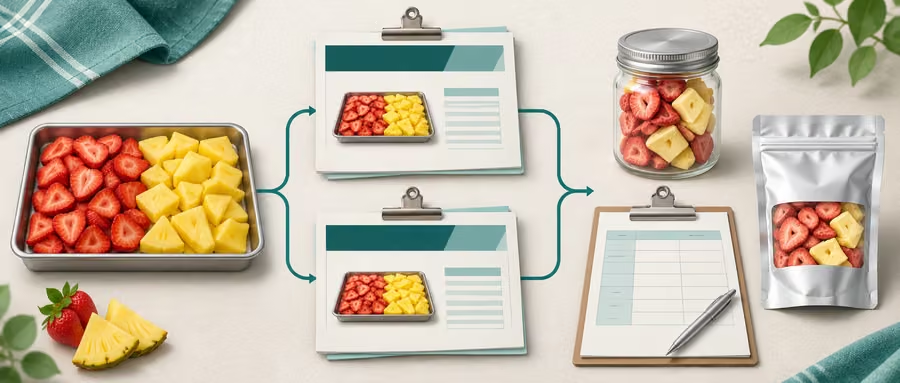
Choose a food, describe how it will be prepared, and state what an acceptable finished batch must be like. Send that same description to each supplier. Then compare the proposed load, complete working schedule, delivered price and responsibilities. A listing in Romania, a large tray area or a dry sample answers only part of the buying decision.
This guide is for food processors, ingredient businesses and commercial pilot teams planning a Romanian project. Household food preservation and sterile pharmaceutical production need different specifications and supplier checks. Romanian listings may use liofilizator; the name does not tell you whether a machine suits your food.
Choose the route from the product questions still open
List what is still unknown about the food before deciding between a pilot system and production equipment. Does the team still need to choose the preparation method, loading pattern or finished specification? If so, define a trial that will answer those questions. Agree what would count as a useful result before running it.
If representative records already exist, use them. A mature product does not automatically need another laboratory stage. Ask which parts of the proposed production duty those records demonstrate and what still needs checking on the quoted configuration. The food R&D and pilot guide explains how to make a development test useful for equipment selection.
| Possible route | When to consider it | What to check |
|---|---|---|
| Food pilot system | The product form, loading or finished result is still being developed. | Can the trial represent the intended preparation, freezing and loading? |
| New production system | The product is defined and the business needs regular production. | Match the configuration, utility needs, supply exclusions, trial scope and acceptance responsibilities to that duty. |
| Used machine | An identified machine could suit the application after inspection and any adaptation. | Check identity, service history, condition, controls support, food-contact suitability and the cost of modifications. |
| Several smaller units | Separate products or batch scheduling may favour several units. | Compare combined labour, loading, cleaning, packing, utilities and support—not just the price of one unit. |
Keep condition and food performance as separate decisions. A used machine may pass a mechanical inspection while still lacking evidence for the intended product. A new machine still needs a clear list of what the supplier will deliver and what the buyer must provide. Neither route removes the need to check the actual application.
Find out what the capacity figure measures
Ask the supplier to write the food and test conditions beside every quoted capacity. A mass of wet food, a mass of dried product and a mass of captured water describe different things. Do not compare them as though they were the same output.
- Prepared wet food: identify the food or recipe, initial moisture or solids, piece size or layer depth, and the load on each tray.
- Acceptable finished food: state the finished specification, usable yield and allowance for rejected product.
- Water removal: distinguish the total water a condenser can capture from the rate at which it captures water. Ask for the conditions behind each rating.
- Daily output: show how freezing, drying, unloading, defrosting, cleaning and changeover fit the available working hours.
Tray area tells you how much space is available for the load; it does not establish the production rate by itself. Ask whether each proposed figure was measured or calculated, with which food, load, duration and operating conditions. An empty-machine temperature or vacuum test must remain separate from loaded water-removal evidence.
An illustrative mass balance—not a capacity promise
Assume a batch contains 240 kg of prepared food at 80% initial moisture, and the proposed finished specification is 2% moisture, wet basis. Assume no solids loss or added ingredients.
Dry solids = 240 × (1 − 0.80) = 48 kg.
Calculated finished mass = 48 ÷ (1 − 0.02) ≈ 48.98 kg.
Calculated water removed = 240 − 48.98 ≈ 191.02 kg.
These are hypothetical inputs and a solids-conservation calculation. They are not a recommended moisture limit, measured yield or equipment rating. Actual trimming, losses, product specification, water-removal rate and complete cycle time still need verification.
Use the calculation to identify the water load, then ask how the configured system will handle that load over the complete schedule. A mass balance cannot supply the drying time. The capacity and cost calculator can help organise preliminary inputs; the product and proposed duty still need representative evidence.
For a Romania price comparison, request an itemised delivered offer. Separate the machine and auxiliaries from freight, unloading, utility connections, installation, tests, documents and training. Have the responsible customs and accounting advisers review classification, taxes and import charges for the actual supply. No single duty rate or catalogue price gives the installed project cost.
Name the importer and check the machine documents
Identify the seller, the supplied configuration and the party handling import formalities before treating an offer as complete. Local stock, an EU distributor and a direct purchase from outside the EU can involve different contracts and responsibilities. Ask who will supply each document and who will check it for the Romanian project.
Confirm the customs operator first
For an importer established in Romania, confirm its EORI position with the Romanian customs authority and its customs representative. EORI is the EU customs identification number. The European Commission says that an EU-established operator requests it from the authority of the country where it is established. [1]
This identifies the operator; it does not establish machine conformity or food-process suitability. Ask the customs representative to confirm the classification, declared value, origin evidence and documents for the actual supply.
Use the placing-on-market plan to check the rules
The European Commission states that machinery placed on the EU market before 20 January 2027 must comply with Machinery Directive 2006/42/EC. Machinery Regulation (EU) 2023/1230 applies mandatorily from that date. Check the actual placing-on-market plan; the purchase-order date alone does not decide the applicable route. [2]
This is general buying context, not a conformity assessment of a particular machine or a complete list of legislation applicable to the project.
If an offer only lists a CE certificate, ask which machine configuration, applicable declaration and conformity assessment procedure it refers to. Then resolve the missing evidence with the supplier and responsible importer.
- Identify the supply: record the model, included assemblies, exclusions and serial identification where available.
- Name the document provider: agree who supplies the applicable declaration, instructions, drawings and installation information for the machine or integration scope being sold.
- Make the information usable: request Romanian operating, cleaning and maintenance information for the intended team. Confirm translation, training and support in the written scope.
The Commission warns that voluntary or additional certificates are not generally a recognised way to prove compliance. Where specific legislation provides for voluntary certification, its stated requirements still apply. Voluntary certificates must not be confused with a notified body’s conformity assessment within its notified area of competence. [2]
Keep the site’s food-establishment and product obligations separate from the machinery documents. The site team should resolve the applicable requirements with the competent authorities. A machinery declaration or a successfully dried sample does not settle those obligations.
Agree what the trial must prove
Write the acceptance criteria before the trial. State which food must reach which finished result, with what preparation and loading, and which part of the intended production duty the test must represent. A hand-selected dry sample does not tell the buyer what happened elsewhere in the batch.
Ratti’s chapter on food-powder production describes laboratory-to-commercial differences in geometry and heat transfer that can affect product temperature. For the buyer, this is a reason to document the conditions a trial represents and the checks still needed at production scale. The chapter does not establish one pressure, temperature or drying time for every food. [3]
Ask for a record that lets the buyer connect the starting food, the process and the finished result:
- Describe the load. Record the food or formulation, raw-material or batch identity, preparation, piece size or layer depth, freezing history, tray layout and prepared masses.
- Record what happened. Retain temperatures, pressure, timing and relevant equipment observations. Identify the instruments, their calibration status, and the sensor and sampling positions used for the results.
- Test the finished food. Use the agreed moisture and other product checks, including appearance, texture, reconstitution or ingredient performance where relevant. Identify where samples came from.
- State what the result proves. Separate measured results from calculations and estimates. List what still needs confirmation on the configured production system.
An empty-chamber test is useful for checking functions under its stated conditions. It cannot replace evidence that the system handles the agreed food and water load. Keep both types of test in the plan rather than accepting one as proof of the other.
The documented pineapple project in Indonesia shows how product preparation, loading and finished-result records can be presented together. It is an example of evidence to look for, not a Romanian installation reference or a forecast for another food.
Agree the number of test runs for the actual project; this guide sets no fixed batch count. If a criterion fails, keep the original result, document the agreed corrective work and retain the retest result. Do not replace a failed record with an unexplained pass. The food freeze-dryer acceptance guide explains the factory and site test questions in more detail.
Give each site task an owner before dispatch
Send the supplier the real site conditions and check them against the selected configuration. A machine outline does not show every connection, auxiliary or maintenance space. Use the approved drawings and utility requirements to plan the factory work, then give every open item a responsible person and a deadline.
Ask the site’s electrical and utility contractors to check the required supply and available capacity. An installed-power figure is not a transformer selection. Cooling, heat rejection, drains and any required steam also depend on the actual configuration. The installation planning guide develops those utility and access checks.
| Work to close | Evidence to agree | People to involve |
|---|---|---|
| Receive and position the equipment | Shipping sections, package dimensions, narrowest opening, lifting method, floor conditions, final position and service access. | Buyer, transport and lifting teams, using supplier drawings. |
| Connect the utilities | Electrical supply, cooling and heat rejection, drains, and steam where the configuration requires it. | Supplier and the site’s utility contractors. |
| Move and pack the food | Preparation, freezing, loading, unloading, hygienic handling and protected packing arrangements. | Buyer’s production and food-safety teams. |
| Commission and accept | Test methods, required site conditions, failures, corrective work, retests and sign-off responsibilities. | Named supplier and buyer representatives. |
| Train and support the team | Actual provider and language; remote or on-site work; parts, travel, response terms and commercial exclusions. | The parties named in the written service agreement. |
Walk the route from unloading the food to the actual pack. At the same time, map the cleaning and defrost work. Decide who will handle the places where these activities meet, so protected food handling is part of the plan rather than an assumption.
Before handover, agree how operators will demonstrate the operating, cleaning and maintenance tasks they need to perform, and which manuals and records they will receive. For every support item, ask who does the work and where. Confirm warranty coverage, on-site attendance, working language, parts availability and response terms for this project. An overseas sales page does not establish a Romanian warehouse, local service team or destination approval.
Send one brief to suppliers and the site team
Send the same project brief to the supplier, the people preparing the factory and the people comparing prices. Mark unknown information as an open question, so an estimate cannot quietly become an agreed requirement.
- The food, recipe or variety; product form and preparation.
- Prepared wet load per batch or day, wanted finished output and available operating hours.
- Known initial solids or moisture, the proposed finished specification and packaging format.
- Trial records already available and the questions still unresolved.
- The Romanian site location, utilities, delivery access and installation constraints.
- The preferred supply route, intended market and installation dates, and who handles import work.
- Required documents, training language, acceptance tests and service scope.
Ask each proposal to identify assumptions, exclusions and work still to be verified. This gives the buyer a way to compare the actual project rather than a set of unrelated machine descriptions.
Discuss a defined Romania food-production project
Send the product, prepared load, required finished result and site conditions to the engineering team for a project-specific equipment and interface discussion. Ask the written proposal to identify assumptions, exclusions and any required trials. Output, destination documents, Romanian-language support and site services require confirmation for the actual project.
Questions to settle before placing the order
What does a freeze dryer cost in Romania?
Build the budget from the configured equipment and the work needed to deliver, install, test and support it. Ask for separate prices for auxiliaries, freight, unloading, site connections, documents and services. Taxes and import charges need project-specific review. A machine-only catalogue price leaves those decisions open.
Can a used machine be a sensible purchase?
Yes, when its identity, condition, controls, serviceability and suitability for the food can be checked. Include modifications, missing documents, installation and site testing in the comparison. Passing a mechanical inspection does not establish the required food result.
Can a laboratory demonstration establish production capacity?
It supplies evidence for the conditions actually tested. Production planning also needs representative preparation and tray loading, heat and vapour transfer, equipment limits and the complete working schedule. Ask the supplier to identify the assumptions still awaiting production-scale checks.
Does the name lyophilizer mean a different buying category?
Lyophilizer and freeze dryer commonly name the same process equipment. Check the intended food, laboratory or pharmaceutical use and the actual configuration. The term by itself does not establish suitability.
References and evidence
- European Commission, Taxation and Customs Union. Economic operators registration and identification (EORI) number. Official identification and establishment principles. Accessed 30 October 2026.
- European Commission. Machinery. EU machinery legislation and transition timing. Accessed 30 October 2026.
- Ratti C. Freeze drying for food powder production. In: Handbook of Food Powders. 2013:57–84. doi:10.1533/9780857098672.1.57. Qualitative food-process and scale-transfer context; no universal settings or output guarantee inferred.
About the Author: Zheng Wei
Founder & Freeze-Drying System Engineer
Fuzhou Xing Shun Da Refrigeration Facility Project Co., Ltd.
Zheng Wei participates in food freeze-drying trials, equipment selection, vacuum-system configuration, refrigeration planning, installation guidance, process optimization, and project handover. The project experience covers fruit, vegetables, cooked foods, seafood, meat, dairy products, herbs, and extracts.