
Drying Fruits and Vegetables on Separate Trays in One Freeze Dryer Batch
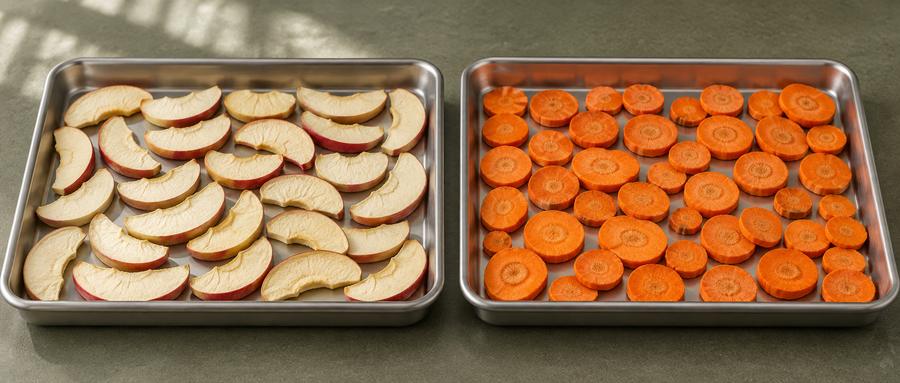
Why Products in the Same Chamber Experience Different Sublimation Conditions
During vacuum primary drying, heat transferred from the shelves supplies the energy for ice sublimation, and the resulting water vapor travels through the developing dried porous layer before reaching the colder condenser surface. Equipment design and tray contact determine how shelf heat reaches the material, while pore resistance, composition, and piece geometry determine how fast moisture can leave. Because these characteristics differ across food matrices, two products placed in the same chamber under identical chamber pressure setpoints can experience different sublimation rates and product temperatures.
Laboratory single-tray drying demonstrates how material differences alter drying trajectories under matched machine conditions. In research by Reale, Torrez Irigoyen, and Giner (2023), peeled Red Delicious apple, banana, and strawberry were prepared in 10 mm slices, frozen in air for 24 h at −20 °C, and dried individually on a single 300 mm circular tray. The condenser reached −48 °C before loading, and 30 Pa was the chamber pressure threshold for switching on shelf heat toward a 40 °C shelf target. Normalized primary-drying curves differed among the fruits, with apple drying slowest and banana fastest in that observed apparatus. The authors interpreted these patterns through differences in laboratory dried-layer vapor resistance and the amount of ice relative to dry matter.
Piece geometry adds another critical variable. In laboratory drying experiments across 1, 2, and 3 mm carrot slices conducted at 0 °C shelf temperature and 7 Pa absolute chamber pressure, George and Datta (2002) observed that thicker carrot slices dried more slowly on normalized initial water curves. An increasing dried-layer vapor path contributes to slowing mass transfer as sublimation progresses. In an industrial plant handling mixed fruit lots and vegetable dice, piece thickness distributions, tray loading densities, and bed depths compound natural botanical variations. Because of these differences in geometry and material properties, fruit and vegetable slices on separate trays can finish primary drying at different times.
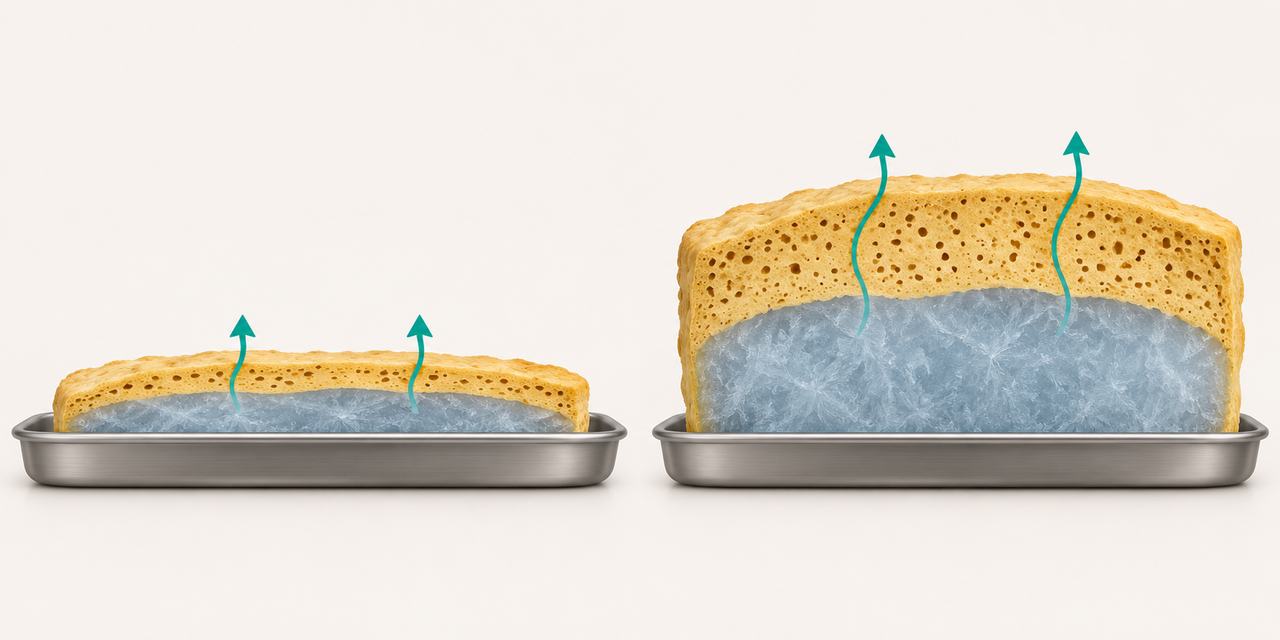
Differences in sublimation timing carry directly into secondary drying, where residual bound water undergoes desorption at warmer shelf temperatures. When only one product completes primary drying first, it loses the cooling effect of sublimation and its product temperature approaches the shelf temperature. Production leads then face the concrete question of whether to hold a lower shelf setting or change to a warmer stage. Holding a lower shelf temperature can prolong drying for the slower product, while transitioning to a warmer stage leaves the earlier-drying item warmer for longer, risking thermal degradation or shrinkage. Before completing a shared cycle, operators must assess whether both products have in fact reached the intended drying stage and satisfy their separate final moisture, sensory, and visual quality checks.
Screening Combined Water Duty and Condenser Capacity
Beyond product quality tolerances, a shared-chamber run must be evaluated against the condenser’s usable ice capacity and vapor handling limits. During sublimation, sublimed vapor collects as ice on the cold condenser surfaces. Equipment constraints depend on two distinct factors: the usable ice mass per run for the actual initial condenser and defrost condition, and the peak sustainable vapor mass flow under target chamber conditions. Placing separate trays of two different foods into one chamber alters both the total water load and the peak rate of vapor release.
To assess whether a combined charge fits equipment limits, engineers calculate an initial mass balance based on prepared wet feed ready for chamber loading. If pre-freezing or staging steps alter moisture levels, calculations should be adjusted to actual loaded values. Moisture content indicates total water fraction by mass on a wet basis, whereas water activity (aw) measures the ratio of vapor pressure over the food to that of pure water at the same temperature, guiding shelf-life stability as outlined by Manitoba Agriculture. For pre-test screening, water removal duty is derived from wet feed weights, initial moisture percentages, and target final moisture specifications.
| Parameter | Product A (e.g., Fruit) | Product B (e.g., Vegetable) | Combined Batch Total |
|---|---|---|---|
| Prepared Frozen Feed Mass (wet basis) | 40.00 kg | 20.00 kg | 60.00 kg |
| Assumed Initial Moisture (wet basis) | 85.0% (34.00 kg water) | 90.0% (18.00 kg water) | 52.00 kg total water |
| Dry Solids Mass (assumed fully retained) | 6.00 kg (15.0%) | 2.00 kg (10.0%) | 8.00 kg total solids |
| Hypothetical Target Final Moisture | 4.0% wet basis | 4.0% wet basis | 4.0% wet basis |
| Calculated Dried Mass (Solids / 0.96; includes 4% residual water) | 6.250 kg | 2.083 kg | 8.333 kg |
| Calculated Water Removal Duty | 33.750 kg | 17.917 kg | 51.667 kg (~51.67 kg) |
This preliminary mass balance provides a screening estimate of 51.67 kg of estimated water removed across the batch under the shown wet-basis moisture assumptions and conserved dry solids. This total water duty must be compared against the usable ice mass per run of the condenser. However, total ice capacity does not confirm that the system can handle peak sublimation rates. In laboratory ice-slab trials using two test units with external condensers and connecting ducts, Srinivasan et al. (2021) observed that vapor flow could be choked by duct throughput limits, allowing chamber pressure to rise above setpoint even while the condenser remained cold. In an operating plant, an unexpected chamber pressure rise prompts investigation rather than diagnosing a specific duct restriction by itself. Total water duty and peak vapor mass flow remain separate constraints: average water removal across an entire run does not reflect peak sublimation flow, and the peak vapor curves of two separate runs cannot simply be added together to predict a shared cycle.
For facilities evaluating condenser margins, consulting technical literature on freeze dryer condenser design provides engineering context on how condensing surface area, duct dimensions, and refrigeration systems interact under varying sublimation loads.
Lot Segregation, Hygiene, and Cross-Contamination Controls
Placing different ingredients on separate labeled trays inside a shared vessel maintains physical batch identity, but it does not isolate the materials from common chamber atmosphere or post-drying handling pathways. Quality leads must evaluate whether co-loading introduces microbiological, sensory, or particulate cross-contact risks across lot boundaries.
Food safety plans established under commercial hygiene standards govern processing operations. Guidance from the University of Minnesota Extension notes that freeze-drying lowers water activity and inhibits microbial growth, but a factory cannot rely on freeze-drying as a kill step without a positive applicable validation. Existing biological hazards originally present on raw ingredients can persist through freezing and sublimation. Furthermore, highly porous dried products readily absorb environmental moisture if exposed during unloading. Risk-based handling hygiene and post-drying humidity controls limit cross-contact and moisture pickup risks, but they do not eliminate existing raw-material hazards.
Volatile aroma transfer and fine particulates represent plausible cross-contact risks to assess for the specific product combination and during shared post-drying handling. Under vacuum, aromatic vegetables could potentially transfer volatile compounds across the shared chamber atmosphere onto mild, porous fruit slices. In addition, fine particles from brittle or powdery dried materials may be disturbed during chamber venting or unloading. While tray labels support lot traceability, they do not isolate products from airborne exposure or shared handling pathways, requiring quality teams to evaluate physical and vapor-phase risks before co-loading.
Commercial documentation and customer specifications establish firm operational boundaries. In commercial ingredient supply, B2B processors such as Indo Tradiz Foods publicly describe item samples, batch-level records, and applicable product documentation. Before deciding to combine trays, production leads must establish exactly what customer contracts and plant quality rules require: individual labeled lots, dedicated cycles, or dedicated equipment. If customer agreements mandate dedicated single-product runs, or if allergen or identity-preservation programs require strict physical isolation that cannot be assured during shared loading, drying, and packaging, products must be dried in separate batches under validated changeover cleaning procedures, though separate cycles alone do not replace comprehensive segregation controls.
Comparing Pilot Trials Against Equal Accepted Product Yields
When pre-screening indicates compatible quality requirements and sufficient condenser margins, pilot trials evaluate whether a shared cycle delivers an operational advantage. In the commercial sector, the Pol’s and GEA partnership case documents a diverse fruit and vegetable operation with dedicated preprocessing and batch drying equipment, though it does not address shared-batch recipes or segregation protocols. Similarly, the on-site Malaysia freeze-dried fruit and vegetable case study provides operational context for material-specific preparation and drying recipes, but does not validate joint cycles. Both highlight that individual products have distinct processing baselines, which an on-site pilot trial must evaluate directly before adopting co-drying.
A pilot evaluation should test the specific product ratio, tray loading, and slice preparation planned for routine production, comparing equivalent accepted quantities of each product against separate baseline batches. Representative runs should account for expected raw material variation while documenting the following parameters:
- Feed Preparation and Loading: Record raw material lot numbers, cut dimensions, measured piece thickness distribution, initial feed moisture, frozen temperature before loading, and fill mass per tray.
- Spatial Tray Mapping: Document exact tray positions and IDs for both products across upper, middle, and lower shelf locations, avoiding the assumption that drying rates are uniform or that the center shelf is always the slowest.
- Process Monitoring: Track product temperatures at selected risk locations, shelf fluid temperature, condenser operating indicators, and chamber pressure stability using the instrument’s installed sensor capabilities.
- Independent Release Testing: Evaluate each product against its own product-specific specifications, selecting applicable tests such as residual moisture, water activity (aw), texture, color, or rehydration ratio, without pooling release data.
A combined cycle should be evaluated by comparing the same demanded quantities of both acceptable SKUs across a consistent chamber occupancy boundary, covering loading, evacuation, drying, unloading, defrosting, and changeover cleaning. For example, if a shared trial requires 36 hours of total occupied chamber time, whereas separate runs require 16 hours and 18 hours that already include any chamber-blocking changeovers (34 hours total), the shared run occupies two additional hours of chamber capacity. Once both SKUs pass their independent quality criteria, production teams assess whether any measured labor, handling, or energy benefits outweigh the difference in occupied chamber time. Rather than relying on total batch weight, the evaluation depends on verified, on-spec yields for each distinct SKU against total turnaround duration.
When pilot testing reveals compromised product quality, excessive cycle duration, or negligible schedule gains, dedicated single-product recipes remain the dependable operational choice. For teams refining separate cycles, methodologies are detailed in technical resources on food freeze-drying cycle development. If chamber utilization proves to be the measured limitation during sustained multi-product demand, evaluating independently controlled drying chambers offers an alternative equipment option. Facilities can use the general technical contact page to reach engineering personnel or submit their specific batch quantities, product moisture targets, and trial logs for technical review.
References
- Reale VA, Torrez Irigoyen RM, Giner SA. Experimental Study and Modelling of the Sublimation and Desorption Periods for Freeze Drying of Apple, Banana and Strawberry. International Journal of Food Studies. 2023;12(1):95–111.
- George JP, Datta AK. Development and validation of heat and mass transfer models for freeze-drying of vegetable slices. Journal of Food Engineering. 2002;52(1):89–93.
- Srinivasan JM, et al. Equipment Capability Measurement of Laboratory Freeze-Dryers: a Comparison of Two Methods. AAPS PharmSciTech. 2021;22:53.
- Manitoba Agriculture. Water Content and Water Activity: Two Factors That Affect Food Safety.
- University of Minnesota Extension. Preserving food at home: Freeze-drying.
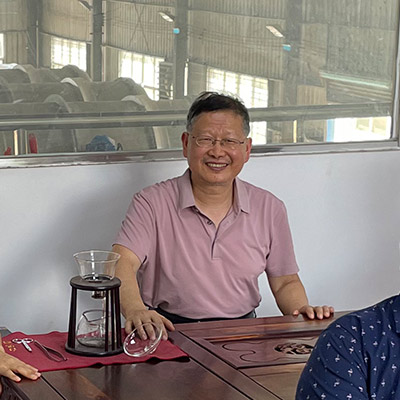
About the Author: Zheng Wei
Founder & Freeze-Drying System Engineer
Fuzhou Xing Shun Da Refrigeration Facility Project Co., Ltd.
Zheng Wei participates in food freeze-drying trials, equipment selection, vacuum-system configuration, refrigeration planning, installation guidance, process optimization, and project handover. The project experience covers fruit, vegetables, cooked foods, seafood, meat, dairy products, herbs, and extracts.