
Food production · Procurement brief
Freeze Dryer Financing: Build a Project You Can Fund and Start
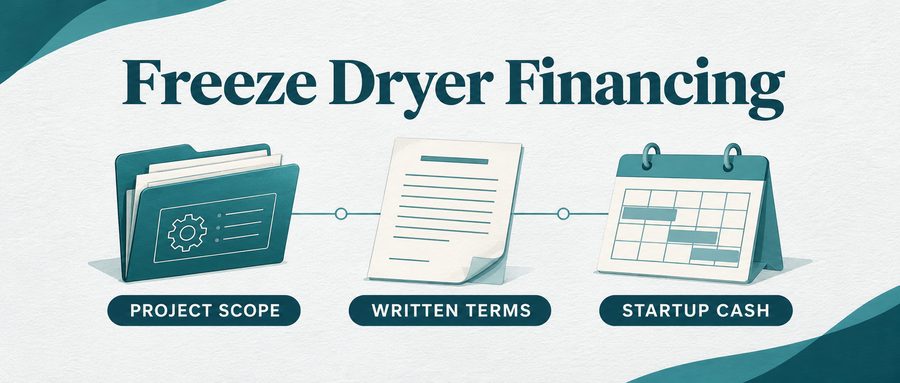
Evaluate the whole project launch before committing to freeze dryer financing. In addition to the machine itself, identify the site work, utility connections and commissioning needed to start production, along with the operating funds required until customers pay for finished food. Establishing these requirements and dates helps you verify whether your proposed financing and separate business cash can support commercial operation without unexpected cash shortages.
For US food-business procurement. Provider examples were checked on 5 November 2026; obtain current written terms for your own transaction. Individual financing, legal and tax decisions require the appropriate advisers.
Prepare one project cost list, one written-offer comparison and one dated cash forecast. Build all three around the same equipment configuration. For every funding route, check shipment timing and the event that starts repayments as separate terms. Establish in advance what physical delivery and technical acceptance will each verify. A low monthly payment cannot make up for unfunded installation costs or an untested production assumption.
Make the three plans agree
Equipment, site work, trials and responsible parties.
Payment dates, total obligations and ownership outcome.
Funds available until customer receipts arrive.
What must be paid for before production can start?
List the complete installed project before asking how much can be financed. The equipment quote is only one part of the initial expenditure. Freight, site preparation, utility connections and commissioning may come under separate quotes, while ingredients and packaging materials may require payment before your first customer invoice is paid.
Assign each item an estimated amount, a payer and a due date. Submit that list to your finance provider to confirm which items qualify for equipment financing. For any unconfirmed or unapproved cost, decide how your business will fund it so that no expense is left unaddressed.
| Cost group | Items to price | Responsibility to record |
|---|---|---|
| Ordered equipment | Selected dryer, trays, vacuum equipment, controls and agreed accessories. | Supplier inclusions and exclusions; buyer contribution; lender-confirmed eligible amount. |
| Delivery and placement | Packing, freight, applicable import and tax items, unloading, rigging and access work. | Who arranges each service, who pays and when the payment is due. |
| Site services | Electrical work, cooling or heat rejection, drainage, ventilation and other interfaces required by the selected configuration. | Buyer/supplier boundary and approved model-specific project drawings. |
| Commissioning and handover | Installation work, training, product trials and agreed laboratory tests. | Service scope, test materials, records, signatories and payment milestones. |
| Cash to begin operating | Raw materials, packaging, labour, occupancy, utilities and the wait for customer payment. | Business cash requirement, tracked separately from equipment-finance eligibility. |
On a phone, scroll the table horizontally. For each item, add its amount, funding status, payer and due date to your own ledger.
Obtain the full equipment pack from your supplier: the dryer model and configuration, product and load objective, quotation validity, delivery assumptions, utility requirements, and proposed handover work. Take your compiled cost list to your finance provider and ask for its document requirements. The supplier defines the equipment interfaces and site criteria; the finance provider determines which costs and records it will approve.
Use the commercial freeze dryer setup guide to identify site work and responsibility gaps. Final utility and construction work follows approved project drawings. This engineering list is not a universal lender approval checklist.
Once you have defined the equipment scope and separated costs paid from business cash, check when each funding route allows you to receive and use the machine.
When will you pay, receive the machine and own it?
Compare payment timing, access to the equipment and ownership as separate questions. One structure may spread payments across monthly instalments while factory dispatch waits until the final payment. Another agreement may allow possession earlier for use, while title transfer or end-of-term ownership depends on the specific contract terms. Check the actual agreement instead of assuming when delivery occurs or how title is handled.
| Route | Check the timing | Confirm the remaining obligation |
|---|---|---|
| Cash purchase | Match supplier deposits, progress payments and the balance to available cash. | What remains for installation and startup? Paying cash does not remove commissioning risk. |
| Layaway | Establish whether shipment waits until the final payment. | Obtain fees, cancellation and refund terms. The cited Trimleaf example ships after final payment and charges an administration fee despite no interest. |
| Equipment loan | Align lender disbursement and repayment dates with the supplier schedule. | Confirm the contribution, funded items, security and guarantees where required, and the ownership/security arrangement. |
| Lease or lease-to-own | Confirm when use starts and how long each payment obligation lasts. | Read the purchase option or final price, renewal and return duties, notice deadlines and additional charges. |
The City National Bank guide describes provider-specific terms and lease-end choices. Trimleaf’s layaway page, checked on 5 November 2026, supplies a seller-specific example; it is not an offer for another supplier’s equipment. None of these routes carries a promised rate, approval, tax benefit or automatic ownership transfer.
Ask each provider about business and transaction eligibility criteria before committing to a specific programme name. As outlined in the SBA loans overview, financing providers and loan programmes have specific qualification requirements; a programme profile does not guarantee credit approval for your business or equipment.
Shortlist funding options whose shipment and possession timing fit your operational plans. Then request written proposals based on the same equipment and service scope, so a lower payment does not simply reflect omitted items.
What will each offer require you to pay and do?
Send each provider the same supplier scope and compare offers on the same date. Tabulate all scheduled payments, the final ownership outcome, and any unquoted fees. Comparing proposals on this basis provides clear context: a lower periodic payment may reflect a smaller financed sum, different charges, or an additional purchase obligation at the end of the term.
| Comparison field | Written information to request |
|---|---|
| Amount and scope | Financed amount, included items, buyer contribution and costs paid separately. |
| Payment dates and amounts | Amount and count of payments; advance, interim, irregular and final payments; first due date and the event that starts repayment. |
| Additional duties | Fees, insurance and tax allocation, plus security and guarantees if applicable. Mark unpriced items. |
| End of agreement | Ownership or purchase option, buyout, residual or balloon amount, return conditions, renewal and required notices. |
| Early settlement | A payoff quote for the same proposed date, its validity, qualifying conditions and confirmation of which obligations it closes. |
Add scheduled cash payments once each
Add the buyer contribution, actual scheduled payments, required separately paid fees and required final amount. Identify charges already included in the payment schedule so that they are not counted again. Keep this equipment/finance commitment separate from the operating forecast.
When reviewing early settlement terms, ask for an itemized payoff quote for a specific date instead of relying on phrases such as “no pre-payment penalty.” As explained in Oakmont’s explanation, that wording does not necessarily result in overall savings. Compare the quote with your remaining scheduled payments and confirm both the qualifying conditions and all remaining final obligations required to close out the agreement.
Multiplying APR by the term is not a substitute for the actual payment schedule or a settlement quote. A lower stated total also does not settle the comparison when the offers fund different items or leave different ownership obligations.
Return the comparison worksheet to prospective providers with every blank or unanswered item clearly noted. Obtain written confirmation on missing fees and buyout terms before considering an offer complete. Then check whether the agreement’s payment triggers align with what your project team can actually verify.
What will your signature confirm?
Read the acceptance wording before the day you are asked to sign it. A delivery receipt at the dock, a financing acceptance form whose effect depends on the specific form and contract terms, and a technical sign-off on a loaded food run serve different purposes. Ask both the supplier and the finance provider to clarify what each document confirms and how it operates under your agreements.
Agree these checkpoints before commitment
- Before signing the purchase: agree the supplied configuration, site responsibilities, trial scope, acceptance criteria, records, authorised signatories and payment milestones.
- When equipment arrives: record identity, contents, condition, shortages and transit damage. State what is still uninstalled or untested.
- Before signing a finance acceptance form: check whether it acknowledges delivery, installation, satisfactory performance, payment commencement or something else. Seek clarification if its statement goes beyond the evidence available.
- When deciding technical acceptance: retain agreed factory/site checks, product and load identity, run records, results, deviations, retest decisions and calibrated measurement records where specified.
An empty-chamber or functional pass does not establish the agreed loaded-product result. Final acceptance and payment follow the contract; finance forms do not all have the same legal effect. The food freeze dryer validation guide explains how to define the technical evidence.
The loaded trial matters because the food and its loading conditions affect the drying task. Ratti discusses drying resistance and differences between laboratory and commercial conditions; Nowak and Jakubczyk review how process conditions affect food properties and drying. These sources support testing the intended product under defined conditions. They do not guarantee a cycle time, monthly output or financial return. Ratti; Nowak and Jakubczyk.
Maintain a simple evidence index in your records tracking passed and pending criteria, the responsible party, and the next agreed decision. Equipment brochures describe standard features, but they do not replace documented test data from agreed completed trials.
Once you define the required evidence and payment events, map each milestone onto your cash forecast. This comparison clarifies whether payments come due before your freeze dryer produces finished inventory and before customer cash receipts arrive.
Can the business pay until customers pay it?
Forecast cash through the expected customer payment date, then test project-specific delays. Delivery, successful commissioning, the first saleable batch, and customer cash receipts represent separate project events that occur on specific dates. A rough estimate of your initial production run cannot confirm whether your cash balance will cover ongoing payments while you await customer receipts.
- Build one dated calendar. Include supplier deposit, lender funding, shipment, delivery, installation, loaded acceptance, first saleable batch, customer invoice, customer receipt and every repayment date.
- Enter the base case. Record opening cash, committed funding, project payments, operating outflows and expected receipts. Label expected customer receipts separately from confirmed cash.
- Move the uncertain dates. Test a delay in installation, a successful product trial or customer collection. Keep contractual payment dates unchanged unless a written amendment changes them. Record the cost inputs and reasons for each delay assumption.
- Find the lowest balance. Compare the projected cash trough with the business’s chosen minimum cash position. Identify the funding, expenditure or timing decision needed to address a shortfall.
Closing cash for each period = opening cash + cash received − cash paid.
This identity tracks cash; it does not forecast profit. Put loan principal, equipment payments and operating costs in the appropriate periods. Do not count a supplier invoice twice because lender funding pays it. Ask the business’s accountant to check the treatment.
Base your cash forecast on specific project costs and schedule dates rather than an unverified general cushion. Review the forecast whenever a material project date changes. If cash shortfalls appear, contact your provider before a missed payment occurs; as noted in Commercial Credit Group’s guidance, early communication is recommended when payment difficulties arise. Payment extensions, restructuring, or refinancing are possibilities that depend on the lender and circumstances rather than guaranteed rights.
If your forecast identifies a cash shortfall before sales receipts arrive, adjust project timing, expenses, or funding arrangements in advance. Obtain written confirmation of any proposed project or payment changes, and keep financing proposals separate from signed commitments until written agreements are finalized.
Get the equipment scope ready for the funding discussion
Provide the equipment manufacturer with your intended product, finished form, wet load per batch, overall production objective, facility location, and available site utilities. Specify your requested quotation detail, commissioning scope, and documentation requirements. Sharing these details helps define the equipment configuration and identify site expenses to discuss with your finance provider.
The company discusses equipment scope and project documentation. Financing terms, eligibility and approval remain with your selected finance provider. A supplier quotation is neither a funding commitment nor a guarantee of saleable output.
Resolve these questions before committing
Does interest-free layaway let the machine start earning immediately?
No. In the Trimleaf example checked on 5 November 2026, shipment occurs only after the final payment, and an administration fee applies. Always check current written terms for shipment timing and fees before planning your operational launch.
Can the funding cover installation and startup cash?
Ask your finance provider for item-by-item written confirmation of which costs it can fund. Financing eligibility for equipment, site installation, and initial operating expenses depends on the provider’s guidelines. Keep each cost item visible in your ledger with an open funding decision until confirmed in writing.
Does finance approval mean the food process has passed?
No. Financing approval addresses credit and transaction acceptance. Technical process acceptance requires agreed evidence from representative food runs, including test records, results, and agreed decisions on any deviations or retests for the project’s requirements.
Sources and scope
Provider pages describe their own services. They are used for bounded contract questions, not as endorsements or offers from this manufacturer.
- City National Bank: equipment finance benefits and terms. Contract-specific loan/lease comparison.
- Trimleaf: Harvest Right layaway programme. Seller-specific shipment and fee example, checked 5 November 2026.
- Oakmont Capital Services: early-payoff questions. Savings, conditions and final obligations.
- Commercial Credit Group: equipment-loan payment difficulties. Early communication; solutions depend on circumstances.
- US Small Business Administration: loans. Lender/programme eligibility overview, not machine-specific approval.
- Ratti, C. (2013). Freeze drying for food powder production. In Handbook of Food Powders. doi:10.1533/9780857098672.1.57.
- Nowak, D.; Jakubczyk, E. (2020). The Freeze-Drying of Foods—The Characteristic of the Process Course and the Effect of Its Parameters on the Physical Properties of Food Materials. Foods, 9(10), 1488. doi:10.3390/foods9101488.
About the Author: Zheng Wei
Founder & Freeze-Drying System Engineer
Fuzhou Xing Shun Da Refrigeration Facility Project Co., Ltd.
Zheng Wei participates in food freeze-drying trials, equipment selection, vacuum-system configuration, refrigeration planning, installation guidance, process optimization, and project handover. The project experience covers fruit, vegetables, cooked foods, seafood, meat, dairy products, herbs, and extracts.