
What Collapse Temperature and Tg′ Mean for Freeze-Dried Food
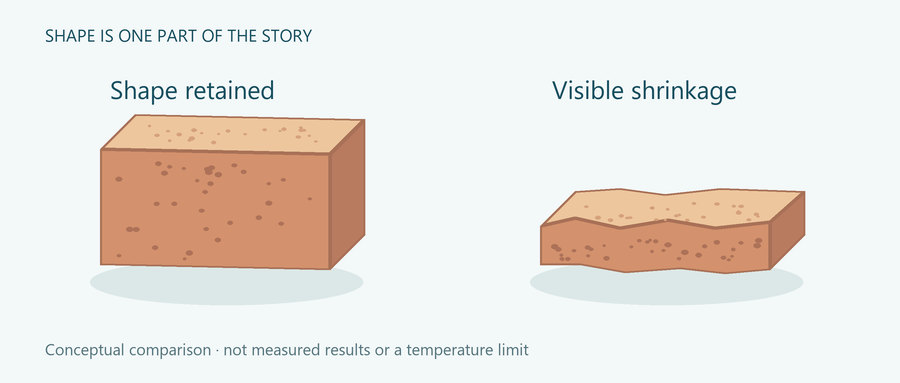
Consider a hypothetical tray of fruit puree that comes out of a freeze-drying cycle visibly flatter than expected. The producer wants to know whether that shrinkage affects texture, drying or how the ingredient takes up water again when used. A photograph can start that investigation; it cannot settle the quality of the batch.
Two temperatures in a laboratory report can help explain the food’s behavior: Tg′, pronounced “Tg prime,” and collapse temperature, Tc. They describe different changes in the material. Neither is a number to copy directly into the freeze dryer’s shelf setting.
What do the two temperatures actually describe?
During freezing, some water becomes ice. Sugars and other dissolved substances become more concentrated in the part that remains unfrozen. Some of this concentrated material does not form crystals of its own. When warmed, it can change from a rigid state to one in which its molecules move more freely. This change is called a glass transition. [1]
Tg′ describes that transition in the noncrystalline material at maximum freeze concentration. It concerns a particular part and state of the food, rather than the whole piece melting. More movement within that material does not mean an entire puree portion immediately loses its shape. [1]
Collapse temperature, Tc, records when a sample is observed to lose its structure during a defined drying test. The result includes the test conditions and what degree of structural change counts as collapse. One laboratory technique detects a thermal change; another watches the structure during drying. These measurements answer related questions, but they observe different events. [2]
Visible deformation also takes time and depends on how the food supports itself. Its composition, supporting structure and test conditions can change the relationship between the two temperatures. Adding a fixed number of degrees to Tg′ therefore does not determine Tc or provide an operating allowance for every food. [2] [3]
Why can similar foods hold their shape differently?
A published mango study offers a useful example. Researchers compared laboratory samples made from mango puree and syrup with different pulp contents. For each reported thermal change, the measured temperatures were similar across the pulp groups. Yet the lower-pulp samples shrank more, while the higher-pulp samples retained more of their overall volume. [3]
The authors linked this contrast to differences in mechanical support: a stronger supporting structure could resist overall deformation. The useful lesson for a food producer is that a thermal result and the ability to hold a shape provide different information about the same food. [3]
This was a small laboratory study, not a validation of an industrial drying temperature. It did not directly measure Tc or establish a Tc–Tg′ conversion. The findings do not provide a rule for increasing drying temperature by adding pulp. [3]
Can a laboratory temperature become a shelf setting?
Not directly. The shelf temperature setting controls how the shelves supply heat to the food. The food’s actual temperature is its response to the heat reaching it and to what is happening inside it.
During primary drying, ice passes directly into water vapor, a process called sublimation that consumes heat. Heat transfer into the food and the conditions for vapor to escape both affect its temperature. The path through the dried material changes as drying progresses. This is why freeze-drying temperature and pressure need to be considered together with the food and load.
The shelf display therefore cannot stand in for a product-temperature measurement. A probe reading is also local: it does not automatically capture the hottest part of the batch. The guide to product thermocouple placement explains what those readings can reveal and how location affects their interpretation.
A laboratory report becomes useful for production when its findings are compared with the actual formulation, food shape, loading arrangement and observed results. That comparison helps assess what the reported result means for that food and load, and what still needs checking under representative conditions. It does not produce a shelf setting by subtracting a standard margin.
What should a food producer compare next?
A useful starting point is to compare three things:
- The food and its form. Compare the formulation and whether the load is a puree, pieces or another form. A change in sugars, solids or pulp can change the material being dried and the support that helps it retain shape.
- The loading conditions. Compare the amount per tray, layer or piece thickness, and planned batch load. These affect how heat reaches the food and how water vapor leaves it, so the same machine setting may give different results.
- The observations and finished product. Bring together any available product-temperature readings with moisture results, structure and the texture, rehydration or other performance required for the intended use. Each answers a different question about the batch.
Good appearance is useful evidence about shape, but it does not establish that the internal pores, moisture and eating or use qualities are all satisfactory. Equally, visible collapse alone does not establish that drying or rehydration is impossible, or that the whole batch must be discarded. The intended product requirements should guide the assessment. The guide to food freeze-drying cycle development explains how food and load observations inform further trials.
Softening or caking that develops later in storage deserves a separate look. Absorbed moisture can make the dried material more mobile by lowering its glass-transition temperature, the dried-product Tg. That is a different material state from frozen-state Tg′. [1] The food packaging guide covers moisture protection in more detail.
For a specific food freeze-drying project, producers can discuss equipment and process requirements by sharing the food type and form, planned load and structural issue. Existing thermal reports can be included, but those basic details are enough to start the discussion.
Technical note: the terms used in a laboratory report
The formal definition of Tg′ is the glass-transition temperature of the maximally freeze-concentrated amorphous phase. “Amorphous” means the material lacks an ordered crystal structure. [1]
Differential scanning calorimetry (DSC) detects transitions through a sample’s thermal response. Freeze-drying microscopy (FDM) observes structural changes during drying. The conditions and observation criteria belong with the reported result, and small-sample behavior needs interpretation before use with a production load. The methods reference comes from pharmaceutical research; it supplies measurement principles here, not food-production settings. [2]
References
- Roos, Y. H. Frozen state transitions in relation to freeze drying. Journal of Thermal Analysis. 1997;48:535–544. doi:10.1007/BF01979500.
- Kett, V. Development of Freeze-dried Formulations Using Thermal Analysis and Microscopy. American Pharmaceutical Review.
- Yamamoto, Y.; Fong-in, S.; Kawai, K. Optimum physical properties of fruit puree for freeze-drying: Effect of pulp content on freeze-concentrated glass transition temperature and yield stress of mango puree. Journal of Food Engineering. 2021;307:110649. doi:10.1016/j.jfoodeng.2021.110649.

About the Author: Zheng Wei
Founder & Freeze-Drying System Engineer
Fuzhou Xing Shun Da Refrigeration Facility Project Co., Ltd.
Zheng Wei participates in food freeze-drying trials, equipment selection, vacuum-system configuration, refrigeration planning, installation guidance, process optimization, and project handover. The project experience covers fruit, vegetables, cooked foods, seafood, meat, dairy products, herbs, and extracts.