
Retrofitting Batch Freeze Drying to an Existing IQF Line: Sizing, Yield, and Interface for Diced Mango
If you manage production at a Peruvian fruit ingredient facility with an individual quick freezing (IQF) line, adding a freeze dryer seems like a direct way to convert frozen inventory into higher-value crunchy fruit dice. A customer inquiry for shelf-stable, crunchy mango dice creates an immediate engineering task: determining whether your existing freezing line can feed a commercial batch freeze dryer, how much wet fruit you must load to hit a delivery schedule, and whether your cold buffers and dry-packaging rooms can support continuous batch turnover.
Treating a batch freeze dryer’s nominal wet chamber rating as guaranteed packed output creates immediate commercial risk. Fruit solids fluctuate from lot to lot, frozen staging limits cycle availability, and dry sorting removes fines that fail buyer specifications. In Peru’s fruit processing sector, distinct operations illustrate different segments of this supply chain. For example, Agromar Industrial operates an industrial IQF tropical fruit processing facility handling mango. The upstream cold infrastructure required for continuous freezing is illustrated by the Apromalpi cooperative in Piura, where Peru MIDAGRI reported the commissioning of a frozen mango cube line featuring fruit ripening, cutting, pre-cooling, a freezing tunnel, and frozen storage. Downstream, dried-ingredient catalogues such as that from Super Foods Freeze Dried show how freeze-dried mango chunks, dice, and powders are specified as commercial ingredients for snack, yoghurt topping, bakery, and beverage applications. These independent businesses demonstrate real operational models rather than a shared commercial contract. Sizing your retrofit requires analyzing how frozen dice behave between your freezing tunnel and the vacuum chamber.
A successful retrofit cannot rely on published cut names or nominal catalogue specifications alone. While published frozen fruit cut options from an export trader such as CFRUITS Perú illustrate multiple commercial cut formats, they do not document piece-size distributions within a single nominal category. Your equipment sizing, tray loading, and condenser load must be calculated using the exact physical dimensions and moisture levels measured from your plant’s trial lots. For foundational context on processing parameters, you can consult our engineering overview on how to freeze-dry mango. Sizing your system begins by examining how individual quick freezing feeds the batch drying trays.
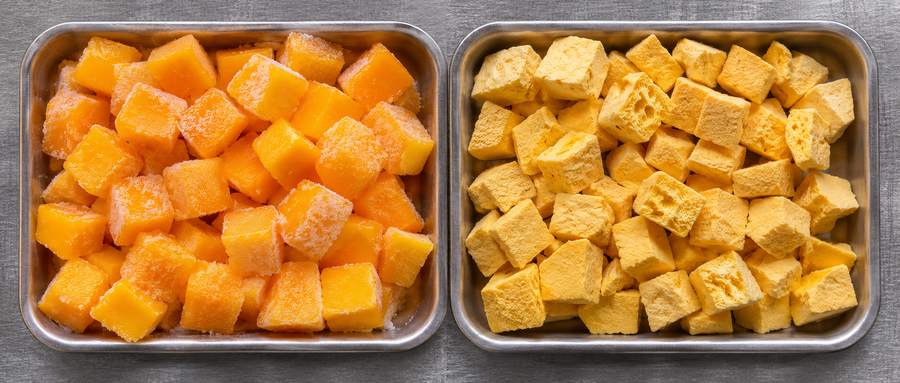
Frozen Infeed: Transferring IQF Dice to Batch Drying Trays
An individual quick freezing (IQF) tunnel commonly uses rapid convective cold airflow to freeze fruit pieces individually, preventing them from fusing into a solid block. For batch freeze drying, that separation must be preserved from the moment the dice exit the freezer discharge through staging, tray spreading, and vacuum chamber evacuation. If frozen dice warm during transfer or sit on ambient loading tables, surface ice can melt and form liquid bridges between adjacent pieces. When pieces thaw, adhere, and refreeze across their handling history, the resulting clumps and altered geometry can disrupt vapor escape and lead to uneven drying across the tray.
Existing individually frozen fruit can feed directly into a batch freeze dryer if product core temperatures, frozen state, cut dimensions, and loading conditions meet your validated product inlet specification. You cannot verify this readiness by checking cold room air temperature or freezer displays alone, as air readings do not reflect core temperatures inside dense transport totes. Operators should measure product core temperature directly using calibrated insertion probes across multiple container depths and in the largest dice before loading trays into the chamber. Check visually for partial surface softening, clustering, and visible free ice. If a lot experiences temperature abuse or bridging during staging, recondition the material only according to your plant’s approved standard operating procedures, avoiding unvalidated refreezing attempts or guessed shelf temperature adjustments.
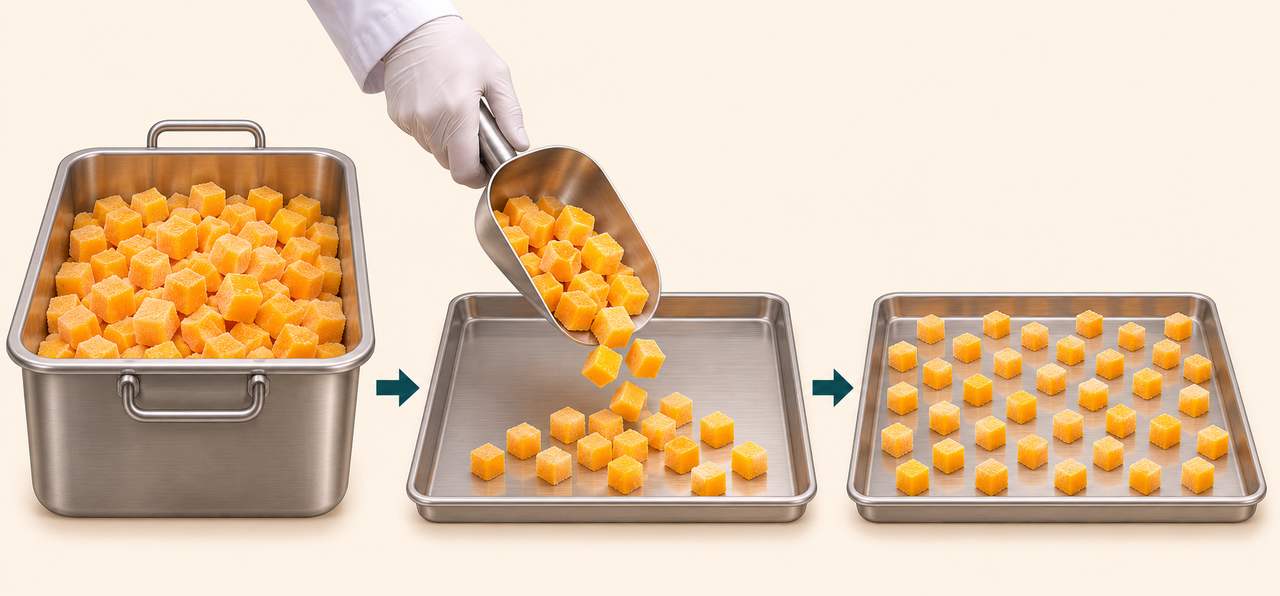
Representative Trials: Piece Geometry, Layering, and Sublimation Vapor Pathways
During primary drying, sublimation removes frozen water by converting ice directly into water vapor under vacuum. This vapor must escape from the retreating sublimation front inside the fruit, navigate through the open pore network left behind by departed ice crystals, flow across the tray bed, and deposit as ice onto the colder condenser surface. Piece thickness determines the length of this internal vapor escape path. When dice vary in size, form clumps, or overlap on trays, the extended path lengths and locally restricted vapor flow can increase mass-transfer resistance alongside local heat-transfer variations and bed structure, causing those sections to dry more slowly and contributing to uneven residual moisture across the batch.
To obtain dependable design data, run trials with documented physical controls across representative loading configurations. Measure cut dimensions across the trial lot, note observed clumps and piece overlap, and record tray mass loading per square meter alongside tray bed depth. Place temperature sensors and pull moisture samples from representative tray positions across the dryer, which may include different vertical rack levels or locations near chamber doors and condenser ports where applicable to the equipment geometry. When conducting comparative trials to evaluate freezing rates or pre-treatments, keep piece dimensions, tray loading density, and bed depth strictly comparable, and disclose any other operating conditions that vary between runs.
The critical role of initial freezing conditions was demonstrated by Salazar, Alvarez, and Orrego (2018) in their study on optimizing freezing parameters for freeze-drying mango slices. Working with Tommy Atkins mango cylinders (6 mm high by 40 mm in diameter) in a laboratory freeze dryer with fixed sublimation shelf profiles, the researchers evaluated vacuum-induced surface freezing alongside varying freezing rates. Faster tested freezing rates shortened total process time in that specific experimental setup, with final moisture content, rehydration capacity, color difference, and polyphenol preservation evaluated as distinct separate responses. This research confirms that freezing history directly affects process kinetics and physical quality measures, but its scope is bounded to laboratory freezing of thin cylinders with surface vacuum nucleation. It does not validate industrial IQF tunnel behavior, nor does it provide universal shelf temperature recipes for commercial factory operations.
Industrial pilot validation helps quantify drying behavior on actual commercial geometries. Published capabilities for pilot-scale equipment, such as the GEA RAY pilot plant freeze dryer, describe frozen-product trial services and continuous sublimation-rate monitoring during drying runs. Where pilot methods and instrumentation support it, requesting measured sublimation rates and ice accumulation under representative tray loading provides empirical data for project sizing. Replicating real load configurations across representative fruit lots reveals how incoming raw material variations shift the overall mass balance.
Mass Balance: Why Identical Wet Batch Kilograms Yield Different Packed Output
A common operational mistake is assuming that loading a fixed number of wet kilograms into the dryer will deliver a predictable quantity of finished packed fruit. Under identical wet loading and identical final moisture targets, incoming raw material moisture dictates both the mass of water removed that challenges your condenser and the gross dry output discharging from the chamber, with saleable packed acceptance determined afterward through sorting. A refractometer reading of soluble solids (°Brix) reflects sucrose-equivalent soluble solids in expressed juice rather than dissolved sugars alone, and it does not measure total dry solids. Insoluble solids, including cell wall structures and insoluble fiber, remain unaccounted for in a °Brix reading, requiring an appropriate measured total-moisture or dry-solids test method to establish an accurate mass balance.
To understand how incoming moisture alters batch economics and machinery loading, consider a comparative mass balance between two hypothetical 100 kg lots of frozen mango dice dried to a target of 4.0% final moisture by mass (wet basis), assuming complete conservation of dry solids with no solids loss inside the chamber, and an assumed 90% acceptance rate by mass after dry-room sorting:
| Parameter | Lot A (Lower Moisture) | Lot B (Higher Moisture) |
|---|---|---|
| Incoming Loaded Wet Mass | 100.00 kg | 100.00 kg |
| Incoming Moisture Content (by mass) | 82.0% | 86.0% |
| Total Fruit Solids (conserved) | 18.00 kg | 14.00 kg |
| Target Final Product Moisture (wet basis) | 4.0% | 4.0% |
| Gross Dry Product Out of Chamber | 18.75 kg | 14.58 kg |
| Calculated Water Removed from Fruit | 81.25 kg | 85.42 kg |
| Accepted Packed Dice (after 90% dry sorting) | 16.88 kg | 13.13 kg |
The calculations demonstrate the operational split between these two hypothetical lots. In Lot A, 18 kg of dry solids divided by 0.96 yields 18.75 kg of dried dice exiting the chamber, leaving 81.25 kg of calculated water removed from the fruit. Applying the 90% dry sorting factor yields 16.88 kg of accepted product (rounded from 16.875 kg). In Lot B, 14 kg of dry solids divided by 0.96 yields 14.58 kg of dried dice, leaving 85.42 kg of calculated water removed and yielding 13.13 kg of accepted product (rounded from 13.125 kg). Before rounding, the difference in accepted product is exactly 3.75 kg per 100 kg wet load. In this comparative model, a four-percentage-point increase in incoming moisture reduces saleable production by more than 22% while increasing calculated water removal by 4.17 kg per batch.
These figures represent an illustrative mass-balance model rather than universal supplier specifications or regulatory standards. When calculating line capacity, measure incoming moisture frequently on representative lots and account for any free surface ice. In addition, total batch water removal cannot determine when the peak vapor flow rate occurs during the cycle. While high sublimation rates may occur during early primary drying under a specified cycle, peak timing cannot be forecast from total water mass alone. The condenser must capture the sublimation vapor flux to maintain chamber vacuum, while product temperature must be kept below product-specific collapse or melt limits through coordinated heat and pressure control. Do not confuse total cumulative ice capacity with instantaneous vapor handling; evaluate condenser performance under actual loaded conditions as detailed in our guide on freeze-dryer condenser selection.
Line Turnover and Interfaces: Bridging Continuous Freezing and Batch Drying
An IQF freezing tunnel operates continuously, measured in kilograms per hour (kg/h). A batch freeze dryer operates on discrete chamber charges, measured in wet kilograms per cycle (kg/batch). Coupling these two systems requires managing cold staging buffers, non-overlapping machine cycles, and utility interfaces to prevent costly plant bottlenecks.
Total cycle turnaround cannot be evaluated from drying duration alone. Machine occupancy consists strictly of non-overlapping operational stages from ready-to-load status until the chamber is ready for the subsequent batch: tray loading, chamber evacuation, primary sublimation drying, secondary desorption drying, chamber venting, tray unloading, and applicable condenser defrosting, moisture draining, and chamber cleaning. Sizing the cold storage buffer requires coordinating continuous freezing tunnel output with these discrete chamber turnaround windows. If the cold buffer cannot stage frozen dice during cycle delays, or if downstream packaging queues stall tray discharge, the freeze dryer sits idle while operating costs accumulate. Sizing equipment therefore requires mapping available chamber turnaround slots to accepted output against the plant’s actual operating shifts.
Utility demands must be evaluated under concurrent operating loads rather than nominal averages, as applicable to the selected equipment design. Commercial batch freeze dryers draw substantial electrical power when refrigeration compressors, vacuum systems, and shelf heating operate concurrently. Depending on the defrost system specified—whether hot water, steam, or electric—defrosting requires matching heat inputs and appropriately sized drainage routes to clear melted ice without introducing excess humidity into processing areas. Before committing to an equipment layout, verify site electrical capacity, cooling water or heat rejection capability, drainage provisions, and transfer pathways between the cold store and dry packaging areas under actual factory operating conditions.
Exit Verification Versus Packed Product Stability: Quality, Handling, and Safety
Quality validation requires two distinct evaluation stages: verification immediately upon chamber discharge, and stability testing after downstream handling and packaging. Testing immediately at chamber exit verifies cycle completion across the tray charge. Measure residual moisture content and water activity (a_w) across representative tray positions and piece sizes. Moisture content measures total water mass, whereas water activity reflects water availability based on the ratio of the equilibrium vapor pressure of water in the food to that of pure water at a specified measurement temperature. Test results should be reported according to defined analytical methods and sample conditioning as applicable. In addition, inspect discharge dice for uniform color, dimensional shrinkage, and dry crisp bite according to buyer release specifications.
Physical handling after drying generates fines and broken pieces that directly reduce saleable yield below raw chamber discharge. Porous dried mango dice can be fragile and susceptible to mechanical attrition during tray unloading, screening, conveying, and packaging. Measuring rejects, fines, and piece size distributions both at dryer exit and after downstream packing establishes your true finished yield. Furthermore, dried mango is hygroscopic; exposure to ambient humidity during handling can cause moisture pickup, which may alter piece texture or soften the product depending on room humidity, exposure time, piece characteristics, and protective packaging. Verifying product acceptance should therefore incorporate defined packaging barrier conditions and an agreed storage recheck.
Sorption and glass-transition properties of dried mango were examined by Caparino et al. (2013) in their study of freeze-dried and refractance-window-dried Philippine ‘Carabao’ mango powder. In laboratory sorption testing, the authors evaluated moisture-dependent water adsorption and glass-transition behavior, showing how increasing moisture content depresses the glass-transition temperature in prepared mango puree powders. While this research provides qualitative evidence of tissue hygroscopicity, it examined ground powders rather than intact diced cellular structures, and its findings cannot establish numerical moisture limits, crispness thresholds, or shelf-life cutoffs for diced fruit. To protect finished diced products, select moisture-barrier packaging tailored to the actual product and environmental exposure, and verify seal integrity across production runs as discussed in our guide on freeze-dried food packaging requirements.
Freeze drying does not provide a validated microbial lethality step. As highlighted in educational food safety guidance from the University of Minnesota Extension on food safety in freeze-drying, sublimation removes water under vacuum but does not reliably destroy bacterial spores or vegetative pathogens, which can survive low-temperature drying. Food safety cannot be assumed from the drying cycle alone, nor can incoming fruit washing alone guarantee pathogen control. Instead, microbiological safety must be managed through verified preventive controls, hygienic handling, and environmental monitoring appropriate to the ingredient’s intended commercial use under the facility’s food safety plan.
Project Evaluation: Engineering Parameters for Batch Retrofit Planning
Establishing a verified frozen inlet specification, representative tray trials, and post-sorting packed yields enables you to decide whether your existing IQF line can directly feed a batch freeze dryer, what chamber capacity and cold buffers are required to hit delivery schedules, and how plant shifts match total line turnover. When preparing to evaluate batch freeze-drying equipment, assemble your operational data: as-loaded frozen lot moisture and solids ranges, target dice cut distributions, buyer moisture and water activity specifications, complete machine turnaround and packaging trial results, daily operating shifts, cold storage buffer capacity, and site electrical and cooling utilities. To discuss your processing parameters and review commercial batch freeze-drying equipment configurations, contact our engineering team.
References
- Salazar, Alvarez, Orrego (2017). Optimization of freezing parameters for freeze-drying mango (Mangifera indica L.) slices. Drying Technology.
- Caparino, Sablani, Tang, Syamaladevi, Nindo (2013). Water Sorption, Glass Transition, and Microstructures of Refractance Window– and Freeze-Dried Mango (Philippine “Carabao” Var.) Powder. Drying Technology.
- Agromar Industrial. Frozen tropical fruits and IQF processing.
- Agroideas / MIDAGRI. MIDAGRI pone en marcha planta procesadora de mango congelado en Piura (2021).
- Super Foods Freeze Dried. Mango, formatos y aplicaciones.
- CFRUITS Perú. Frutas congeladas IQF.
- GEA. RAY® Plus Pilot Plant Freeze Dryer.
- University of Minnesota Extension. How to freeze-dry and sell foods safely in Minnesota. General handling and non-lethality context.
About the Author: Zheng Wei
Founder & Freeze-Drying System Engineer
Fuzhou Xing Shun Da Refrigeration Facility Project Co., Ltd.
Zheng Wei participates in food freeze-drying trials, equipment selection, vacuum-system configuration, refrigeration planning, installation guidance, process optimization, and project handover. The project experience covers fruit, vegetables, cooked foods, seafood, meat, dairy products, herbs, and extracts.