
Freeze Dry Food Manufacturers: Commissioning a First Commercial Run
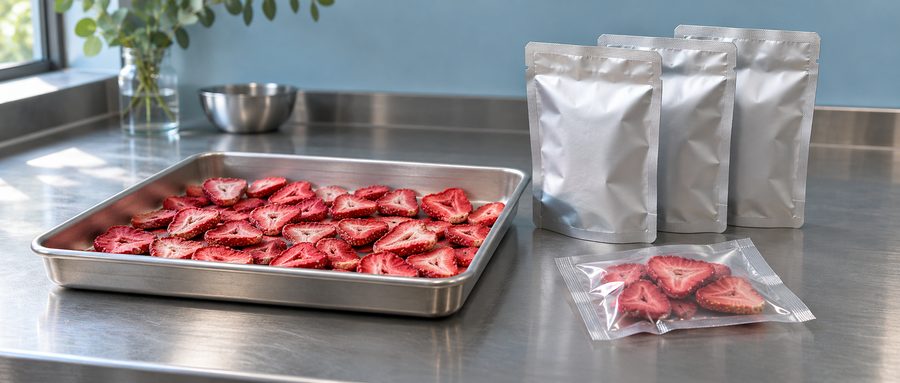
When an operations lead at an Australian food processor approves a small trial sample, the immediate decision is how much recurring commercial volume can safely be committed. An approved pilot establishes product viability only under its specific tested conditions. Moving to a commercial batch chamber introduces different heat transfer, vapour flow, sorting losses, packaging integrity, and lot traceability. Rather than relying on sample approval alone, operations teams must use the quality assurance data and reconciled released kilograms from a representative first commercial run as the evidence before committing the next order.
Navigating the Manufacturing Landscape and Setting the Production Brief
Search queries for freeze dry food manufacturers in Australia frequently return a confusing mix of industrial equipment manufacturers, finished ingredient wholesalers, and toll or turnkey food contract manufacturers. Equipment vendors supply freeze-drying machinery for internal factory operations; ingredient sellers distribute pre-dried commodities; and toll processors dry, mill, or pack customer-supplied raw materials. For processors that have already evaluated the broader trade-off between purchasing equipment and outsourcing production (commercial freeze-drying services vs buying a freeze dryer), identifying the right contract manufacturing service scope is the critical first hurdle.
In Australia, contract manufacturers operate across defined service categories. As related operations, Aus Freeze Dry describes customer-supplied or sourced raw material, preparation options, freeze drying, milling, and bulk or retail packing[1], operating as a wholly owned business of Forager Foods Pty Ltd, while Forager Food Co. lists capabilities covering trial batches, raw material and packaging sourcing, storage, food processing, freeze drying, and contract packing in Tasmania[2], alongside documented collaboration on seconds fruit with Burlington Berries[8]. As a separate example, Inspired Ingredients confirms custom Australian trials and commercial work, with project-dependent scope covering freeze drying, milling, and bulk packaging[3]. Beyond commercial toll processors, product and process development projects can also involve multi-party trials; the FareShare project team (working with the Queensland Department of Primary Industries and End Food Waste Australia CRC) documented collaborative product and process development investigating both freeze drying and retort routes for shelf-stable meals, alongside physicochemical, microbiological, and sensory assessments[4].
To bridge the gap between an exploratory trial and a commercial commitment, you and your contract manufacturer must agree on practical receiving conditions in the production brief. This agreement should document the receiving manufacturing site, the specific commercial chamber, the target tray load and product depth, the exact food form, the arrival condition (including any documented frozen history), preparation steps, and the final packaging specification. If an exploratory trial intentionally differed in loading depth, chamber geometry, or raw preparation, record precisely what that preliminary run established and what remains unverified on the commercial line. Without documenting these operational boundaries in advance, a commercial run risks unexpected yield shortfalls or non-conforming finished product before the first repeat order is placed.
Chamber Physics: Why Commercial Drying Trays Differ from Pilot Trials
For managers and procurement leads without a thermal engineering background, freeze drying can appear straightforward: frozen water within the food sublimes directly from ice into water vapour under vacuum. However, that water vapour must escape through the developing porous dried layer of the food, move across the chamber, and deposit as ice onto cold condenser surfaces. Removing water from a full production charge depends on balancing shelf heat input with vapour removal. Adding more trays to a chamber increases the total volume of water to be removed, which can change total vapour handling and condenser loading rather than simply scaling output linearly under unstated settings.
Under the same per-tray layer depth, adding more trays increases the total mass of water that must be removed across the cycle. For a fixed tray area, loading additional food onto a tray can increase layer thickness or cause product overlap, which can lengthen the porous path vapour must traverse to escape. Concurrently, thermal conditions across a production chamber are shaped by distinct mechanisms. As Ratti outlines in the engineering of food powders, differences in equipment geometry, shelf-to-tray thermal contact, and radiant heat exchange across different scales directly influence product temperatures during freeze drying[5]. Trays adjacent to chamber walls or doors experience radiation differing from trays situated within the rack core, while variations in tray flatness alter direct conductive contact with heated shelves, without establishing a universal shelf ordering across all chambers.

In pilot trials using sucrose and lactose model solutions alongside frozen spinach, Pisano, Barresi, and Fissore showed that equipment setup and spatial heat transfer directly shape drying dynamics and temperature monitoring responses[6]. Because local heating and vapour pathways vary across a commercial chamber, selecting an arbitrary convenient tray or taking a single pooled composite sample across multiple positions can easily conceal a locally under-dried pocket. A practical sampling protocol identifies representative tray locations alongside positions that are likely difficult to dry (such as chamber corners, lower shelves, or door perimeters) and records individual results where local compliance matters. Systematically evaluating these chamber-specific variations forms the foundation of robust process development (food freeze-drying cycle development).
Release Protocols: Sampling Points, Traceability, and QA Holds
Disputes over product specifications often arise when test results from dryer unloading conflict with tests on finished stock. A sample collected from a tray at the chamber unload point reflects product quality only at that specific time and location. By contrast, a sealed retail pouch or bulk liner reflects post-dryer sorting, room exposure, packing-line conditions, and package seal integrity. Moisture uptake and analytical variation depend on the specific food matrix, ambient exposure conditions, and the test methods employed. When investigating whether an out-of-specification result arose during post-dryer handling, teams should compare like samples within each stage and evaluate linked batches with comparable analytical methods across stages, rather than assuming that comparing results within a single stage alone validates the root cause.
Because unload samples and finished packs represent distinct stages of evidence, the commercial manufacturing agreement should explicitly define product-specific testing protocols and clear operational ownership. You and the contract manufacturer must agree on test methods, sampling timing and locations, sample quantities, and designated sign-off authority for releasing or holding stock. Depending on the product, relevant quality attributes can include residual moisture where specified, piece size distribution or fines grading, rehydration texture or functional end-use performance, package seal integrity, and net product weight. These agreed quality checks govern batch acceptance for the production run and function alongside, but distinct from, your company’s food safety program or validated shelf-life studies, without prescribing a universal test panel.
Maintaining clear lot identity across every stage supports operational control and commercial accounting. Under Food Standards Australia New Zealand (FSANZ) public guidance on food traceability, food businesses must maintain records of receipt identification for incoming food, and businesses that manufacture, supply wholesale, or import food must maintain a food recall system[7]. Relevant recorded fields include lot or batch codes, supplier and customer details, product quantities, and receipt or transaction records. In commercial contract freeze drying, establishing a practical mapping between incoming raw material lots, chamber dryer runs, and finished pack-out batches provides an effective way to connect product identity across processing stages, without claiming that this operational example guarantees regulatory compliance:
- Incoming Raw Material Lot: The specific agricultural or supplier harvest delivery, including documented cold chain history and receipt condition.
- Chamber Dryer Run: The specific drying load cycle, capturing chamber ID, loading arrangement, and run logs. A single raw material lot may be divided across multiple dryer runs, or conversely, multiple harvest lots might be processed across a drying shift.
- Finished Packout Lot: The sealed retail pouches or bulk liner cartons produced during a distinct packing shift. When a chamber run is split across multiple pack formats or packaging shifts, the approved traceability system should map subdivisions to identify affected product reliably if a packaging defect occurs.
When quality issues arise during packing or testing, disciplined segregation prevents compounding losses. For instance, if an isolated heat-seal failure occurs during a single packaging shift, product on hold must remain strictly unreleased until formal technical review is complete. Unaffected sublots can be released only where physical segregation is confirmed, documented evaluation demonstrates the issue is confined, and an authorized disposition is approved. Held stock never counts toward available inventory until that authorized release occurs. Conversely, if a defect involves a broader food safety hazard or process failure that could extend across batches, arithmetic segregation is never acceptable—all potentially affected connected stock must remain held pending full investigation.
Reconciling the Mass Balance: From Wet Intake to Saleable Kilograms
For financial and supply planning, confusing gross dry yield with released, saleable inventory is a critical pitfall. When an intake of raw food is loaded into a dryer, mass is lost to preparation scrap, sublimated water, handling fines, quality testing, and packaging line rejects. To understand true operational yield, a plant manager must track mass across mutually disjoint categories from wet intake through to finished release.
Consider a hypothetical commercial trial run starting with 400 kg of incoming raw food. Trimming, peeling, or sorting removes 20 kg of preparation waste, leaving 380 kg of prepared wet food loaded onto the dryer shelves. Following drying, 80 kg of gross dry food is weighed at chamber unload. The measured 300 kg difference between the loaded wet mass and gross dry food includes removed water, but it does not determine whether minor handling losses occurred or what specific fraction was recovered as ice on the condenser without separate measurements. Operational planning must rely strictly on recorded mass endpoints rather than unmeasured assumptions.
Once the 80 kg of gross dry food passes across the sorting, sizing, and packing lines, the dry mass subdivides into disjoint post-drying buckets, as outlined in Table 1 below:
| Processing Stage / Mass Category | Net Mass (kg) | Share of Gross Dry Mass (%) | Commercial & Inventory Status |
|---|---|---|---|
| Incoming Raw Food Received | 400.0 | — | Delivered raw material intake baseline |
| Preparation Waste (trimming, peeling, sorting) | 20.0 | — | Culled prior to chamber loading |
| Prepared Wet Food Loaded into Chamber | 380.0 | — | Active wet charge placed onto drying shelves |
| Gross Dry Food Weighed at Chamber Unload | 80.0 | 100.0% | Total dry mass before sorting, testing, and packing |
| Out-of-Specification Fines & Broken Pieces | 4.0 | 5.0% | Screened out during sorting; unsaleable for primary SKU |
| Destructive QC Testing & Retained Reference Samples | 2.0 | 2.5% | Consumed in laboratory analysis or vaulted; unavailable to ship |
| Traceably Segregated Sublot on QA Hold | 6.0 | 7.5% | Quarantined due to packaging line inconsistency; unreleased |
| Accepted Packed Food Authorized for Release | 68.0 | 85.0% | Net product weight sealed in primary packaging, fully approved to ship |
Accounting for all post-drying material demonstrates exact mass reconciliation: 80 kg gross dry = 4 kg fines + 2 kg QC samples + 6 kg QA hold + 68 kg accepted packed food. Examining the resulting yields illustrates why procurement teams must separate intake ratios from load records:
- Accepted Yield per Incoming Mass: 68 kg released / 400 kg incoming = 17.0%. This figure governs intake procurement budgeting and raw agricultural purchasing contracts.
- Accepted Yield per Prepared Wet Load: 68 kg released / 380 kg wet load = approximately 17.89% (rounded to 17.9%). This ratio defines the released packed-food yield per prepared wet charge for load-based planning and comparing operational run records. Because it incorporates downstream sorting, QC sampling, packaging losses, and quarantine holds, it reflects overall line conversion rather than pure chamber sublimation or equipment efficiency, and should not be treated as a validated forecast.
This mass balance illustrates the commercial risk of booking forward sales on gross chamber output rather than reconciled packed stock. If a business commits to a 75 kg customer order based on the 80 kg gross dry weight at unload, the warehouse immediately faces a 7 kg shortfall against currently released inventory (68 kg released). Even if technical investigation later verifies that the packaging defect was strictly confined and the entire conditional 6 kg sublot is authorized for release, the resulting 74 kg total still leaves a 1 kg shortage against the contract. Such a deficit requires adjusting the customer delivery schedule or sourcing additional approved stock. These hypothetical figures demonstrate the necessity of load reconciliation, without implying that these specific percentages are typical across all foods.
When to Repeat: Managing Raw Material Drift and Line Changes
A single commercial run establishes processing capability only under its documented operational conditions, rather than assuring identical yields across seasonal harvests. Agricultural raw materials naturally vary in soluble solids, sugar content, initial moisture, and physical product state across growing seasons. These variations can influence freezing characteristics and sublimation dynamics within the chamber, though elevated Brix or moisture alone does not indicate a uniform food-wide shift in freezing point or drying behaviour. When incoming crop characteristics shift significantly, operations teams should review whether cycle timing or shelf heat parameters warrant adjustment, without assuming predetermined recipe settings.
Rather than committing to a rigid schedule of mandatory repeat trials, follow-up confirmation runs should target specific material uncertainties where predictable repeat output is required. Even when incoming ingredients remain within standard raw material specifications, variations between grower lots or seasonal deliveries can affect final yield and drying consistency. A targeted follow-up run helps verify performance across these within-specification differences before committing full commercial volumes. Key operational changes that warrant bounded verification include:
- Change in Raw Material Supplier or Harvest Lot: Switching growing regions or receiving fruit with higher sugar content provides a practical reason to confirm the specific incoming lot under commercial drying conditions, rather than assuming its freezing behaviour and drying resistance remain unchanged.
- Transfer to an Alternate Receiving Chamber: Shifting production from the qualified primary cabinet to an alternate chamber with different shelf geometry, condenser capacity, or refrigeration performance.
- Changes to Post-Dryer Packaging Queues: Altering bulk storage hold times, moving from manual packing to a high-speed automated pouch line, or switching barrier film specifications.
When faced with production changes or borderline trial outcomes, operations leads must choose between three distinct business actions:
- Commit a Limited Commercial Booking: If the trial run met all quality criteria but minor yield variances remain, commit volume constrained strictly to the demonstrated parameters (same raw spec, identical chamber, verified packing line).
- Execute a Bounded Confirmation Run: If raw material source or chamber lanes change, commission a targeted confirmation run designed specifically to validate the uncertain parameter before booking high-volume supply.
- Enforce a Production Hold: If critical attributes (such as residual moisture thresholds or pack seal hermeticity) fail specifications, place recurring bookings on hold until root causes in cycle execution or handling are resolved.
Evaluating Internal Production Capabilities
Reviewing trial load records, reconciled pack-outs, and verified yields often clarifies the long-term boundaries of contract manufacturing. For processors considering on-site processing, commercial run data can inform evaluations of target tray area, batch loads, and packaging lines alongside broader water-removal and cycle requirements. If your facility is assessing in-house equipment, you can contact our engineering team to discuss industrial food freeze dryers.
References
- Aus Freeze Dry. Australia Freeze Dry.
- Forager Food Co. Contract Manufacturing & Partnerships.
- Inspired Ingredients. Custom Freeze Drying.
- End Food Waste Australia. Transforming Rescued Food Into Shelf-Stable Meals. Project summary, 26 March 2025.
- Ratti, C. Freeze drying for food powder production. Handbook of Food Powders, 2013, pp. 57–84. DOI 10.1533/9780857098672.1.57.
- Pisano, R., Barresi, A. A., & Fissore, D. Innovation in Monitoring Food Freeze Drying. Drying Technology, 29(16), 2011, pp. 1920–1931. DOI 10.1080/07373937.2011.596299.
- Food Standards Australia New Zealand. Food traceability.
- Forager Food Co. Burlington Berries.
About the Author: Zheng Wei
Founder & Freeze-Drying System Engineer
Fuzhou Xing Shun Da Refrigeration Facility Project Co., Ltd.
Zheng Wei participates in food freeze-drying trials, equipment selection, vacuum-system configuration, refrigeration planning, installation guidance, process optimization, and project handover. The project experience covers fruit, vegetables, cooked foods, seafood, meat, dairy products, herbs, and extracts.