
How to Freeze Dry Spinach for Food Ingredients: Flake and Powder Routes, Feed Preparation, and Trial Design
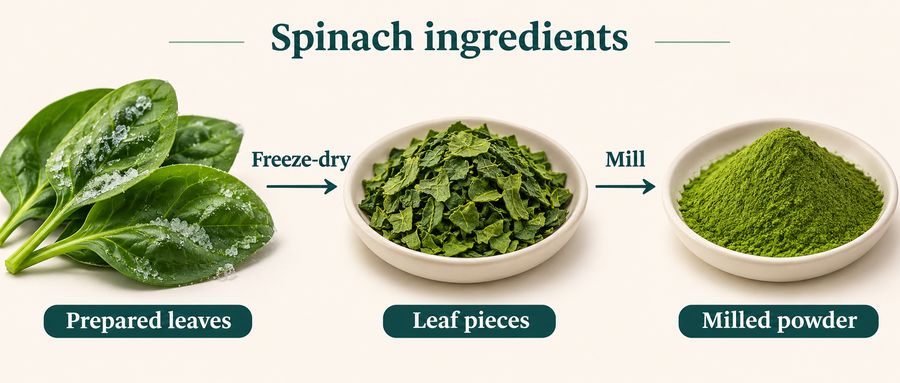
Choosing Between Spinach Flakes and Powder for Food Formulations
When formulating a dry soup blend, seasoning packet, ready meal, or baked good, your first decision is whether the finished food demands visible leaf piece identity or uniform color dispersion. Ordinary spinach (Spinacia oleracea) behaves differently in a recipe depending on whether it enters the mix as a whole or cut piece or as a finely milled powder.
Commercial vegetable ingredient processors supply freeze-dried spinach in distinct visual and physical forms. Industrial suppliers like BCFoods list both flakes and powders for soups, sauces, seasoning, bakery, pasta, and ready meals, while ingredient manufacturers such as Van Drunen Farms list commercial product forms including 1/4-inch chopped pieces, 1-inch chopped pieces, and a -40 powder.
The choice between these formats dictates both product performance and subsequent plant operations:
- Flakes and chopped pieces: Evaluated primarily for identifiable leaf piece identity and rehydrated bite in applications like instant soups, seasoning blends, and prepared meals where consumers expect visible leafy greens. Handling and packaging must account for piece integrity to limit crushing during blending and transit.
- Milled powders: Evaluated for particle size, color, dispersion, and dosing across doughs, extruded pasta, sauce bases, and dry seasoning blends without leaving distinct leaf pieces. Commercial products such as Organic Freeze Dried Spinach Powder from Nutra Ingredients show that carrier-free powders (such as a listed <1 mm specification) are produced commercially by freeze drying individually quick frozen (IQF) spinach and milling the resulting dry material.
Because fine leaf powder disperses across a liquid or dough matrix rather than completely dissolving, evaluating ingredient performance requires testing within your actual formulation under real mixing, shear, and cooking conditions. A powder may deliver intended color and suspension at ambient temperature, yet show distinct settling, color shifting, or flavor release once subjected to hot broth, acid sauce bases, or baking temperatures.
Defining the Incoming Leaf Feed and Moisture Load
A freeze dryer removes water from the specific mass and geometry placed on its trays, but comparing equipment performance or batch cycle times requires defining incoming feed characteristics. Interpreting cycle duration and condenser loading depends directly on knowing the incoming dry-matter content, physical preparation, surface moisture, and freezing state rather than relying on total wet feed weight alone.
Processors generally introduce spinach into a commercial freeze dryer through one of two raw material streams:
- Fresh harvested leaves: Washed, sorted, cut, and prepared leaf. When fresh leaf is blanched, the National Center for Home Food Preservation notes that heating vegetable tissue controls enzyme activity responsible for undesirable changes in flavor, color, and texture during frozen storage, and leaves must be cooled promptly and drained after the defined heating period. Factory blanching times, temperatures, and equipment must be established to fit the processor’s specific food application and product standards, as under-processing or over-processing can affect texture and color.
- IQF (Individually Quick Frozen) spinach: Commercially procured pre-frozen leaf. Procuring IQF spinach follows defined supplier preparation and receiving checks. Receiving inspections should verify whether raw material is blanched or unblanched, its cut dimensions, surface ice glaze, and the presence of clumps, ensuring these feed variables are documented and kept consistent across planned frozen-feed trials.
Processors must also establish clear microbiological safety boundaries. As outlined by the University of Minnesota Extension, freeze drying removes moisture through ice sublimation under reduced pressure, but the drying process itself does not kill illness-causing microorganisms. Controlling biological hazards requires a validated food-safety programme with appropriate hazard controls or upstream lethality steps, which remain distinct from enzyme-inactivating blanching and routine facility hygiene.
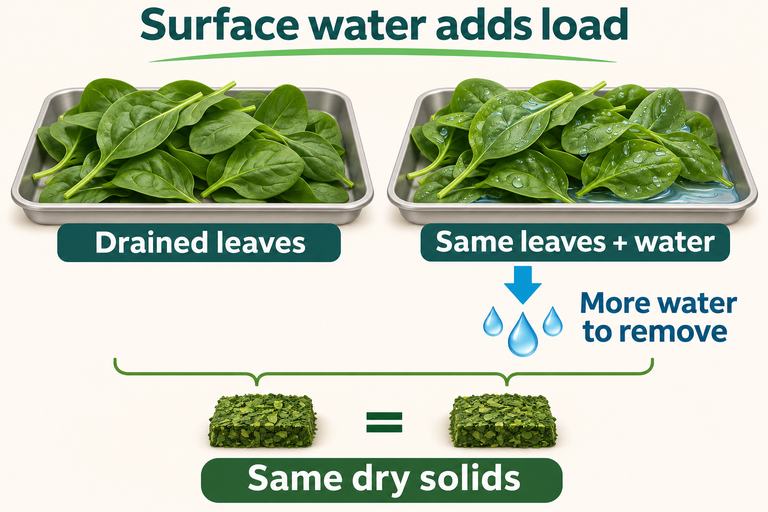
A consequential variable when staging washed or blanched fresh leaf is retained surface rinse water. Thin spinach leaves have an expansive surface area with crinkled folds and cut edges that readily hold free external water, substantially altering the total water load delivered to the drying chamber.
The actual yield of finished dry ingredient depends on the incoming dry matter, process losses, and final moisture content. If a batch of prepared wet leaves of mass M contains a measured dry-matter fraction x, the total dry solids content is S = M × x. The ideal finished product mass P containing residual wet-basis moisture fraction w, after accounting for dry-solids loss L during processing, follows the mass balance relationship:
P = (S - L) / (1 - w)
Consider an illustrative engineering comparison with 80 kg of properly drained prepared spinach leaves having an assumed 8% natural dry matter (0.08 solids fraction). This feed contains exactly 6.4 kg of vegetable dry solids (80 kg × 0.08). If inadequate post-wash draining leaves an extra 12 kg of free surface water clinging to the leaves, the scale registers 92 kg of wet feed, but the actual dry solids remain identical at 6.4 kg.
Assuming zero mechanical solids loss (L = 0) and an illustrative, hypothetical finished moisture content of 3% wet basis (w = 0.03)—used strictly for calculation purposes rather than as a commercial specification or product release target—the ideal recoverable dry product mass is identical for both batches:
P = 6.4 kg / (1 - 0.03) = 6.4 / 0.97 ≈ 6.598 kg (approximately 6.60 kg)
The operational consequence appears in the total water-removal duty imposed on the freeze-drying system. In the properly drained 80 kg lot, the system removes 73.402 kg of total water (80 kg − 6.598 kg). In the poorly drained 92 kg lot, total water removal rises to 85.402 kg (92 kg − 6.598 kg)—demanding an additional 12 kg of water removal without yielding any extra dry spinach ingredient. Furthermore, refractometric Brix readings cannot serve as a universal dry-solids measurement for fibrous leafy vegetables, because soluble optical solids do not measure total dry matter, which contains both soluble solids and insoluble plant fiber. Feed dry matter should instead be verified using an appropriate validated solids testing method.
Reading Tray Dynamics, Sublimation Fronts, and Dry Endpoints
Placing leafy greens across freeze-drying trays creates distinct bed geometry. Chopped or whole spinach leaves curl, overlap, and create irregular air voids alongside dense overlapping stems and leaf clumps, making physical heat and vapor distribution across the tray bed an essential focus during trial observations.
Freeze drying removes water through sublimation, converting frozen ice directly into water vapor under reduced chamber pressure while heat is supplied to the product. In an actual tray load, both the delivery of heat to frozen regions and the escape of generated water vapor through the surrounding bed geometry govern drying behavior across the product bed:
- Exposed edges and loosely spread leaves: Thin single layers and exposed perimeter leaves have open paths for water vapor escape and direct heat exposure, allowing them to dry differently from thicker sections. An individual exposed dry leaf therefore cannot represent the drying state of the entire tray.
- Overlapping folds, stems, and dense clusters: Compacted leaf folds, thick petiole stems, and frozen clumps present greater local mass and resistance to vapor escape, while also altering heat transfer to interior ice. In a loaded trial, observing these distinct locations helps prevent ending drying prematurely or overheating exposed areas while dense regions still retain ice.
Standardizing tray loading density, spreading leaves evenly to avoid compressed clumps, and verifying that incoming feed is frozen solid prior to primary vacuum drying are vital operating practices. For detailed engineering considerations on product freezing states, cold-chain handling, and tray loading protocols, see our technical guide on freeze dryer pre-freezing requirements.
Relying solely on visual appearance or touching exposed perimeter leaves cannot determine batch completion. Establishing a reliable drying endpoint requires working with the processor quality team to define sampling protocols, monitor product temperatures across representative tray locations, and evaluate drying completion using suitable chamber monitoring tools alongside validated laboratory moisture and water-activity determinations.
Evaluating Spinach Powder Routes: Drying Mechanisms and Particle Properties
When processors evaluate drying technologies for spinach powder, comparing freeze drying with spray drying requires recognizing that the two methods handle fundamentally different physical feed streams. In this application, freeze drying processes solid frozen leaf pieces that are subsequently milled, whereas commercial spray drying requires a pumpable liquid feed that can be atomized into a drying tower.
This structural difference was illustrated in a research study by Song Juan et al. (Modern Food Science and Technology, 2021, 37(9): 207–215). Working with washed, root-removed 3–4 cm leaf pieces of cultivar Lüshen 1 in 1 kg test lots across three parallel trials, the authors applied blanching and a 0.2% sodium bicarbonate color-protection treatment under research preparation conditions rather than an industrial processing recipe, before splitting the prepared vegetable into distinct drying routes:
- Freeze-drying route: The solid leaves were blanched and treated in a 0.2% sodium bicarbonate solution, frozen, freeze dried as solid leaf pieces, coarse-ground through a 60-mesh screen, and then subjected to 40 minutes of ultrafine grinding to pass a 160-mesh screen.
- Spray-drying route: The leaves were blended with water at a 1:1 ratio, pulped, colloid-milled, and homogenized into a fine liquid suspension before atomization in a heated air drying chamber.
Because the spray-drying feed underwent 1:1 dilution with water, mechanical pulping, colloid milling, and homogenization, the two drying systems processed markedly different incoming physical forms. The spray route dried a prepared liquid suspension, while the freeze-drying route dried solid leaf pieces before dry grinding, meaning that the complete upstream preparation, drying, and finishing routes differed between the two methods.
The combined differences in feed preparation, drying method, and mechanical grinding yielded distinct powder particle sizes in the study. In wet laser diffraction measurements, the median particle diameter (D50, defined on a volume basis where 50% of the sample volume consists of smaller particles and 50% of larger particles) was reported as:
- Freeze-dried and ultrafine-ground spinach powder: D50 = 38.91 ± 0.46 μm.
- Spray-dried spinach powder: D50 = 17.76 ± 0.36 μm.
The reported smaller median particle diameter belongs to the complete spray preparation and drying route, as the study cannot apportion individual contributions across preparation, drying, and finishing steps. Notably, the study did not find freeze drying to be the most favorable method across every measured color and chemical parameter. Choosing between these ingredient routes requires evaluating how finished flakes or powders perform in your specific food matrix at the intended use dose, balancing color stability, dispersion, and flavor release against the capital and operational requirements of each processing path.
Measuring True Saleable Output and Executing Meaningful Production Trials
A practical consideration when planning commercial trials is distinguishing between theoretical dry product calculated from initial dry matter and actual saleable ingredient yield. In a commercial food processing line, material is lost during milling, classification, quality sampling, and packaging.
Dry spinach flakes and powders require disciplined environmental control. As highlighted in general food preservation principles by the University of Minnesota Extension, freeze-dried biological foods readily absorb ambient moisture upon exposure to atmospheric air. Downstream yield and quality are shaped by distinct operating steps:
- Moisture pickup: Exposure to humid ambient air allows dry flakes and powders to reabsorb water vapor, potentially elevating water activity and contributing to clumping or reduced shelf stability. Environmental humidity in grinding and packaging rooms must be monitored and controlled accordingly.
- Milling hold-up and sieve classification: Grinding dry leaf material into powder involves line-specific accounting for physical hold-up in mills, transfer points, and dust collection systems. Sieve-separated oversize fractions, such as fibrous stems, should be weighed and accounted for as rework or rejects according to product specifications.
- Quality retain samples and process waste: Recorded sample withdrawals for laboratory moisture determination, water-activity testing, quality retain archives, and line purges represent real mass removed from saleable inventory that must be accounted for in yield calculations.
To obtain meaningful data from an equipment trial, process teams should establish structured observation protocols rather than relying on unstandardized drying runs. Meaningful comparisons between trials or equipment configurations require recording consistent incoming feed characteristics, tray loading patterns, drying progress, and final ingredient performance in the finished food application:
| Trial Parameter | Measurement and Engineering Objective |
|---|---|
| Raw Leaf Feed Status | Document cultivar, preparation method, fresh cut geometry (leaf versus stem ratio), blanching time and temperature, or incoming IQF piece condition, surface ice glaze, and clump presence. |
| Water Removal Duty | Measure initial drained feed mass, incoming dry-matter fraction (avoiding soluble-only Brix readings), targeted final moisture basis, and accounted dry solids losses to determine water removal duty. |
| Tray Loading and Distribution | Record tare weight of trays, net loading mass, tray surface area, calculated loading density (kg/m²), and observe leaf bed distribution across edges, center zones, and overlapping clusters. |
| Sublimation and Core Endpoints | Log product probe temperatures at representative center and perimeter tray locations, shelf heating fluid temperatures, chamber vacuum levels, and drying endpoint indicators in accordance with equipment capabilities and QA criteria. |
| Final Product Balance | Record gross dry cake mass, moisture content wet basis, water activity (aw), post-milling sieve recovery, dust collection losses, quality retain sample weights, and sealed net saleable yield. |
| Food Application Test | Evaluate finished flakes or milled powder within the targeted recipe (such as dry soup, sauce base, or dough) at the planned formulation dose under actual mixing, shear, and cooking conditions to assess color, dispersion, and flavor performance. |
By grounding pilot trials in rigorous mass conservation, validated dry-matter testing, controlled tray observation, and realistic recipe testing, ingredient manufacturers can evaluate freeze-drying performance on a fair, comparable engineering basis.
If you are evaluating equipment sizing or scaling up batch production for leafy greens, discuss your spinach freeze-drying project with our team to review chamber capacities, condenser water-removal duty, and tray loading configurations based on your specific fresh or IQF feed streams and intended flake or powder formats.
References
- Van Drunen Farms. Spinach.
- Nutra Ingredients Ltd. Organic Freeze Dried Spinach Powder.
- BCFoods. Spinach.
- University of Minnesota Extension. Freeze-drying.
- National Center for Home Food Preservation. Blanching Vegetables.
- 宋娟, 张海燕, 袁晶, 曾朝珍, 慕钰文, 康三江, 李玉新, 苟丽娜. 不同干燥方式下菠菜粉理化性质的比较. 现代食品科技. 2021;37(9):207–215. DOI:10.13982/j.mfst.1673-9078.2021.9.0127.

About the Author: Zheng Wei
Founder & Freeze-Drying System Engineer
Fuzhou Xing Shun Da Refrigeration Facility Project Co., Ltd.
Zheng Wei participates in food freeze-drying trials, equipment selection, vacuum-system configuration, refrigeration planning, installation guidance, process optimization, and project handover. The project experience covers fruit, vegetables, cooked foods, seafood, meat, dairy products, herbs, and extracts.