
Oxygen Absorbers for Freeze-Dried Food: Resolving Slow Oxygen Removal in Sealed Packs
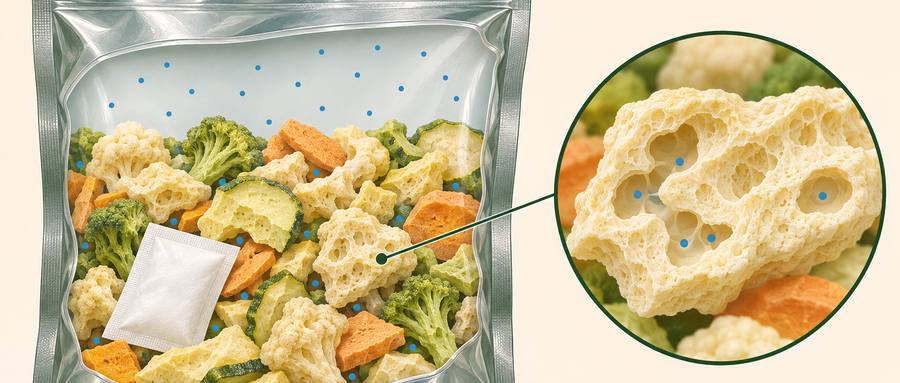
If a food freeze-drying factory or contract packaging facility seals dry product with an oxygen absorber, unexpected residual oxygen can sometimes remain in the sealed container. A sachet rating in cubic centimetres (cc) measures the volume of oxygen gas it can absorb, not the total volume of the package or the air inside it, and nominal capacity alone does not govern how quickly oxygen is removed.
When oxygen removal proceeds too slowly, technical and purchasing teams face an operating question: why is oxygen lingering in a dry pack, and what practical comparison helps identify a solution? The answer can involve the sachet formulation grade, the total oxygen burden inside the container, elapsed time, and the actual packaged product environment.
Why Sachet Grade Compatibility Matters in Dry Food
Most commercial oxygen absorbers used in food packaging rely on the oxidation of iron to consume oxygen (Cichello, 2015). In this process, iron reacts with oxygen to form iron oxides, with moisture acting as a necessary participant in the reaction pathway. If sufficient moisture is not available, iron oxidation cannot proceed normally.
To accommodate different foods, manufacturers supply sachets with different reaction mechanisms. As catalogued by MGC Trading (AGELESS), formulations include moisture-dependent types that start reacting after exposure to high-humidity conditions, and self-reacting types that contain the moisture needed for the reaction. If a moisture-dependent sachet is sealed into a dry freeze-dried food pack without contact with high humidity, it can struggle to scavenge oxygen because the necessary moisture is absent. The exact sachet grade must therefore match the intended food environment.
Self-reacting sachets incorporate the moisture needed for oxidation within the sachet itself, but packagers still need to check the manufacturer’s catalogue application range. In food specifications, water activity differs fundamentally from total moisture content:
- Moisture Content: The total quantity of water held within the food matrix, typically expressed as a percentage by weight.
- Water Activity (aw): A dimensionless value on a scale from 0 to 1 representing the availability of water in a product, defined as the vapor pressure of water in the food divided by the vapor pressure of pure water at the same temperature.
Manufacturer application ranges illustrate why selecting the appropriate grade matters. For instance, MGC Trading catalogues its AGELESS Z-PKC grade for low-moisture foods such as dried vegetables, coffee, and spices, with an application range of aw 0.65 or lower and explicit compatibility with co-packaged desiccants. In contrast, its self-reacting S grade is catalogued for foods with an aw range of 0.65 to 0.95. These product examples reflect manufacturer design boundaries rather than an automatic recommendation or universal threshold for every freeze-dried product.
When packaging dry freeze-dried foods, packagers must also account for any co-packaged desiccant. A desiccant removes water vapor, whereas an oxygen absorber removes oxygen. Placing an absorber physically away from a desiccant or food does not establish compatibility between them, and operators should not attempt to wet or hydrate sachets with water. Instead, teams should confirm with the sachet supplier that the exact grade is compatible with the product’s actual aw, intended storage temperature, and any accompanying desiccant.
Where Is the Air in a Sealed Freeze-Dried Pack?
Sizing an absorber requires understanding capacity units. An absorber’s nominal rating is stated in cubic centimetres (cc), where 1 cc equals 1 millilitre (mL) of oxygen capacity under the supplier’s rated conditions (Mitsubishi Gas Chemical; IMPAK). For example, a 200 cc sachet is rated to absorb 200 mL of pure oxygen gas, not 200 mL of total package volume or 200 mL of air.
Ambient air consists of approximately 21% oxygen, with mostly nitrogen remaining after oxygen is consumed. As oxygen is removed, flexible packaging may tighten around the food, but package shrinkage varies with the container and product and does not serve as a quantitative measurement of residual oxygen.
Determining the required absorber capacity requires accounting for the total oxygen inventory inside the container. As detailed in the comprehensive review by Cichello (2015), this inventory consists of three distinct elements:
- Visible Headspace Gas: The open volume of air residing directly above the product fill inside the package.
- Void and Pore Volume: The air trapped in interstitial spaces between particulates and accessible internal pores within the porous food structure.
- Food-Associated Gas and Packaging Ingress: Food-associated or dissolved oxygen not already accounted for initially, alongside oxygen that may gradually enter through the packaging material over storage.
Counting only the visible space above the product can omit air situated between pieces or inside accessible pores. In freeze-dried foods, internal structure varies widely. For example, research by Malik, Gouseti, and Bakalis (2018) examining thin layers of concentrated coffee and gum-arabic systems at 50% and 60% solids demonstrated that formulation and freezing conditions directly affected pore structure and reconstitution behavior. While that study evaluated specific model materials rather than universal food porosity, it demonstrates that pore networks depend on formulation and freezing. When estimating pack oxygen inventory, evaluating which pores contribute is a separate qualification, because not all internal pores are necessarily accessible on the same timescale.
To illustrate the quantitative difference between visible headspace and total accessible air, consider a hypothetical worked scenario for a sealed pack with an internal container volume of 1,000 mL:
| Gas Parameter | Visible Headspace Only | Total Accessible Air (Given) |
|---|---|---|
| Air Volume Considered | 100 mL | 750 mL (100 mL headspace + 650 mL interstitial/pore air) |
| Initial Oxygen Volume (at 21% O2) | 100 mL × 0.21 = 21.0 mL O2 | 750 mL × 0.21 = 157.5 mL O2 |
This hypothetical comparison illustrates how considering only visible headspace (21.0 mL O2) rather than all accessible air counted once (157.5 mL O2 from the stipulated 750 mL total) can underestimate initial gas burden. However, these figures represent given hypothetical inputs rather than a measured rule for commercial packs. Sizing an absorber also requires distinguishing static oxygen inventory from how quickly gas reaches and reacts at the sachet. A final packaging decision must evaluate food-associated oxygen not already counted, barrier ingress over shelf life, capacity consumed by atmospheric exposure during handling, and whether the chosen sachet grade achieves the required oxygen reduction within an acceptable timeframe, as discussed in broader freeze-dried food packaging barrier guidelines.
Absorption Capacity Versus Absorption Rate
A fundamental operational distinction exists between total nominal absorption capacity and absorption speed (Mitsubishi Gas Chemical; IMPAK). Capacity defines the total cumulative volume of oxygen an absorber can bind before its chemical reactants are exhausted. Rate defines how rapidly the sachet binds that oxygen hour by hour.
Absorber manufacturers provide distinct grades for different reaction speeds, offering fast-acting and general-purpose formulations (MGC Trading). While a sachet’s nominal capacity rating addresses the total volume of oxygen it can bind, the time required to reach a specific residual oxygen level depends on the sachet grade and actual packaging conditions. Because products vary in their sensitivity and shelf targets, packaging teams need to define their required oxygen level and allowable timeframe based on product requirements rather than relying on a universal timetable.
In practice, several conditions affect how an absorber performs inside the pack and should be held constant or documented during evaluation:
- Temperature and Humidity: Sachet performance is affected by ambient temperature and relative humidity (IMPAK). Absorber behavior depends on the specific grade and storage environment, making it important to evaluate sachets under the intended storage temperature and humidity conditions.
- Sachet Placement: According to Mitsubishi Gas Chemical, sachet placement within the package can alter deoxygenation time. Because gas transport throughout the container can differ depending on where the sachet sits relative to the food, packagers should test performance at the exact intended placement location.
- Pre-Sealing Atmospheric Exposure: Self-reacting sachets begin reacting with oxygen upon exposure to ambient air. Leaving sachets open on the packaging line before sealing consumes a portion of their active capacity, so operators should follow grade-specific handling instructions and record exposure times during packaging trials.
Commercial packaging provides practical context for oxygen absorber use in freeze-dried meals. In its consumer guidance, prepared meal manufacturer Mountain House notes that it freeze dries meals at its Albany, Oregon facility and includes oxygen absorbers in its packaging, instructing consumers to remove the sachet before rehydrating the food (Mountain House). For any freeze-dried food packager, confirming that an absorber performs as intended requires evaluating it within the actual finished package.
Comparing Sachet Performance in the Actual Pack
When quality audits indicate that oxygen removal is proceeding too slowly, packaging teams should avoid changing pouch materials, line speeds, and sachet sizes all at once. Instead, operations should execute a controlled actual-pack comparison derived from established manufacturer testing principles (Mitsubishi Gas Chemical).
A practical comparison requires keeping packaging variables closely matched. Test packs should use the same production lot of freeze-dried food, holding fill mass, container format, sealing settings, sachet placement, ambient storage temperature, and pre-sealing exposure consistent. If the goal is to determine whether sachet grade or capacity is causing a delay, change only one of those factors at a time; changing both simultaneously tests an overall configuration but cannot isolate which variable was responsible. Rather than following a universal standard protocol, a practical comparison derived from actual-pack testing principles evaluates two configurations:
- Current Baseline: The existing sachet grade and nominal capacity currently in production.
- Candidate Specification: A sachet confirmed with the supplier as suitable for the product’s actual aw, storage temperature, and any co-packaged desiccant, with capacity assessed against the total oxygen inventory.
During sample preparation, teams should record the sachet product code, manufacturing lot, and open exposure time before sealing according to handling instructions. Because opening a sealed package introduces fresh air and alters the internal atmosphere, trials relying on destructive testing require sealing enough separate, unopened packages for each planned inspection timepoint, unless a qualified non-destructive method is used.
Evaluating test packages requires understanding what different measurements tell you. As described by packaging test laboratory Smithers, quantitative headspace analysis measures oxygen concentration in the sampled gas mix, which tracks gas reduction over time alongside packaging permeability tests. However, headspace sampling measures only the extracted gas, not every internal food-associated reservoir. Packagers should combine planned headspace observations under intended storage conditions with checks on product appearance, aroma, and flavor, recognizing that instrumental gas readings and sensory checks address different aspects of package performance.
Conversely, qualitative visual tools have distinct operational limits. Colorimetric oxygen indicator tablets change appearance based on a specific threshold concentration under their individual specifications; they do not measure the numerical residual oxygen percentage or indicate how much active capacity remains within the absorber. Similarly, package wall shrinkage, sachet warmth, or packet stiffness are not quantitative gas measurements. Food operations should establish acceptable oxygen thresholds and clearance timelines based on their specific product oxidation vulnerability and validation data, as discussed in freeze-dried food shelf-life evaluations, rather than relying on supplier marketing claims or lab detection limits as universal release criteria.
Resolving Packaging Line Deoxygenation
When sealed freeze-dried packs retain oxygen longer than expected, packaging teams should distinguish total absorption capacity from sachet grade and reaction speed before changing specifications. A matched actual-pack comparison tests a candidate configuration against your required oxygen level and allowable timeframe alongside food-quality observations, providing the practical evidence needed to evaluate performance without assuming a single cause or changing multiple line variables at once.
Packaging teams reviewing oxygen management on an existing line can clarify their operating parameters by examining the handoff between freeze drying and packaging. If you are assessing your production process, visit goodfreezedryer.com/contact to discuss your freeze-drying cycle conditions, food characteristics, package volume, sachet grade, and observed oxygen readings over time.
Sources and references
- Simon Angelo Cichello (2015). Oxygen absorbers in food preservation: a review. Journal of Food Science and Technology 52(4):1889–1895. doi:10.1007/s13197-014-1265-2.
- Malik N, Gouseti O, Bakalis S (2018). Effect of freezing on microstructure and reconstitution of freeze-dried high solid hydrocolloid-based systems. Food Hydrocolloids 83:473–484. doi:10.1016/j.foodhyd.2018.05.008.
- MGC Trading. AGELESS®, Oxygen absorber: product types and application ranges.
- Mitsubishi Gas Chemical. Features of AGELESS.
- Mitsubishi Gas Chemical. エージレス®パックの作り方: actual-pack testing and handling.
- IMPAK Corporation. All About Oxygen Absorbers: capacity units and conditions.
- Smithers. Oxygen Headspace Analysis.
- Mountain House. FAQs: own production and package instructions.

About the Author: Zheng Wei
Founder & Freeze-Drying System Engineer
Fuzhou Xing Shun Da Refrigeration Facility Project Co., Ltd.
Zheng Wei participates in food freeze-drying trials, equipment selection, vacuum-system configuration, refrigeration planning, installation guidance, process optimization, and project handover. The project experience covers fruit, vegetables, cooked foods, seafood, meat, dairy products, herbs, and extracts.