
1,320 kg Batch Vacuum Freeze Dryers: Evaluating Single-Chamber Versus Twin-Chamber Proposals
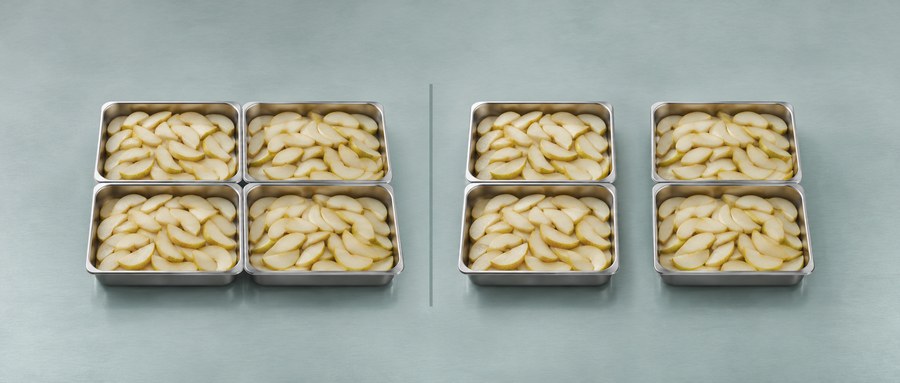
When comparing equipment proposals that quote the same 1,320 kg wet batch capacity, a fruit-ingredient processor faces a direct choice between one large vessel and two 660 kg chambers. Both options offer the same nominal aggregate, but they handle incoming raw fruit lots and plant turnaround schedules very differently. Deciding between them depends on two governing operating questions: whether your largest intact fruit lot fits into a single chamber without splitting, and whether multiple chambers can actually run concurrent cycles under your factory’s utility and handling limits.
The Quoted 1,320 kg Rating: Usable Tray Area Versus Nameplate Mass
Industrial vacuum freeze dryers are marketed by wet batch weight, but initial loading depends on available tray space. In commercial food production, multiplying the usable loaded tray area (m²) by the demonstrated wet loading density (kg/m²) for the specific cut, slice thickness, and arrangement establishes an area-based estimate of wet capacity (kg). This calculation determines physical geometric fit, which remains distinct from verified operating capacity; validating actual throughput also requires drying trials to confirm cycle times and customer-specified product quality at that load.
A supplier-neutral hypothetical calculation illustrates how tray area determines nominal wet load. Assuming a plant trial supports 12 kg/m² at the prepared fruit thickness and arrangement, a single chamber with 110 m² usable tray area gives 1,320 kg by area, while two equal chambers with 55 m² usable area each give 660 kg per chamber, reaching the same total. These assumptions represent an area-only example, not values for a purchased model, rated drying throughput, or a guarantee of process capacity. For an actual buyer, this calculation translates into concrete procurement actions: confirm the net usable tray area and acceptable loading density on your specific product per chamber, and require vendors to provide written conditions alongside a representative load trial before accepting nominal throughput ratings.
Real-world production records confirm how areal loading density governs batch mass. In a first-party 2018 Oregon food processing case, an SDG3000 freeze dryer with 100 m² of drying area processed roughly 1,200 kg of fresh pear slices, utilizing an areal loading density of 12 kg/m² (100 m² × 12 kg/m² = 1,200 kg) [1]. That specific run achieved an approximately 12-hour reported drying interval (distinct from total cycle turnaround) and reached a reported final moisture of 2.21%, with the measurement basis unspecified [1]. Across that same 100 m² shelf layout, loading 1,320 kg of wet fruit would mathematically require an areal density of 13.2 kg/m²; however, the available record provides no evidence that this higher density would be acceptable under those trial conditions or that it would necessarily increase product layer thickness without altering fruit arrangement. Distinguishing arithmetic scaling from verified operational output remains essential when evaluating chamber capacity.
Altering tray loading density and arrangement influences heat and mass transfer dynamics. In a 1995 freeze-drying experiment conducted by K. Sharma and C. P. Arora, layer thickness, chamber pressure, and heating conditions directly affected drying results and production rates [3]. Transfer from that laboratory yoghurt study is strictly limited to the qualitative necessity for processors to test their specific fruit geometry, piece thickness, and tray loading against their established drying process and customer quality standards, rather than assuming generic heating or condenser outcomes as necessary consequences. Exploring design configurations in batch freeze dryer systems helps clarify how shelf spacing, tray depth, and chamber geometry interact when establishing workable product loading limits.
Lot Segregation and Chamber Turnaround Schedules
In food ingredient manufacturing, lot integrity rules often dictate operating schedules. When a facility’s internal quality system, organic certification, or customer agreement requires an exclusive cycle for each agricultural delivery, different lots cannot be co-loaded in the same chamber. For example, European contract operator 0°NOVA operates two independent trolley-loaded freeze dryers without shared condensers and dedicates each chamber cycle to a single production lot [2]. When multiple wet lots arrive at once, chamber configuration determines how those separate runs move through the plant schedule.
Tracking batch timing requires distinguishing three separate milestones: when the drying cycle ends and product is ready to unload under required conditions, when chamber turnaround is complete so the vessel is ready to reload, and when subsequent quality review authorizes commercial lot release. For equipment scheduling, the chamber-slot clock starts at loading and includes evacuation, drying, unloading, and applicable cleaning or defrost before the vessel is ready to reload for the next batch. Downstream quality assurance and customer release proceed on their own timelines after drying completes.
Consider a hypothetical scheduling model (Model E1) comparing one 1,320 kg chamber with two 660 kg chambers, assuming both options physically fit each 600 kg wet lot. Two separate 600 kg lots of prepared fruit (Lot A and Lot B) are ready to load at hour 0, and plant policy requires each lot to run in an exclusive chamber slot. For this comparison, chamber-slot durations are assumed to be 18 hours for Lot A and 22 hours for Lot B (covering loading through ready-to-reload turnaround), rather than values derived from fruit composition.
| Configuration | Lot A Chamber Assignment | Lot B Chamber Assignment | Lot A Chamber Slot Complete | Lot B Chamber Slot Complete | Total Schedule Elapsed |
|---|---|---|---|---|---|
| Single 1,320 kg Chamber | Chamber 1 (Runs h0 to h18) | Chamber 1 (Queued; runs h18 to h40) | Hour 18 | Hour 40 | 40 hours |
| Twin 660 kg Chambers (Assuming Overlap Available) | Chamber 1 (Runs h0 to h18) | Chamber 2 (Runs h0 to h22) | Hour 18 | Hour 22 | 22 hours |
Under the single-chamber option, Lot A occupies the vessel from h0 to h18. Because lot segregation prohibits co-loading, Lot B waits until h18 and completes its chamber slot at h40, requiring 40 elapsed hours to finish both runs. In the twin-chamber option, if shared utilities, condenser capacity, and tray-handling workflows are qualified for concurrent operation, both runs can start at h0. Lot A completes its chamber slot at h18 and Lot B finishes at h22, clearing both chamber slots 18 hours earlier. Proving that cycles can actually overlap in practice requires verifying that shared vacuum and refrigeration services, as well as plant material handling, can support simultaneous operation.
Handling Large Lots: The Indivisible Batch Boundary
While two chambers offer flexibility for smaller segregated batches, they introduce a physical limit when a single wet lot exceeds 660 kg. Consider another hypothetical condition (Model E2) where a customer contract or internal specification designates a 900 kg wet fruit lot as an indivisible batch that cannot be split during processing.
In a single 1,320 kg chamber, the 900 kg lot loads directly into one run, assuming verified tray area and product-qualified operating parameters support that wet mass with approved acceptance. Running the order in one vessel under one recipe and cycle provides a single agreed operating record, but achieving uniform final moisture and color across all tray positions still depends on validated process control and physical loading consistency.
In a twin 660 kg installation, neither chamber can hold 900 kg. If the customer agreement or quality system does not allow lot splitting, the plant cannot run the order. Only if the customer and quality system formally authorize an approved split plan can the batch be divided between the two vessels, which introduces specific operational and release requirements:
- Dual Sublot Records: Traceability and testing must follow the agreed split authorization, establishing distinct sublot identifiers (such as 900-1 and 900-2) with their own thermal records, vacuum curves, and agreed verification checks for each vessel.
- Synchronized Release Schedules: When the customer agreement requires the complete intact order, final order disposition waits until both sublots are finished. If Chamber 1 finishes its slot at hour 18 and Chamber 2 finishes at hour 21, the machine completion times remain distinct, and the full shipment release waits for both sublot QA dispositions.
- Blend Uniformity: Attempting to re-blend dry fruit from two separate drying runs can induce physical attrition, breakage, or powder generation, particularly with fragile freeze-dried berry or tropical fruit pieces.
Equipment selection should match historical lot sizes: two 660 kg chambers cannot run a 900 kg indivisible lot without an approved split, while running an isolated 600 kg lot in a 1,320 kg chamber utilizes only a portion of the verified single vessel wet load allowance.
Procurement Verification Steps for 1,320 kg Systems
Before selecting a 1,320 kg batch freeze dryer configuration, procurement and engineering teams should review proposals against verified design parameters and actual production patterns:
- Confirm Usable Tray Surface Area: Obtain the net usable tray surface area (m²) excluding structural margins and clearances. While multiplying area by loading density estimates wet tray fit, verify per-chamber product capacity and acceptable dried results through a representative trial.
- Audit Ice Condenser Performance: Verify the expected ice accumulation over the time between defrosts against usable ice-holding capacity (kg), and verify expected overlapping vapor flow against continuous vapor capture rate (kg/h) at your target working pressure and intended cycle phases.
- Review Piping and Instrumentation Diagrams (P&IDs): Inspect refrigeration, vacuum, and fluid schematics to determine whether systems are dedicated or shared. If utilities are shared, request loaded trend data and product acceptance records demonstrating stable pressure control across the intended overlapping phases. Reference site guidance such as food freeze dryer validation for commissioning and acceptance considerations.
- Quantify Chamber Turnaround Time: Map tray loading, vacuum pull-down, drying, tray unloading, and chamber turnaround (including defrost and cleaning where applicable) independently from subsequent quality release times to evaluate scheduling against historical batch arrival patterns.
Choosing between a single 1,320 kg chamber and twin 660 kg chambers depends on your largest intact wet lot, typical separate lot arrivals and timing, and specific QA and overlap expectations. If you are evaluating batch freeze dryer bids for an established food ingredient operation, contact the technical inquiry team to discuss how equipment configurations and utility layouts match your facility’s production schedule.
References
- Freeze-Dried Pears Case Study: 100 m² Freeze Dryer, Oregon production record.
- 0°NOVA. Production: Exclusive chamber cycles.
- Sharma K, Arora CP. Influence of product thickness, chamber pressure and heating conditions on production rate of freeze-dried yoghurt. International Journal of Refrigeration. 1995;18(5):297–307.
- Tchessalov S, Maglio V, Kazarin P, et al. Practical Advice on Scientific Design of Freeze-Drying Process: 2023 Update. Pharmaceutical Research. 2023;40:2433–2455.
- Brennan JG. Evaporation and Dehydration. In: Brennan JG, Grandison AS, eds. Food Processing Handbook. 2nd ed. Wiley-VCH; 2012. Section 3.2.7.1.
About the Author: Zheng Wei
Founder & Freeze-Drying System Engineer
Fuzhou Xing Shun Da Refrigeration Facility Project Co., Ltd.
Zheng Wei participates in food freeze-drying trials, equipment selection, vacuum-system configuration, refrigeration planning, installation guidance, process optimization, and project handover. The project experience covers fruit, vegetables, cooked foods, seafood, meat, dairy products, herbs, and extracts.