
Freeze Dryer Thermocouple: Placement, Errors & Food-Tray Readings
What a freeze dryer thermocouple actually measures
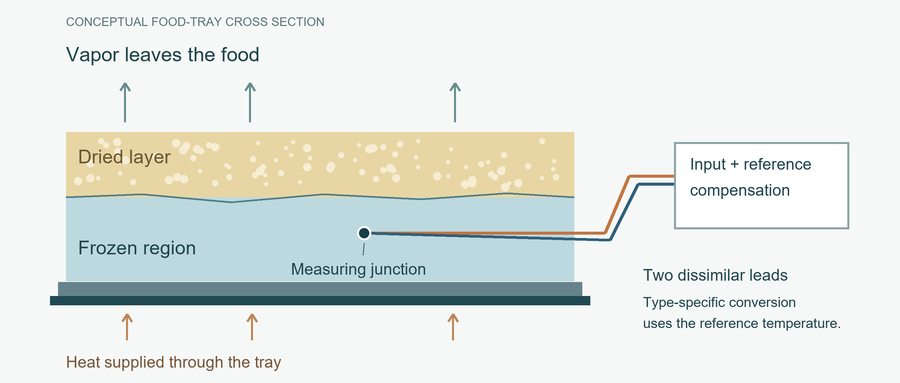
A freeze dryer thermocouple reports the temperature of its measuring junction, where two dissimilar conductors meet. That reading represents a food location only when the junction has suitable thermal contact with it. The displayed value also depends on the wiring, reference-temperature compensation and acquisition input. A temperature curve therefore needs both a location and a measurement context. [3]
The thermocouple circuit develops a small voltage through the Seebeck effect. The instrument converts it into temperature using the relationship for the configured thermocouple type and the temperature at the reference connections. That voltage-to-temperature relationship is not strictly linear across the full range. [3]
The reference connections are often called the cold junction. The term does not mean that they sit at 0°C or are colder than the food. Cold-junction compensation accounts for their temperature so that the instrument can interpret the voltage correctly. [3], [4]
| Device | Signal used | What the reading describes |
|---|---|---|
| Temperature thermocouple | Thermoelectric voltage, with type-specific conversion and reference compensation. | Temperature at the measuring junction. [3] |
| Thermistor or RTD | Temperature-dependent resistance, using suitable excitation and input circuitry. | Temperature at the sensor, through a different measurement principle. [3] |
| Thermocouple vacuum gauge | Temperature response of a heated element, interpreted through its heat transfer to gas. | Indirect pressure indication, affected by gas properties and calibration. It is not a food-temperature probe. [5] |
A small coriander freeze-drying study published in 1996 illustrates the distinction: copper–constantan thermocouples recorded material, heater and cold-trap temperatures, while a separate thermocouple vacuum gauge measured chamber pressure. This was a small experimental study, not a production-scale validation. [2]
Placement determines which food location the curve represents
The useful placement question is which part of the food the junction actually contacts. A continuous food layer and an irregular food piece present different possibilities; a channel label such as “product temperature” does not resolve them.
For example, a junction embedded at a defined depth in a food layer has different thermal contact from one resting against the tray underneath. In a food piece, a junction surrounded by food differs from one lying in a crack or a gap between pieces. Tray contact allows direct heat conduction between the tray and junction; a gap weakens contact with the intended food region. Either can make the junction temperature unrepresentative of that food region, even with correct electronics. Probe construction and mounting also affect thermal contact and response. [3]
A useful placement record identifies the tray and shelf, food thickness or piece dimensions, junction depth, contact condition and lead route. It also records whether the probe was present during freezing or introduced after freezing. This makes a later curve comparison more meaningful than comparing channel numbers alone.
Center and bottom positions can be candidates for investigation, but neither is automatically the last place to dry. Heat supply and the route for escaping vapor depend on the food and loading arrangement. The last location to freeze also cannot simply be assumed to be the last to dry. Placement must be justified against the actual product and process. [1]
During primary drying, the boundary between frozen and dried material changes position and shape. A fixed junction does not continuously follow that boundary or identify the slowest region elsewhere in the batch. Pisano and colleagues distinguish local temperature measurements from model estimates of temperature distribution and remaining frozen-layer thickness. Those estimates contain information that a single thermocouple does not directly measure. [1]
The probe can change the food immediately around it
A correctly functioning thermocouple can record a local process that the probe itself has altered. This is different from an electrical error: the junction may truly be warmer, while the surrounding uninstrumented food follows a different drying history. [1]
In their food freeze-drying research, Pisano, Barresi and Fissore examined tray liquids, including sucrose and lactose solutions, and prefrozen spinach in a small apparatus. The study discusses several ways that an inserted probe can disturb the process. [1]
- When food freezes around a probe: the probe may influence nearby nucleation and crystal growth, changing the local structure through which vapor later travels.
- When a probe enters already frozen food: insertion may disturb the structure and provide a preferential vapor path. The spinach work illustrates this possibility; it is distinct from influencing the original freezing event.
- During drying: metal leads can conduct heat between the food and regions at different temperatures, changing local heat transfer. The direction depends on the temperature difference; the leads do not necessarily add heat to the food. Probe insertion can also change resistance to vapor movement.
These mechanisms are discussed in the food study. They do not mean that every probe accelerates drying or produces the same bias in every food. The spinach geometry and experimental conditions, including reduced radiation, limit how its drying behavior can be generalized. No universal temperature correction or drying-time adjustment follows from it. [1]
The practical implication is to assess representativeness separately from electrical accuracy. Calibration can assess the sensor and acquisition input under stated test conditions; it cannot establish that the pierced food dries exactly like nearby unpierced food. Product trials need evidence from relevant locations beyond the instrumented spot before that spot is used to represent a tray or batch.
Why two temperature channels can disagree
Different readings may reflect different food temperatures, changed contact, different probe response or an error in the measuring chain. None of these possibilities can be identified from curve shape alone. Placement records and time-aligned process data help determine what deserves checking. [1], [3], [4]
Hypothetical example: one channel rises suddenly while the others remain broadly unchanged. Its food location might be warming, its junction might have lost contact, or its measurement circuit might have changed. The observation alone establishes neither that the food has dried nor that the sensor has failed.
| Observation | Possible explanations | Evidence to check | Conclusion still unsupported |
|---|---|---|---|
| One channel warms earlier | Real local drying, probe disturbance, altered contact or an electrical change. | Junction location, food geometry, placement history and associated process events. | The whole tray is dry. |
| Two curves remain separated | Different thermal locations, probe response, configuration or calibration behavior. | Comparable placement, sensor identities, input settings and approved comparison results. | The higher reading is necessarily wrong. |
| A reading shifts or becomes noisy | Contact movement, wiring or interference issues, reference compensation, or a real process event. | Event timing, physical condition and measurement-chain checks. | A particular wiring fault has been proved. |
| Several channels change together | A shared process change or a shared acquisition/reference problem. | Shelf and pressure records, channel configuration and reference-end conditions. | Agreement proves correct product temperatures. |
JUMO identifies incorrect thermocouple type, polarity, extension or compensation leads, reference conditions, interference and aging as potential error sources. NI likewise treats the sensor and acquisition hardware as parts of the measurement system. [3], [4]
For the measurement chain, the responsible personnel should establish whether the installed thermocouple type matches the configured input, polarity is correct, extension or compensation leads are compatible, and scaling and cold-junction compensation are appropriate. They should also establish what the calibration or comparison actually covered: the sensor, the acquisition input, or the assembled chain. A reference-end problem cannot be ruled out solely because only one channel appears affected. [3], [4]
Physical and electrical checks belong in manufacturer-approved maintenance or test conditions. Their purpose is to separate causes, rather than adjust the reading until two different food locations appear identical. The wider batch monitoring and abnormal-trend records provide the process context for that comparison.
Why warming toward shelf temperature does not release the batch
Where ice is sublimating, part of the incoming energy supports the phase change. If that local sublimation diminishes while heat continues to arrive, the measured location can warm toward its thermal surroundings, sometimes toward the shelf temperature. Probe-induced local drying can make that change occur before other food regions have finished primary drying. [1]
Warming can also reflect lost food contact, changed heating conditions or a measurement-chain problem. It is not uniquely a sign of local ice removal, and convergence with the shelf temperature is not a required feature of every process. [1], [3], [4] The compared “shelf temperature” must also be identified: a setpoint, heating-fluid reading and measured shelf surface are different quantities. The guide to freeze-drying temperature and pressure explains the broader relationship between heating conditions and product temperature.
1. What happened near this junction?
A verified rise can be consistent with reduced local sublimation cooling. Interpreting it requires the junction location, retained contact and surrounding process history. It remains evidence about that location, including any disturbance caused by the probe.
2. Has primary drying finished across the batch?
This requires evidence that accounts for regions that may dry later. Depending on the equipment and validated method, comparison of appropriate pressure measurements or an approved pressure-rise test can supplement temperature observations. These methods examine chamber behavior beyond a single food junction. Pisano and colleagues studied pressure-rise testing and model-based monitoring for food trays; that work does not establish a universal production endpoint rule. [1]
Pressure evidence needs its own interpretation. Thermal-conduction gauges respond to gas properties. [5] The assessment must also account for leaks and desorption—gas or vapor released from surfaces—rather than attributing all pressure change to remaining food ice. Stable pressure or agreement between gauges therefore cannot, by itself, establish final residual moisture. Method suitability and acceptance criteria must come from the actual equipment and product work.
3. Does the finished product meet its requirements?
After ice removal, non-frozen water can remain associated with the food; its removal by desorption is part of secondary drying. Primary-drying completion therefore does not establish final moisture. As discussed in food freeze-drying cycle development, final checks need defined sampling locations, methods appropriate to the product, and acceptance criteria established for its intended use.
A single average moisture value can conceal differences between locations. Crispness or water activity alone also cannot establish every food-safety or batch-release requirement. The decision needs both the qualified process evidence and the required product checks; one warming probe cannot supply either a universal release rule or a fixed extra drying time.
Information for a food-production project discussion
For an existing temperature-reading problem or a new food-production project, a useful starting record includes the food and its form, layer thickness or piece size, wet batch load and loading arrangement, equipment model, sensor identities and junction locations. Time-aligned product, shelf and pressure curves, with relevant events marked, help frame the question.
That information can accompany a food freeze-drying project discussion. The actual equipment configuration determines which measurement checks and further trials are appropriate.
References
- Pisano R, Barresi AA, Fissore D. Innovation in Monitoring Food Freeze Drying. Drying Technology. 2011;29(16):1920–1931. DOI: 10.1080/07373937.2011.596299.
- 李蔚,陈民。冻干香菜加工工艺的探讨。西安公路交通大学学报,1996,16(4):88–90。
- NI. Measuring Temperature with Thermocouples, RTDs, and Thermistors.
- JUMO. 15 Most common thermocouple problems and solutions [COMPLETE GUIDE].
- Kurt J. Lesker Company. Pressure Measurement Technical Notes.
About the Author: Zheng Wei
Founder & Freeze-Drying System Engineer
Fuzhou Xing Shun Da Refrigeration Facility Project Co., Ltd.
Zheng Wei participates in food freeze-drying trials, equipment selection, vacuum-system configuration, refrigeration planning, installation guidance, process optimization, and project handover. The project experience covers fruit, vegetables, cooked foods, seafood, meat, dairy products, herbs, and extracts.