
Meat snacks · Process and texture
Can You Make Beef Jerky in a Freeze Dryer?
Yes—beef can be freeze dried, including as part of developing a jerky-style product. But a freeze dryer is not a shortcut to a guaranteed chewy jerky. The starting product and the intended bite matter as much as the name.
For a food processor, the decision is whether to retain conventional jerky, develop a different dry snack, or make a meat ingredient intended for rehydration.
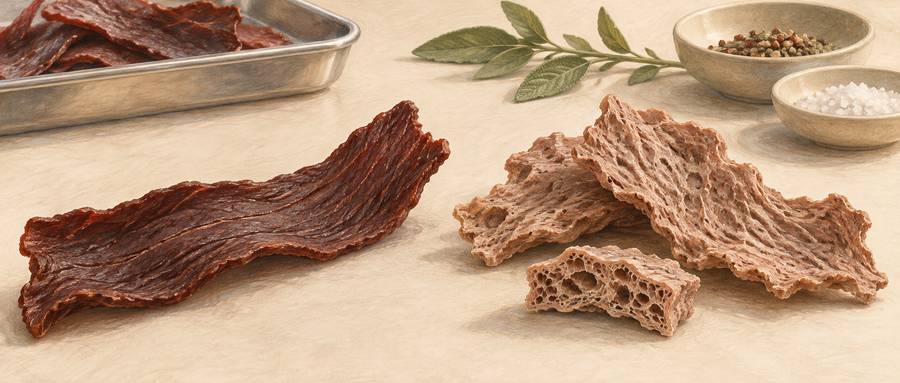
Start with the product: chewy jerky or freeze-dried beef
Beef can be freeze dried. The important qualification is that a freeze dryer does not automatically make the same chewy product as conventional jerky. It changes the route by which water leaves the food, and the final bite depends on the starting meat, its preparation and the drying conditions. [1]
For a meat-snack developer, the useful question is therefore more specific than the product name: should the finished piece bend and resist chewing, break cleanly as a dry snack, or recover a particular texture after water is added? Those are different development targets.
A freeze-dried product may be developed and described as a jerky-style snack. The name alone does not establish how it will eat. A sample comparison should establish whether the intended bite has actually been achieved.
| Question | Conventional jerky route | Freeze-drying route |
|---|---|---|
| How does water leave? | Drying removes water by evaporation; heating and air movement are commonly used. | Ice is removed by sublimation under low pressure, followed by further removal of associated water. |
| What defines a successful product? | The specified jerky texture and flavor, together with its validated safety and storage requirements. | The specified dry or rehydrated eating quality, together with its own safety and storage requirements. |
| Can the route alone predict the bite? | No. Preparation, formulation and drying conditions still matter. | No. A porous structure does not by itself specify hardness, crispness or chewiness. |
This is a qualitative process comparison, not a production recipe or a legal definition of a product name. [1] [2]
Why freezing, heat and water removal change the bite
Freeze drying uses heat. First, water in the prepared food is frozen. During primary drying, controlled heat supplies the energy for ice to turn directly into vapor under reduced pressure. The vapor must also escape through the product and leave the drying chamber. Too little heat can slow removal; excessive heating relative to the product’s ability to lose water can damage its structure. [1]
As ice leaves, spaces can remain in the dried material. Their size and arrangement depend on the freezing history and the food’s structure. That helps explain why freeze-dried foods can have a porous, brittle character, but it does not make every meat product equally crisp. Composition, prior treatment and the conditions during drying also influence the result. [1]
Primary drying is not the whole process. During secondary drying, some water associated with the solid material is removed by desorption. Not all water remaining in a previously dried jerky will necessarily freeze into ice. Salt and sugar can also change freezing behavior, so the same settings cannot be assumed to suit every formulation. [1]
A shelf-temperature setting therefore tells only part of the story. To understand a result, the developer needs to know what happened to the product itself. A thin cooked strip, a formed meat cube and an already-dried piece of jerky should be treated as different starting materials.
What a meat study can tell a snack developer
The state of the sample matters when reading a texture result. In a study of precooked freeze-dried beef, Ayrosa and Pitombo rehydrated the dried cubes before measuring hardness, springiness, cohesiveness and other texture properties. Their comparison was with precooked beef, not with a dry jerky snack. [3]
A separate study by Yu, Chen and Jin examined minced, formed and steam-cooked chicken, pork and beef. It also measured texture after rehydration. Responses differed among the meats, and longer drying did not continuously improve the measured rehydration capacity. These results do not establish how an intact piece of finished jerky will fracture or feel when eaten dry. [4]
The practical lesson is to match the test to the intended food. A dry snack needs a dry-bite assessment. An ingredient intended for soup or a prepared meal needs a defined rehydration test and an assessment after rehydration. Success in one form does not establish success in the other.
Neither study supplies a universal jerky cycle. The newer study used frozen storage for its samples and did not validate ambient packaged shelf life or a microbial kill step. Its process settings should not be copied as a commercial jerky recipe. [4]
What happens if already-made jerky is freeze dried?
Further drying an existing jerky is a different task from freeze drying newly prepared beef. Its previous cooking, where used, drying and formulation have already shaped the product. The amount and state of remaining water, the meat structure and the formulation affect what further removal can accomplish. Freeze drying should not be presented as a way to restore the original fresh-meat structure. [1]
A processor should start with the actual jerky rather than expect a guaranteed conversion from chewy to crunchy. Record the recipe, fat level, salt and sugar additions, prior heat and drying steps, piece dimensions and starting moisture information. Keep an untreated sample of the same product as the comparison.
For example, if the aim is a lighter, more easily fractured snack, compare that characteristic directly with the retained jerky. If further drying makes the product less pleasant to eat or too fragile to pack, the process has not met that target simply because more water was removed.
The studies discussed here do not test the reader’s finished jerky. Its eventual bite and packaged storage life remain questions for a representative product trial and a separate stability assessment. A longer shelf life cannot be assigned just from the extra drying step. [1] [4] [5]
Dryness, water activity and safety answer different questions
Moisture content describes how much water a product contains. Water activity describes how available that water is for microbial growth. The two measurements are related, but they are not interchangeable: the way water interacts with the food also matters. [1] [5]
Low water activity can inhibit growth while viable microorganisms remain. Utah State University Extension specifically warns that freeze drying can preserve foodborne bacteria. Freezing, a completed drying cycle or a brittle sample therefore does not demonstrate that raw beef has become safe to eat without further control. [5]
Keep three conclusions separate
- Water was removed: a drying and moisture result.
- Growth is controlled under defined conditions: a question involving water activity, formulation, packaging and storage.
- Pathogens were adequately controlled: a food-safety result requiring its own supporting evidence.
For a commercial ready-to-eat meat snack, the processor needs a qualified, product-specific safety process and controls against contamination after treatment. The quality team should define the required measurements, sampling, package and storage conditions before deciding whether a batch can be released.
The cited USDA and Extension pages explain the safety distinction; their household cooking and drying guidance is not a commercial process specification. No single temperature, drying time, moisture percentage or water-activity limit is prescribed here for every jerky product. [2] [5]
Compare the product in the way it will be eaten
A useful comparison starts with a written product target and a retained baseline. Record the preparation and formulation of each sample, its dimensions and loading, the actual drying conditions and when each measurement is taken. Where practical, change one defined factor at a time so the result can be interpreted.
The following comparison is a proposed development framework. It describes the questions to answer, rather than a test already performed by the company or a validated release protocol.
| Compare | What to examine | What the result answers |
|---|---|---|
| Dry eating quality | Resistance to bending or biting, fracture, chew, flavor, color and breakage during handling. | Whether the product meets the intended dry-snack experience. |
| Rehydration, if intended | Use the same water conditions, contact time and draining method; then assess water uptake and the rehydrated texture. | Whether it works in the intended meal or ingredient use. This does not measure dry crispness. |
| Moisture and water activity | Measure each separately using the product’s defined methods and sampling plan. | Whether the product meets its specified water-related requirements; neither result alone demonstrates lethality. |
| Packaged stability | Assess the proposed package and storage conditions, including moisture pickup and relevant quality deterioration. | Whether the packaged product retains its required quality and safety over the claimed period. |
A candidate that dries successfully but fails the target bite needs further product development. Once the product is defined, the broader commercial meat freeze-drying guide connects preparation, loading and production requirements with equipment capacity.
The decision is then concrete: retain conventional jerky, develop a different freeze-dried snack, or develop a product intended for rehydration. The chosen route should follow the measured food result.
Define the meat product before discussing equipment
For an industrial batch food freeze-drying project, share the starting product and preparation, target eating texture and intended use, piece dimensions, production target and any existing trial results. These details give an equipment discussion a clear product basis.
An equipment-scope discussion does not establish a validated food recipe, safety approval, shelf life or guaranteed texture.
Sources and scope
- Nowak D, Jakubczyk E. The Freeze-Drying of Foods—The Characteristic of the Process Course and the Effect of Its Parameters on the Physical Properties of Food Materials. Foods. 2020;9(10):1488. Food-process review; individual material examples are not universal meat settings.
- USDA FSIS. Jerky and Food Safety. Consumer guidance, last updated November 3, 2016; not a commercial process specification.
- Ayrosa AMIB, Pitombo RNM. Influence of plate temperature and mode of rehydration on textural parameters of precooked freeze-dried beef. Journal of Food Processing and Preservation. 2003;27:173–180. Precooked cubes tested after rehydration; no dry-snack texture guarantee.
- Yu H, Chen L, Jin Z. Comparative Analysis of Quality Attributes in Restructured Steam-Cooked Chicken, Pork, and Beef System as Affected by Freeze-Drying Duration. Foods. 2026;15(6):989. Defined formed/cooked samples; not a finished-jerky or ambient shelf-life validation.
- Carlile V, Wayment M, Brandao J. Can I Freeze-Dry That? A Practical Guide to Safe and Effective Freeze-Drying. Utah State University Extension. January 2026. Home-preservation factsheet used for the qualified microbial-survival and water-activity explanation.
Sources checked November 10, 2026. The proposed product comparison is an engineering framework, not a company trial result or a validated commercial manufacturing procedure.

About the Author: Zheng Wei
Founder & Freeze-Drying System Engineer
Fuzhou Xing Shun Da Refrigeration Facility Project Co., Ltd.
Zheng Wei participates in food freeze-drying trials, equipment selection, vacuum-system configuration, refrigeration planning, installation guidance, process optimization, and project handover. The project experience covers fruit, vegetables, cooked foods, seafood, meat, dairy products, herbs, and extracts.