
Food production · Project planning
Buying a Freeze Dryer in Israel for Food Production
For a food factory buying a freeze dryer in Israel, the useful comparison is a defined production duty at a prepared site. Before ordering, bring the food trial, actual factory services, delivered scope, local checks and acceptance plan into one agreement.
This guide follows the decisions facing a fruit, vegetable or food-ingredient processor adding or expanding industrial batch production.
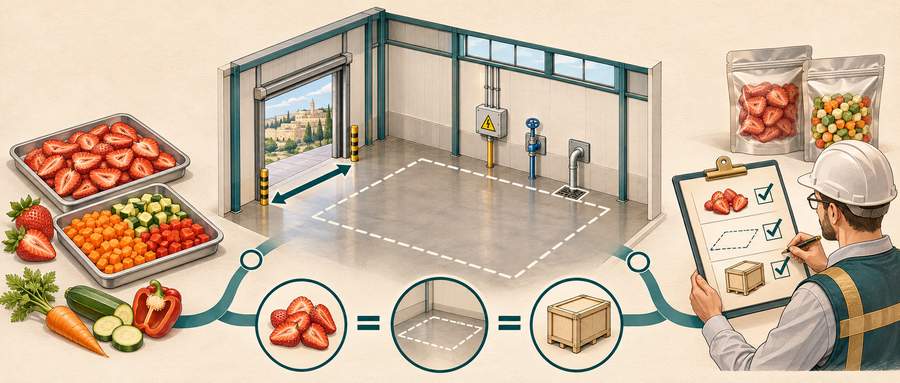
1. Decide whether the food project is ready for ownership
Start with the product the factory intends to sell. Record its formulation, prepared shape, quality specification, expected orders and raw-material supply. Then estimate how often the line could run, including seasonal gaps and product changes. A machine quotation becomes useful when those assumptions are visible.
If the product or sales route is still uncertain, use development trials or an outsourced batch to answer that uncertainty first. Ask for the preparation method, loading, finished yield and quality results—not just an attractive sample. The trial should help define what a production supplier will later be asked to deliver.
In batch freeze drying, food is frozen and ice is removed under vacuum while controlled heat supplies the energy for sublimation. A small successful trial does not establish industrial output or a finished product’s shelf life. Keep the food and process conditions with the result. [5]
For an established processor adding capacity, compare ownership and outsourcing against the same accepted finished product and schedule. Include the installed machine, site work, labor, utilities, packaging, maintenance, financing and downtime. Test a lower-sales or longer-cycle scenario as well as the expected one. There is no single utilization percentage or payback period that makes every food project ready to buy.
Once the investment has a credible product and operating basis, the next task is to turn it into one brief that every equipment supplier can price.
2. Send one food and site brief to every supplier
Give each bidder the same version of the food and factory information. Separate what the site can supply from what the proposed machine requires. This prevents an offer based on ideal cooling conditions or a different food load from appearing equivalent to one designed for the actual plant.
| Information from the buyer | Evidence to request in the offer | Boundary to keep clear |
|---|---|---|
| Food, formulation, preparation, piece size or liquid depth, initial moisture or solids, and prepared wet load. | Offered configuration and trial basis for that product and loading. | Wet input, water removed and accepted finished output are different quantities. |
| Finished-product specification, required output and available shifts. | A complete batch schedule: freezing where included, loading, drying, unloading, defrosting and cleaning. | A drying-stage time alone does not establish daily production. |
| Measured supply voltage, phase, frequency, available electrical capacity and connection constraints. | Machine-specific connected load, operating demand, protection and connection requirements for local engineering review. | A country voltage summary is not an electrical design for this site. |
| Cooling-water conditions or air-cooled heat-rejection location, actual ambient design conditions, drainage and other available services. | Required flow, temperatures, pressure, quality and heat-rejection duty for the supplied arrangement. | Confirm which surrounding systems and connections are included. |
| Unloading route, door clearances, floor capacity, rigging limits, operating and maintenance space. | Approved dimensions, weights, access envelope and installation drawing. | A footprint is not the full space needed to install and maintain the line. |
| Pre-freezing, hygienic product flow, cleaning/changeover and packaging plan. | Written interfaces and responsibility for each upstream and downstream step. | The dryer quotation does not automatically include a freezer, dry room, packaging line or food-process approval. |
The food-production design guide explains the material, loading and turnaround calculations behind this brief. Use those calculations to question a capacity claim; ask the supplier to confirm the assumptions in writing before choosing a model.
3. Compare the delivered scope and local responsibilities
Compare what reaches the prepared operating site, not only the machine price. A local seller may exclude site work; an overseas supplier may include commissioning. The supplier’s location does not settle either question. Ask both parties to fill in the same scope list and name who pays for and performs each item.
| Scope to confirm | What the written offer should identify |
|---|---|
| Delivery and movement | Named delivery place; the Incoterm and edition where used; packing, freight, insurance, port handling, inland transport, unloading and rigging. |
| Import and local checks | The importer and customs broker; who supplies classification and conformity documents, verifies current requirements, pays the assessed charges and resolves missing information. |
| Installation and interfaces | Buyer’s site work and utilities; supplier’s assembly or supervision; local mechanical, electrical and refrigeration work; connection points and commissioning prerequisites. |
| Acceptance and handover | Factory and site tests, representative food, instruments, records, training, travel and accommodation, deviations, retests and acceptance milestones. |
| Operating support | Warranty scope, software and backups, spare parts, remote support, on-site work, exclusions and charges. |
Use the current Israeli verification paths before ordering
The Ministry of Economy and Industry explains that import requirements are linked to specific Customs Tariff Headings. It directs importers who lack precise classification information to a customs broker or Customs House. Its guidance distinguishes declaration and approval routes for goods subject to mandatory standards. It does not establish one route for every freeze dryer. [2]
The official mandatory-standards search provides information including editions, mandatory clauses, regulatory changes and import-group classification. Have the responsible professional check the exact supplied machine and relevant components, and retain the dated result and required documents with the order. This article assigns no HS code, tax rate, exemption or machine-specific standard. [3]
Name a local project lead to coordinate the broker, qualified electrical and other installation specialists, and the factory’s food or quality lead. Give them the actual equipment specification early enough to identify missing documents and site changes before dispatch. A general CE statement or a supplier’s “food grade” description does not answer all of those separate project questions.
Keep the food business’s permissions separate from machinery import checks. The Ministry of Health provides a service to apply for or renew a food manufacturing license. The factory’s responsible adviser should confirm the requirements for its product, process and site; the public service entry is not a completed application or an approval of this project. [4]
4. Agree food acceptance before shipment and at the site
Define the result that will count as acceptance before the supplier runs the demonstration. Identify the food and lot, formulation, preparation, geometry, wet load, freezing condition and loading pattern. Agree the finished-product specification, sampling positions, test methods and pass/fail rules. Without these details, two apparently successful demonstrations may be testing different duties.
At factory acceptance testing (FAT), check the ordered configuration, agreed functions, records and product performance before shipment. State which tests will be deferred. At site acceptance testing (SAT), check installation and repeat the agreed tests with the actual Israeli site services and connected equipment. Record a site limitation separately from a machine defect; both may require action before the line can meet its production commitment.
Require the record to show accepted finished output, rejected material, the agreed complete-cycle duration and measured utilities within a clearly stated boundary. Keep the original temperature and pressure trends, instrument identities, test results and signed deviations. Metered consumption should say which equipment and stages were included; otherwise an apparently low energy figure cannot be compared fairly.
- Product result: use the agreed moisture, center-dryness, mass-stability, texture, rehydration, consistency and packaging checks. Add water activity or other tests where the product specification, risk assessment, customer or laboratory plan requires them. They are not presented as routine measurements performed by the company in every project.
- Equipment result: retain configuration, functional and safety checks with the defined load, utility and instrument conditions. Empty-chamber checks alone do not establish accepted food throughput.
- Open items: retain failed results, corrections and retests. Name who can close each deviation, and how unresolved items affect shipment, payment or acceptance under the agreement.
The detailed food freeze dryer FAT/SAT guide provides the test-planning framework. Set numerical limits for the actual machine and food; do not borrow a generic moisture target, vacuum figure or fixed number of successful batches. Equipment acceptance also leaves product safety and shelf-life verification as separate responsibilities in the factory’s food-control plan.
5. Name the people and support route before handover
Make the handover package part of the order while the scope can still be negotiated. Name the factory contact, supplier project lead, installer and relevant local specialists. Record who performs each task, what evidence they hand over and who accepts it. Remote advice and on-site work are different services.
- People: training for the assigned operators and maintenance, cleaning and quality staff, using language they understand and the supplied machine’s procedures.
- Documents and recovery: current manuals, as-built drawings, approved settings or recipes, acceptance records, calibration information, parts identification, software versions, backups and open-item list.
- Parts: agreed critical items, part numbers, compatible alternatives where approved, actual stock location, lead time, replenishment and the route for getting them to the Israeli site.
- Service: separate targets for acknowledgement, remote diagnosis, parts dispatch and arrival, and on-site attendance. State working hours, escalation, travel, labor charges and warranty exclusions.
- Remote access: factory-approved access with named users, appropriate time limits, logging, backups and change control. Follow the factory’s security policy; do not bypass its firewall to obtain support.
Ask the supplier to demonstrate the agreed backup and recovery process and to explain which work requires a qualified specialist. The service and maintenance guide covers ongoing care; use the actual machine’s instructions for intervals and procedures. A statement such as “local support” should be backed by named people and written commitments, not an assumed warehouse or response time.
The purchasing team is ready to compare final offers when the product duty, site requirements, delivered scope, local checks, acceptance evidence and support route tell the same story.
Bring the food and factory brief to an equipment discussion
For an industrial food-production project, send the food and preparation, planned wet load and finished target, Israeli site location and available services, desired startup date, and the supply or acceptance items still unresolved. These inputs help identify missing assumptions before comparing machine offers.
The discussion concerns equipment and project scope. It does not promise local representation, customs or legal approval, turnkey site works, a particular service response, or guaranteed product and investment results.
Sources and scope
- Technion, Carasso FoodTech Innovation Center — High Performance Freeze Dryer (Lab1ST). Public pilot-facility listing; confirm access and trial suitability directly.
- Ministry of Economy and Industry — Import of Goods Subject to Mandatory Standards. Classification-linked import requirements and declaration/approval paths; not a classification or approval for this project.
- Ministry of Economy and Industry — Official Mandatory Standards Search Engine. Current search-service explanation; verify the applicable standard, edition and scope for the actual supply.
- Ministry of Health — Application for a New Food Manufacturing License or Renewal. Official service entry; separate from machinery conformity and the complete site/product application.
- Egas-Astudillo LA, Silva A, Uscanga M, Martínez-Navarrete N, Camacho MM. Impact of shelf temperature on freeze-drying process and porosity development. IDS 2018: 21st International Drying Symposium Proceedings, 2018, pp. 843–850. DOI: 10.4995/IDS2018.2018.7481. Small grapefruit-purée experiments; no industrial scale, Israeli site or company performance guarantee follows.
Sources checked November 10, 2026. The checklists are a project-planning framework. Applicable requirements, machine scope and acceptance limits must be confirmed for the actual product, site and agreement.
About the Author: Zheng Wei
Founder & Freeze-Drying System Engineer
Fuzhou Xing Shun Da Refrigeration Facility Project Co., Ltd.
Zheng Wei participates in food freeze-drying trials, equipment selection, vacuum-system configuration, refrigeration planning, installation guidance, process optimization, and project handover. The project experience covers fruit, vegetables, cooked foods, seafood, meat, dairy products, herbs, and extracts.