
Food equipment procurement · independent recording
Freeze Dryer Data Logger: Specify, Compare and Test the Record
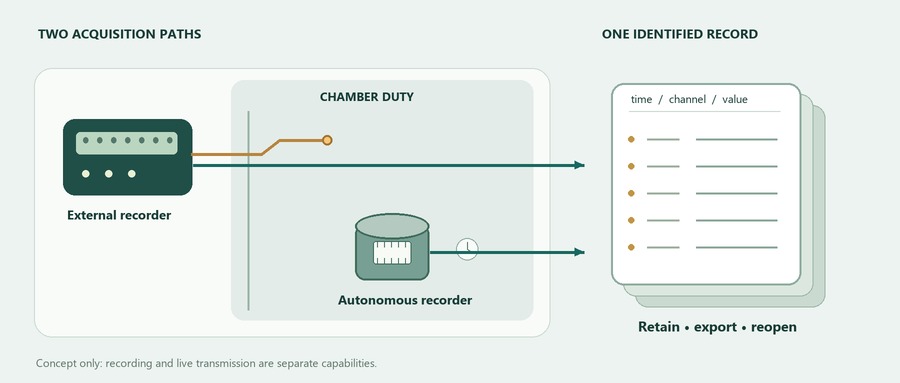
A freeze dryer data logger purchase should begin with an identified gap: a measurement the dryer does not capture, or a record the project cannot reliably retrieve. Clarify that specific recording need before evaluating hardware.
This guide traces the recording chain from initial setup through final handover. It shows food project teams how to define operating duty, verify usable memory capacity, compare complete supplier offers, and test what a vendor must demonstrate before acceptance.
Does the project need an independent record?
Review an actual exported batch file against your project measurement and export requirements before contacting suppliers. Identify which readings are missing, who requires them, and which equipment or purchase decision the additional record will support. If the dryer’s existing control record already meets the user requirements, purchasing another instrument may add unnecessary cost without solving a real problem.
Clarify what “independent” means for your installation. Determine which parts of the sensing, power, storage, or retrieval chain must operate outside the dryer control system, and verify that this separation directly resolves the missing measurement or record gap.
- Measurement: a separate sensing and input chain, or another view of the dryer’s existing signal?
- Power: a separate supply or battery, or dependence on the same interrupted supply?
- Storage: a locally retained record, or a display that depends on another computer?
- Retrieval: an identified native file and usable export, or only a photograph, screen trend or alert?
A remote camera can show a screen; that image alone does not establish an independently measured time series. Conversely, an HMI or USB export is not automatically inadequate. Check the actual channels, timestamps, stored interval and file behavior. The existing freeze dryer monitoring guide covers which process data to review and how to organize the wider batch record.
Choose where the logger body will operate
Present the same operating duty description to competing suppliers. Request written confirmation covering the offered logger body, all inputs, and system interfaces, rather than relying on shorthand marketing labels like “low temperature” or “wireless”.
Use the comparison below to evaluate external versus in-chamber placement. Require the selected freeze dryer supplier to approve the machine interface, chamber penetration, feedthrough, or port connection; this guide does not recommend or provide retrofit wiring designs.
| Purchase question | External acquisition | Autonomous in-chamber logger |
|---|---|---|
| Where is the body? | Outside the chamber; specify the ambient environment and external power arrangement. | Inside the chamber; obtain approval for the whole body, battery, seals and actual chamber duty. |
| What reaches the measurement point? | Compatible sensors and leads through an approved interface or feedthrough. Check the complete input chain. | The selected sensing element or probe. Its measuring range and location are separate from the body’s operating limits. |
| Which exposure matters? | Separate outside-body conditions from chamber-side sensor, cable and feedthrough conditions. | Specify the actual temperature and absolute-pressure range, duration, and any cleaning, defrost or wash exposure. |
| How is the record retained? | Confirm logger memory, computer/server dependence, stored interval and behavior when communications or external power stop. | Confirm usable local memory, cold-duty battery allowance, stop/overwrite behavior and the approved download method. |
| Is live viewing required? | Demonstrate the offered connection and software. A cable alone is not proof of uninterrupted recording. | Specify whether data are retrieved after the run or transmitted live. Demonstrate any live link in the actual approved arrangement. |
A range is meaningful only with its label
Ellab’s LyoPro page lists a measuring range of −62 to +62 °C and an operating temperature range of −62 to +140 °C. Those are different specification fields; the hotter operating limit must not be used as the measurement limit. The page concerns a pharmaceutical/biotech validation product, so the values are a model-specific illustration, not a universal food-project specification. [2]
Will memory cover the entire study?
Ask each supplier to show how quoted memory capacity is calculated for the proposed setup. Battery endurance indicates operating power over time, but it is not retained recording duration; usable memory must hold all data points until retrieval.
Base duration estimates on the actual stored interval rather than the internal sensor scan rate. Confirm how the manufacturer allocates quoted capacity across individual channels, timestamps, event entries, and other stored information, then verify that total capacity covers the agreed study duration with planned contingency.
Campbell Scientific distinguishes sensor scanning from stored records and describes both fill-and-stop and ring-memory behavior. A scan can be processed into a less frequent stored value; a ring buffer can overwrite earlier records. Neither behavior should be inferred from a memory-size label. [1]
For planning, include a reading at the start and the first scheduled reading at or after the required end. If the interval does not land exactly on the end time, agree whether recording continues to that next reading. Confirm the offered logger’s counting convention and usable capacity.
Worked example — a hypothetical study
A 48-hour window stored every 30 seconds contains 5,761 timestamps when both endpoints are included. With eight channels, that is 46,088 individual channel values if the memory is a shared pool counted that way. A specification expressed as complete multi-channel scans could allocate memory differently. Timestamp/event overhead and the required margin must also be confirmed.
This is capacity arithmetic, not a recommended interval for every freeze-drying process and not a measured company trial.
A legacy-sheet example shows the distinction. The Kaye X2534 surface-logger page lists 10,000 stored samples separately from battery figures of 1,600 hours at a one-second interval at 20 °C and 180 hours at the same interval at −85 °C. A pool of 10,000 individual readings at one reading per second represents only about 2.8 hours of recording; the exact first/last-point convention changes the endpoint slightly. A battery endurance claim is therefore not a retained-duration claim. [3]
Availability limit: the linked Kaye advisory says sales of the old ValProbe product line ceased after December 31, 2025. Its specifications are used here as a historical example, not a current product recommendation. Do not transfer them to a ValProbe RT offer or assume an upgrade is available for a particular unit. [4]
Compare the complete measurement and software offer
Send the same duty requirements to every candidate supplier and ask for itemized confirmation. Clarify what is needed for the offered arrangement to open, view, and use the record, requesting only the software licenses, download cradles, or accessories required for that configuration.
A thorough proposal lists exclusions clearly. Confirm what the supplier includes and what the buyer must supply, configure, license, or maintain over the equipment service life.
| Offer item | Evidence to request | What the buyer can compare |
|---|---|---|
| Configured measurement chain | Body, sensor/input, channel and firmware identities; written duty approval. | The exact configuration against the same measurement location and exposure. |
| Calibration and accuracy | Calibration scope, identified channels, points/range, results, traceability and stated conditions. | Whether the evidence covers the intended measurement chain and use; display resolution alone is not accuracy. |
| Timebase | Clock specification, synchronization method, time zone and observed alignment over the intended window. | Whether records can be related to the agreed reference and event times. |
| Retained and exported files | Native/raw record plus a sample export from the offered software version; channel IDs, units, timestamps and missing values. | Whether the buyer can retrieve, reopen and analyze the required record. |
| Software and complete cost | Readers/cradles, cables, licenses, seats, export functions, recurring charges, training and version support. | A complete delivered scope, including access to existing files after a license or network change. |
| Supply and service | Current model/version availability, replacement parts, battery/seal service, calibration route and support limits. | What is included now and which future services remain conditional. |
The legacy Kaye sheet, for example, gives clock accuracy separately from temperature accuracy. That illustrates why the timebase deserves its own question; its published drift is not the acceptance tolerance for another project. The product-line advisory also makes some continuing service dependent on parts availability. [3] [4]
A vendor’s compliance statement is not, by itself, proof that the complete proposed configuration meets the project’s requirements. This guide does not decide which electronic-record or food regulations apply to a particular plant.
Witness a complete, identified record before acceptance
Agree on demonstration steps and required file deliverables before conducting an acceptance check. Check that handed-over files clearly identify each channel, show measured values with their corresponding timestamps, and document missing data and actual recovery steps after an interruption.
Evaluate the record against the core purpose of your test. A live software display is not enough if retained files do not preserve measured values and times or fail to demonstrate how the system behaves during unexpected disconnects.
Set the test boundary first. Use a supplier-approved bench test or another agreed nonproduction demonstration. Do not cut power to an operating dryer, safety controller or food batch to test a logger. Any interruption test needs an approved method and a responsible person.
| Demonstration | Observe and retain | Acceptance question |
|---|---|---|
| Normal recording | Configuration, channel map, units, time reference, stored interval and required start/end. | Can the buyer identify each value and account for the agreed recording window? |
| Communications interruption | Approved interruption/reconnection times, local files, server/export record and actual recovery steps. | What continued recording locally, what reached the destination later, and are gaps or duplicates explicit? |
| Power interruption | Approved test conditions, last retained value, restart identity, existing-file readability and any unpowered interval. | What survived, what restarted and what was not measured? Do not substitute interpolated values for a missing measured record. |
| Export and reopening | Native/raw file, analysis export, software version and a witnessed reopen from the retained copy. | Can the buyer recover the same identified channels, timestamps, units and missing-value information? |
Network loss and power loss are different cases. Do not promise continuous measurement while the actual sensor or logger has no power, or assume automatic backfill and restart without observing the offered arrangement. Campbell’s storage and communications discussion is a useful starting point for these questions. Its general storage explanation and legacy FAQ contain differing battery-dependence language, so the specific model’s documents and demonstration must settle the claim. [1]
The FDA’s Computerized Systems in the Food Processing Industry inspection guide discusses configured-system review, abnormal conditions and shutdown/restart behavior. It is a historical inspection reference with dated regulatory and technology references, not a current legal requirement or a prescribed power-cut test for this purchase. [5]
Logger acceptance establishes the agreed recording capability. It does not by itself validate the drying process, determine food safety or authorize batch release. Those wider decisions belong to the plant’s process and quality system; the food freeze dryer validation guide addresses whole-machine acceptance planning.
Keep the record usable after handover
Assign clear responsibility for setup, configuration, and data retrieval. Establish repeatable preparation routines so staff can configure runs, verify channel tags, and reopen archived files when needed.
Follow maker instructions alongside agreed plant requirements. Define routine handling steps on a plant checklist without setting universal calibration intervals, battery thresholds, or record retention periods across all instruments.
- Preserve the setup. Keep the logger/model, channel identities, software/firmware versions, clock reference, stored interval and study identification with the record.
- Check readiness. Confirm usable memory and the battery allowance for the actual duty before the planned study; follow the maker’s approved battery, seal, cleaning and download instructions.
- Manage measurement checks. Keep calibration and verification evidence tied to the relevant channels and use conditions. Set frequency and acceptance limits through the actual equipment guidance and the plant’s requirements.
- Retrieve and reopen. Retain the native/raw file and the required analysis export. Check identity, units, times, gaps and readability, then test reopening from the backup location.
- Track changes. Record service and software/configuration changes so a later reviewer can identify which setup produced the file.
The Kaye sheet distinguishes factory calibration from user-verification capability; the specific procedures cannot simply be transferred to another model. Its obsolescence notice also shows why service and software access belong in the handover discussion. [3] [4]
Turn the record requirement into an equipment discussion
When planning a commercial food freeze-dryer project, prepare details on your dryer model, required channels, study duration, target logging interval, and an example of the export format the team actually needs. Sharing these parameters makes the compatibility discussion specific.
The discussion can identify machine/interface questions to confirm with the relevant suppliers. It does not promise a particular independent logger, accredited calibration, regulatory certification or a validated process result.
Sources and limits
- Campbell Scientific — Data Loggers. General acquisition, scanning/recording, storage and retrieval guide. Not evidence that its general-purpose devices are approved for a freeze-drying chamber.
- Ellab — TrackSense LyoPro. Published product specifications in a pharmaceutical/biotech validation context; verify the actual offered configuration and intended use.
- Kaye — ValProbe Freeze Dryer Logger. Legacy X2534 shelf-surface specification, used as a bounded historical example.
- Kaye — ValProbe Product Line Product Advisory Notice. One-page notice dated November 30, 2025; sales cessation and conditional service/upgrade information.
- FDA — Computerized Systems in the Food Processing Industry. Historical inspection guide. Current legal applicability and retention requirements are not established by this article.
Sources checked November 9, 2026. The capacity calculation is an explicit hypothetical example. No instrument test results or customer outcomes are claimed.
About the Author: Zheng Wei
Founder & Freeze-Drying System Engineer
Fuzhou Xing Shun Da Refrigeration Facility Project Co., Ltd.
Zheng Wei participates in food freeze-drying trials, equipment selection, vacuum-system configuration, refrigeration planning, installation guidance, process optimization, and project handover. The project experience covers fruit, vegetables, cooked foods, seafood, meat, dairy products, herbs, and extracts.