
Laboratory component selection
Freeze Dryer Flask: Match the Vessel, Top and Adapter
A freeze dryer flask is bought as part of a working connection. The glass vessel, closure and adapter must suit both the sample and the equipment port. A familiar brand reference or a large volume printed on the listing does not settle those questions.
Start with the intended sample arrangement, then identify every part between the sample and the manifold. The following checks turn a product listing into a specification that a supplier can confirm and a laboratory can receive.
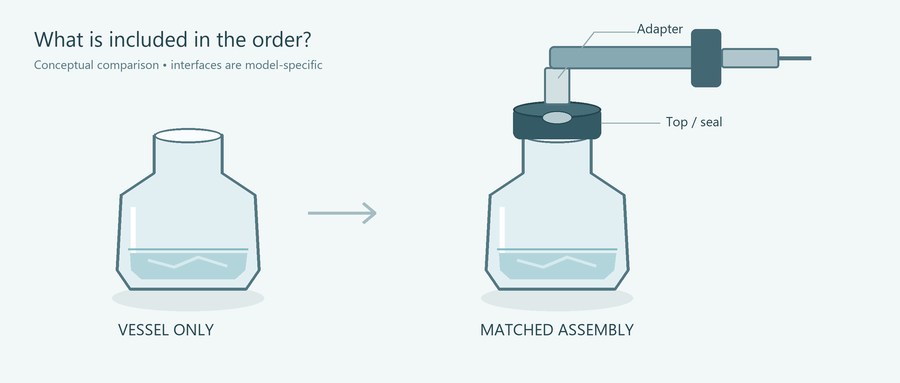
What will the flask hold?
The first choice is how the sample will sit inside the vessel. It may be placed directly in a compatible flask, or held in smaller containers using a specified holder. Those arrangements need different accessories and instructions. Write down the sample format before choosing a capacity.
A flask used on a manifold connects through a closure and adapter to a vacuum port. It is not the whole freeze-drying system. Labconco’s accessories guidance describes several sample arrangements, including direct flask loading and smaller containers with holders. The equipment and accessory instructions must support the chosen arrangement. [3]
Separate nominal size from the permitted load
Use the proposed sample quantity to ask for a model-specific loading limit. Leave the supplier to confirm the vessel and preparation method for that application. Do not convert the largest advertised flask volume into a permitted batch size.
For example, SP Wilmad lists a 1200 mL maximum volume and a 600 mL working volume for its particular flask. The Labconco Fast-Freeze catalog instead instructs users to fill that flask family no more than one-third full. These are different product-specific statements, not interchangeable rules for every lyophilization flask. [1] [2]
A useful enquiry therefore names the material, desired dried form, proposed load, direct-fill or inner-container arrangement, and the freeze dryer model. Add the relevant sample-preparation instructions and any solvent or cleaning constraints. If these are unknown, resolve them before asking for a larger flask.
Which parts have to match?
Trace the connection from the glass opening to the equipment port. For each joint, request the matching part number or interface specification. A capacity match alone leaves the closure and connection unresolved.
| Part or interface | Information to obtain | Decision it resolves |
|---|---|---|
| Vessel | Manufacturer, model, material, nominal capacity, permitted working load and intended vacuum use | Whether this is the correct vessel for the proposed sample arrangement |
| Neck and closure | Neck or flange specification; matched top, stopper, seal or O-ring part numbers | Whether the closure belongs to this vessel rather than merely looking similar |
| Filter and holder, if specified | Required type, location, replacement reference and inclusion in the order | Whether the chosen sample arrangement is complete |
| Adapter | Both ends of the interface, matched part number, required clearance and stated application | Whether it joins this top to this equipment connection |
| Equipment port | Freeze dryer model, port or valve details and supported accessory configuration | Whether the proposed assembly is supported on the actual machine |
Labconco’s catalog says its complete Fast-Freeze flasks include a glass bottom, rubber top and filter supply, but require a separately purchased adapter. “Complete flask” therefore does not automatically mean “everything needed to connect to the port.” [2]
Send photographs of the existing port and legible part labels when replacing an assembly. Ask the supplier to mark both mating interfaces on the quote. Photographs help identify parts; they do not replace a written compatibility statement.
For equipment configuration and the wider trial arrangement, use the separate manifold freeze dryer guide. This page covers the flask assembly; it does not size the condenser, pump or complete system.
What does each offer include?
Compare the cost of the usable assembly after checking compatibility. One quote may include only the glass bottom, while another includes a top and consumables. Put the contents on separate lines so that a lower price does not conceal missing parts.
Chemglass labels its cited product “flasks only” and excludes the rubber top, filter and O-ring. It also states that the referenced Labconco and Virtis companies have not approved or validated those products for their equipment. A cross-reference can identify the intended comparison without establishing OEM approval. This disclosure applies to that listing; it is not a verdict on all third-party glassware. SP Wilmad likewise identifies its cited offer as a flask-only item and points buyers to a separate complete set. [1] [4]
| Compare on the same basis | Record for each quotation |
|---|---|
| Delivered contents | Vessel, top, seals, adapter, specified filter or holder; quantities and exclusions |
| Compatibility evidence | Exact vessel and equipment references; who confirms the interfaces; any OEM approval or validation limitation |
| Application limits | Permitted load, sample/material compatibility and the applicable preparation and care instructions |
| Replacement support | Individual replacement part references, availability, lead time and handling of a mismatched or damaged delivery |
| Acceptance basis | Agreed incoming inspection and first-use procedure, responsibilities and required records |
An OEM name and a third-party compatibility claim answer different questions. Ask what evidence supports the exact proposed combination, and who will resolve a mismatch. Where substitution is proposed, ask the original equipment manufacturer about that exact arrangement as well. Keep unanswered items open in the comparison instead of awarding a pass from the listing title.
What happens before the first sample?
Agree the checks while the order is being placed. On arrival, match the delivered part labels and contents to the confirmed specification. Keep a record of missing items or visible damage before putting the assembly into service.
DWK’s general laboratory-glassware guidance calls for inspection and rejection of scratched, chipped, cracked or etched glass. It also calls for suitable protection when glassware is used under vacuum, careful support and gradual pressure changes. These principles do not supply an acceptance procedure or operating limit for an unspecified flask assembly. [5]
- Confirm that every delivered component matches the written assembly list and its instructions.
- Inspect the glass and mating components using the supplier’s procedure. Set aside questionable parts and ask the supplier how to resolve them.
- Have the responsible laboratory staff confirm the specified support, protection and assembly method before use.
- Perform the equipment and accessory manufacturer’s agreed first-use checks, then retain the observations with the part references.
The check record should identify the equipment, assembly, procedure revision, operator, date and result. This makes a later replacement or fault investigation more useful than a note saying only “fits.”
Do not invent a universal vacuum target, hold time, thermal-shock test or pressure test for incoming glassware. Obtain the applicable procedure and acceptance criteria from the equipment/accessory manufacturer and the laboratory’s responsible personnel before use. This guide supplies a purchasing record, not a validated test method.
What will repeated use require?
Keep care instructions for the whole assembly rather than just the glass. When ordering, ask which instructions cover each material and which parts are intended to be replaced. An incomplete maintenance record can make a later spare-part order as uncertain as the first purchase.
| Record item | Question for the supplier or laboratory |
|---|---|
| Cleaning, drying and any required sterilization | Which methods and agents are permitted for the glass, top, seal, coating and specified filter? |
| Inspection and retirement | What damage or deterioration requires removal from service, and who makes that decision? |
| Storage and handling | How should the vessel and closure be protected and supported between uses? |
| Consumables and spares | Which parts are replaced, under which conditions, and by which exact references? |
| Traceability | Where are the part identity, instruction revision, sample exposure, inspection findings and replacements recorded? |
The Fast-Freeze catalog describes removable tops and bottoms and separately specified holders; their inclusion and handling requirements depend on the selected configuration. A temperature statement about glass does not establish the limit of an assembled rubber top, seal, coating or filter. Do not infer that every component may be autoclaved, lubricated or cleaned by the same method. Use the instructions for the actual parts; no universal replacement cycle is established here. [2] [5]
The final purchasing record should leave another trained colleague able to identify the vessel, obtain the matching closure and adapter, and find the approved handling instructions. That is a more durable outcome than choosing by nominal volume alone.
Taking a food sample toward a tray trial?
A flask result does not establish tray loading or production performance. For a discussion of a food freeze-drying trial, share the formulation, the actual flask trial record, the intended tray depth and load, and the questions still unanswered. The discussion should define what a separate tray trial needs to establish.
Frequently asked questions
Can ordinary laboratory glassware replace a freeze dryer flask?
Do not assume that it can. Ask for a manufacturer-supported vessel, adapter and equipment configuration rated for the intended use. Some manufacturers specify particular adapters and alternative vessels; that does not make arbitrary glassware suitable. [2]
Does a compatible part number mean OEM approval?
No. Check the supplier’s exact statement about the proposed combination. The cited Chemglass listing explicitly separates its cross-references from OEM approval or validation. [4]
What should an enquiry include?
The equipment and port references, proposed vessel and sample arrangement, intended load, complete parts list, relevant material constraints and the compatibility or procedure questions the supplier still needs to answer.
Sources and scope
The examples below are product-specific or general glassware guidance. They establish the stated examples, not interchangeable ratings for other assemblies. All three pages of the adopted catalog were reviewed. No claim of supplying these named accessories is made.
- SP Wilmad: Freeze Drying Flask, 1200 mL.
- Labconco: Fast-Freeze Flasks and Accessories, three-page catalog hosted by Thermo Fisher Scientific.
- Labconco: Optimizing the Freeze Dry Process—What Accessories Are Right for My Application?
- Chemglass: Flasks Only, Freeze Dry.
- DWK Life Sciences: Care and Maintenance of Laboratory Glassware.
About the Author: Zheng Wei
Founder & Freeze-Drying System Engineer
Fuzhou Xing Shun Da Refrigeration Facility Project Co., Ltd.
Zheng Wei participates in food freeze-drying trials, equipment selection, vacuum-system configuration, refrigeration planning, installation guidance, process optimization, and project handover. The project experience covers fruit, vegetables, cooked foods, seafood, meat, dairy products, herbs, and extracts.