
Laboratory equipment · Food ingredient R&D
Manifold Freeze Dryer: Flask Testing and Food Scale-Up Limits
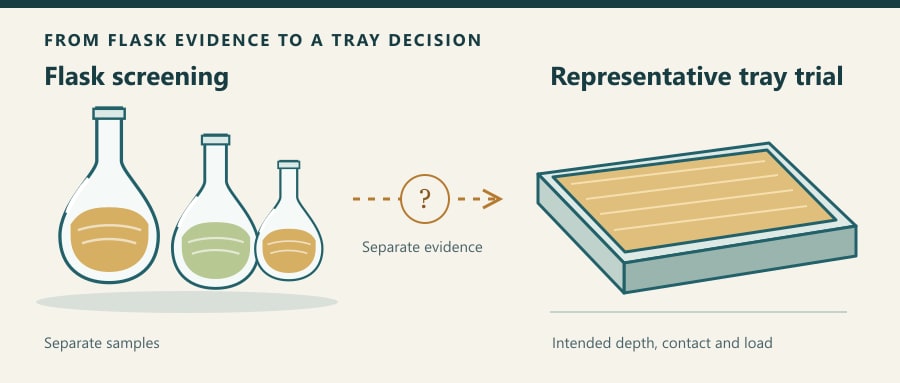
Start with the decision your experiment must support. Comparing small aqueous food-ingredient samples is one task; proving a repeatable tray process is another. Choose the sample format and required controls before comparing port counts or catalogue capacity.
A manifold freeze dryer connects separate sample vessels to a shared vacuum and ice-collection system. A basic external flask arrangement can serve exploratory aqueous food-ingredient work. It does not, by itself, establish a production tray cycle, output or uniformity. Confirm the actual heat-control arrangement and require evidence for the intended load. [1, 2]
What must your flask experiment decide?
Write down what you need to learn before choosing the dryer. If the task is to compare separate aqueous ingredient formulations or prepare small samples for analysis, ask whether the offered vessels, connections and records support that task. If the task is to predict a food tray cycle, plan a representative tray trial as a separate step.
Check where the heat comes from
In the basic manifold configuration described by Millrock Technology, the surroundings supply heat to the external flask. Room conditions and the way the container is presented therefore matter. A controller on the base unit does not automatically mean that heat input to each flask is controlled. [1]
Some laboratory systems also accept drying chambers and heated or unheated shelf accessories. Labconco distinguishes configurations with built-in freezing from those requiring external pre-freezing. Confirm the exact model and options; the word “manifold” does not settle these questions. [2]
Ask the supplier to identify the heat source, what it controls and where the sample is frozen. Then decide whether that arrangement can answer your experimental question. Documented shelf control may help when developing a tray process, but its presence still needs loaded verification and does not guarantee uniform product results.
For equipment categories, see the freeze-dryer types guide. Once the role is clear, describe the same intended load to every supplier so their offers can be compared.
What exactly should each supplier quote?
Send one load description with every request for quotation. Name the aqueous ingredient and show how it will sit in the flask. A vessel’s nominal volume tells the supplier which container you mean; it does not establish an acceptable fill or combined working load.
Keep three capacity questions separate: how much ice the collector can hold before defrost, how much water it can collect over a stated day, and the vapor load it can handle at one time. Ask for the rating conditions as well as the numbers. Otherwise, two offers using the same word “capacity” may describe different things.
The load description to send with the RFQ
- Sample and presentation: identify the ingredient, aqueous composition, solids content, flask dimensions, connection type, intended fill and frozen-product arrangement. Ask the supplier to confirm the supported load rather than treating nominal flask volume as allowable fill.
- Usable connections: list the flasks to be connected together, their spacing, adapters and valves. Confirm simultaneous compatibility and which items are included.
- Total ice holding: request the usable ice inventory before defrost, its units and the rating conditions. Relate it to the water expected from the whole proposed load.
- Collection and load rates: request the 24-hour water-collection rating and the instantaneous vapor-load limit separately, with their test conditions. A daily average does not establish the system’s response to the highest combined load.
- Vacuum evidence: identify the quoted pump, gauge type and measurement location. Separate an empty-system minimum from pressure control and measured behavior during the agreed loaded test.
Labconco explicitly distinguishes instantaneous load capacity, total ice holding and the 24-hour collection rating. These are three different procurement fields. A single “capacity” number should not stand in for all three. [3]
Have the supplier confirm the proposed duty against that description. Do not fill missing information with a universal pressure, fill fraction or collector temperature. Those choices depend on the sample and equipment. Once the load is defined, check which parts of the proposed system are actually included.
Does the quoted configuration include what you need?
Compare the exact model, document revision and accessory list. For each required feature, mark the offer as supplied, optional, excluded or awaiting confirmation. Ask the supplier to close the unanswered items in writing before you treat two prices as comparable.
First check whether the flasks fit together with the required adapters and spacing. Next check heat control and pre-freezing. Then check whether the measurements and saved files will let you judge the experiment. Passing one check does not answer the others.
| Advertised item | What the buyer should establish | Document to request |
|---|---|---|
| Ports and flask sizes | Compatible vessels, spacing, adapters and simultaneous intended load; included versus optional items. | Configuration drawing and itemized accessory list. |
| Litres or tray area | Whether litres refer to a vessel, collector or stated liquid load; whether area belongs to a separate tray accessory. | Exact-model datasheet with rating definitions and conditions. |
| Heating and pre-freezing | Where heat enters the product; which shelves are actively controlled; whether freezing is internal, external or an accessory function. | System description, option list and operating manual. [2] |
| Minimum pressure | Empty versus loaded measurement, gauge location and control scope for the quoted pump/system combination. | Vacuum specification and relevant test record. |
| Display and recording | Which variables are measured and actually saved, timestamps, export format and included sensors/software. | Controller specification and an example exported run file. |
Request an example exported run file, not just a controller screenshot. A displayed temperature may belong to the collector rather than the ingredient, and a USB socket does not tell you which variables are saved. Confirm the sensor locations, timestamps, export format and any software needed to read the record. Missing measurements should remain visible in the comparison.
What result would justify the next step?
Agree the trial’s purpose and acceptance criteria with the supplier before testing. A water-only check can answer a stated equipment question. To accept the behavior of your ingredient, use a representative ingredient trial and product-specific tests. A dry-looking flask alone does not establish residual moisture, ingredient function or repeatability.
Keep a trial record that another person can assess. It should show what was tested, what was measured, which samples passed or failed and which decision the results support.
- Describe the test: retain the formulation identity, actual load, vessel geometry, freezing route, occupied positions and exact equipment configuration. List departures from the proposed production task.
- Keep the original measurements: record the measured temperatures, pressure measurement location, collector conditions, timing and interruptions. State which variables were not measured or saved.
- Set product criteria: agree relevant methods and limits for residual moisture, dispersibility, appearance or ingredient function. Choose them for the product and intended use; appearance is not a substitute for a moisture result.
- Show the spread: identify the vessels and repeat runs tested, include unsuccessful samples and report the range of results. The best flask alone cannot describe variability.
- Limit the conclusion: name the formulation or equipment decision the trial supports, the conditions tested and the questions that remain open.
Why a tray trial remains a separate decision
A 2017 pure-water vial study found that contact arrangement and vial position affected effective heat transfer within its apparatus and tested conditions. It did not compare manifold food flasks with production trays. It provides no manifold-to-tray scale-up factor or guaranteed food cycle. [4]
Use the flask result to choose the next experiment it can reasonably inform. Before accepting tray cycle time, output or uniformity, request a trial in the intended tray arrangement, at the intended product depth and loading, with agreed sampling and product criteria. Changing the container, contact arrangement or load calls for evidence that matches that change.
The vial study explains why configuration deserves attention; requesting a representative tray trial is a procurement recommendation drawn from that limited evidence, not a method the study itself validated. The food freeze-dryer pilot guide can help frame the next equipment decision.
Who will make the delivered system ready to use?
Put a named responsibility beside each installation and support item in the order. “Installation included” leaves too much open unless the laboratory and supplier agree who provides the connections, checks the delivered configuration and hands over the records.
- Site and utilities: obtain dimensions, weight, access requirements, clearances, electrical specifications and environmental limits. Assign placement, connections and commissioning.
- Vessels and contact materials: confirm compatible glassware, adapters, seals and inspection requirements. Obtain the manufacturer’s cleaning and material-compatibility instructions for the actual aqueous ingredient.
- Pump and exhaust: identify the supplied or separately sourced pump, its compatibility basis, the exhaust arrangement and the maintenance owner. Have the laboratory and supplier check the site arrangement against the applicable equipment instructions.
- Service and records: name the legal seller and support contact. Agree warranty scope, replacement parts, training, the maintenance log and documents for the delivered configuration.
Use the instructions for the actual model and application. Manufacturer guidance treats maintenance as dependent on the application and equipment arrangement; a generic oil-change interval, cleaning method or valve sequence from another model is not a handover plan. [1, 3]
Bring the flask evidence to your food tray-pilot discussion
Prepare a short brief with the ingredient, wet load, intended dried format and planned tray depth. Attach the flask trial record and list the quality, cycle and loading questions it has not answered. These details help define what the next trial needs to demonstrate.
Share those inputs through the company’s contact page for a food shelf or tray-pilot discussion. Any proposed configuration or trial scope needs separate confirmation. This guide does not establish availability of a manifold model or a guaranteed scale-up service.
Common manifold freeze-dryer buying questions
Does a manifold freeze dryer always lack heated shelves?
No. A basic external flask arrangement receives heat from its surroundings, while some laboratory systems accept chamber or shelf accessories. Ask where the quoted configuration supplies and controls heat, and whether pre-freezing is included. [1, 2]
Can eight ports take eight flasks at their full nominal volume?
Do not assume that. Confirm vessel sizes, actual fills, spacing, adapters and the combined vapor load with the supplier. The number of physical connections does not establish the acceptable working load.
Does kg/24 h mean total ice capacity?
No. It describes collection over a stated period. Ask separately for total ice holding, instantaneous vapor-load capacity and the conditions behind each rating. [3]
What does a successful flask trial tell you about a production tray cycle?
It can support a stated formulation or sample-preparation decision under the tested conditions. Tray cycle, output, uniformity and product claims need representative evidence in the intended tray arrangement.
References and evidence boundaries
- Reiter C. Manifold Freeze Dryers – An Overview of Their Use, Limitations and Some Helpful Hints. Millrock Technology technical note, June 2016. Manufacturer guidance; basic configuration and operating-context discussion.
- Sprung J. Optimizing the Freeze Dry Process: What Accessories are Right for You? Labconco. Manufacturer guidance; accessory and freezing arrangements depend on the named equipment.
- Labconco. How to Properly Care for Your Freeze Dryer. Manufacturer guidance; distinguishes instantaneous load, ice holding and daily collection ratings.
- 朱明星, 杨伟兵. 食品真空冻干传热差异性研究[J]. 淮海工学院学报(自然科学版), 2017, 26(2):79–83. DOI: 10.3969/j.issn.1672-6685.2017.02.018. Pure-water vial experiments; no direct manifold-to-food-tray performance comparison.
The quotation, trial-record and handover questions are procurement recommendations derived from these bounded sources. They are not a supplier specification, company trial report, universal operating recipe or product-performance guarantee.
About the Author: Zheng Wei
Founder & Freeze-Drying System Engineer
Fuzhou Xing Shun Da Refrigeration Facility Project Co., Ltd.
Zheng Wei participates in food freeze-drying trials, equipment selection, vacuum-system configuration, refrigeration planning, installation guidance, process optimization, and project handover. The project experience covers fruit, vegetables, cooked foods, seafood, meat, dairy products, herbs, and extracts.