
Portugal · Food production · Purchasing brief
Freeze Dryer Portugal: A Food Project Buying Brief
Start with the food you plan to freeze-dry, check the Portuguese site where the machine will operate, look for trial evidence, and confirm what work each offer includes.
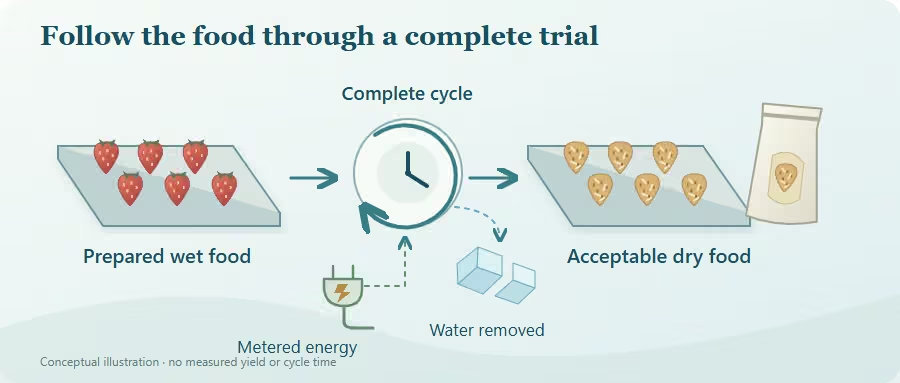
To choose a freeze dryer for a food project in Portugal, define the food-production task first and put the project requirements in writing. A catalogue model or advertised capacity only provides a starting point for an enquiry. What matters is whether the equipment can turn your specific raw food into an acceptable finished product, under agreed operating conditions, at a site prepared to run it.
Use the steps below to prepare a shared brief for every supplier. This sequence helps separate equipment selection, capacity figures, Portuguese establishment rules, on-site installation work, and acceptance checks. This guide addresses food processing and commercial pilot facilities; household rankings and sterile pharmaceutical production require separate assessment.
01 · Start with the food
Choose the duty before choosing the machine
State the food, how it will be prepared, and what quality you require in the finished product. Explain whether the machine is meant for recipe development, pilot batches, or routine production. Putting these details in writing gives suppliers a clear basis to evaluate before recommending a model.
Food freeze drying starts with frozen material. During primary drying, ice is removed as vapour under reduced pressure; further drying removes additional moisture. The food, its preparation and its freezing history therefore belong in the process specification. They cannot be replaced by a generic drying-time claim.[5]
| Intended use | What to establish | What it does not establish |
|---|---|---|
| Household food preservation | The exact model, usable loading, operating instructions, maintenance and items included in the purchase. | A successful household batch does not demonstrate a factory production schedule. |
| Food development or pilot work | A representative formulation, preparation and freezing method, tray loading, product quality and usable process records. | A laboratory sample rating or a spray-freeze method does not establish conventional tray-food production capacity. |
| Routine food production | Acceptable finished output, a complete batch schedule, representative food trials and the utilities required at the site. | Shelf area, wet food loading and condenser water capture are different measures. |
If the tray loading, complete finished-product specification, or turnaround time remains unverified, arrange a food trial before committing production capacity. Ask suppliers to distinguish verified trial results from engineering estimates, and keep remaining questions visible until a trial answers them.
For a detailed review of sizing methods, consult the food freeze-dryer selection guide. Where recipes or preparation methods are still being developed, conduct food pilot testing before deciding production capacity.
Separate food input, water removal and finished output
Ask what the quoted kg refers to before comparing two offers. Then request the following information on the same food and operating basis.
- Describe the food going in. State the prepared wet-feed mass, usable tray area, food dimensions or fill depth, and loading pattern. Keep the water removed separate from the mass of acceptable finished food.
- Identify the condenser duty. Ask for usable ice-holding capacity and the rate of water-vapour capture under stated conditions. Neither is a finished-food production rating.
- Count the complete turnaround. Include loading, freezing where included, drying, unloading, defrosting and cleaning. Identify work done outside the dryer and tasks that can overlap. Acceptable output needs this schedule before it can support production planning.
- Define what the energy measurement includes. Request metered kWh for the stated batch, including a clear account of freezing, cooling and other auxiliaries. Installed kW describes power, not the energy used by a batch.
An empty-chamber or ice-only test describes a different duty from a representative food trial. Any food-capacity or energy commitment should keep the food, loading, endpoint method and operating conditions beside the result.
02 · Check where it will operate
Check the site and activity in Portugal
Check the actual site region, intended activities, and food categories with the appropriate Portuguese authority or project adviser before fixing the project schedule. Purchasing the freeze dryer and securing the operating route are separate tasks; machine size does not identify the procedure.
Industrial activity and food-establishment approval need separate checks
Start with the activity. IAPMEI links industrial licensing to activities whose economic activity code, or CAE, appears in the relevant SIR listing. Its licensing simulator helps identify the establishment type, procedure and coordinating entity. The actual activity must be checked; the equipment purchase alone does not determine the route.[1]
Confirm the region. The gov.pt installation service describes establishments covered by the Sistema da Indústria Responsável in mainland Portugal. It starts the classification process with the Formulário de Enquadramento and directs projects in the autonomous regions to their regional portals.[2]
Review the food activity as well. DGAV addresses the relationship between licensing and approval, the activities covered and special cases. Its page also links to registration for establishments handling foods of non-animal origin. The cited guide excludes animal by-products and animal-feed establishments; a project combining activities needs the correct route for each. DGAV marks the guide and decision tree as being updated.[3]
These official pages are starting points for checking a particular site, not a complete legal checklist or certification of a machine. Their relevant scope was rechecked on 8 November 2026.
Keep a list of unresolved site questions, the person responsible, and the affected milestone in the project brief. A shared brief helps the supplier, site team, and project adviser work from common assumptions.
03 · Decide who does the work
Name the seller, site contractors and support provider
Whether you work with an EU reseller or a direct-import seller, settle the commercial and delivery roles early. Who signs the supply contract? Who acts as the importer or customs declarant where an import is involved? What exact delivery point is named in the proposal, and who handles unloading? Settle the support arrangements just as clearly: who provides technical support after arrival?
Check who pays for diagnosis, parts freight, labour, and travel. An EU address, a Portuguese listing, or freight forwarding does not guarantee local support in Portugal. Request the support provider’s identity, location, language, scope, and exclusions in writing.
Use the responsibility table below as a proposed engineering aid rather than a statutory form, assigning delivery and installation work instead of assuming essential site tasks are covered.
| Part of the project | Questions to settle | What to record |
|---|---|---|
| Machine and documents | Which configuration is supplied? What conformity deliverables, food-contact information and operating/cleaning documents apply? | The issuer, language, document revision and delivery milestone. |
| Customs and transport | Who handles import/declaration and clearance? What destination is included? Who unloads, and is onward island transport required? | Named parties, priced inclusions and costs still unresolved. |
| Utilities and building | Who provides electrical supply, cooling and heat rejection, drainage, access and service clearance? Does the selected system require steam? | Approved drawings and responsibility for each connection. |
| Operation and support | Who commissions the system and provides training, in which language and where? Who identifies parts and provides warranty, remote or on-site support? | The contracted provider, work included and exclusions. |
For customs preparation, Portugal’s tax and customs authority describes EORI as an identification number used when relevant customs activities require the operator’s identification across the EU. Its guidance distinguishes operators established in Portugal and cases involving another Member State. The actual importer or customs representative should confirm the registration and declaration arrangements before shipment. This guide does not calculate customs duty or tax.[4]
Review proposed connections and clearances against an actual site survey and approved equipment drawings. A generic machine footprint does not settle access, heat rejection, or service space. For facility preparation steps, see the commercial installation guide.
04 · Test the proposed food duty
Agree what a food trial must demonstrate
Agree the food, loading and acceptance criteria before the trial starts. A dry sample can show that a process is feasible under the tested conditions. To plan routine production, the buyer also needs to know how much acceptable food was made, how that result was checked and how long the complete operation took.
In a small-scale tray-based system, Pisano, Barresi and Fissore studied pressure-rise monitoring with sugar solutions and prefrozen spinach. They found that behaviour near the drying endpoint depends on cycle settings, loading and product type. For a buyer, the useful lesson is to retain those conditions and the endpoint method with the trial result. The study does not provide a universal food cycle or validate a particular commercial machine.[5]
Keep a trial record that another party can interpret
- Food and preparation: formulation or raw-material lot, preparation, food dimensions or fill depth, and freezing history.
- Loading and operation: tray masses and positions, usable area, loading pattern and the operating conditions tested.
- Acceptance checks: sampling positions and the agreed moisture or water-activity method where relevant, together with the texture, reconstitution or ingredient test that matters to this product.
- Results and trace: recipe revision, temperature and pressure history, endpoint method, acceptable finished output, deviations and the complete turnaround boundary.
Equipment acceptance does not replace the food business’s food-safety or shelf-life validation.
Before shipment, agree who will perform and accept the factory and site checks, what documents they will retain, and who will correct any shortfall. The food freeze-dryer FAT and SAT guide explains that wider test structure. Keep unresolved results visible instead of treating a demonstration as a completed production commitment.
05 · Compare the same purchase
Compare the same complete project
Send the same version of the brief to each prospective supplier and evaluate each price against scope before looking at headline figures alone. Distinguish confirmed inclusions from assumptions that depend on a food trial or site survey, checking proposals across four main areas:
- Process equipment: freezing arrangement, dryer, condenser, vacuum system, controls, trays, handling accessories, and necessary auxiliaries.
- Destination works: freight, customs clearance, unloading, positioning, utility connections, integration, and any separate regional delivery.
- Evidence and handover: product trial, process, operation, and compliance documents, factory checks, site checks, training, and outstanding actions.
- Operating basis: acceptable output, complete cycle boundary, measured energy where available, cleaning, routine maintenance, and contracted service terms.
Record a named owner and cost basis for each exclusion. Untested capacity and energy remain unverified; assign the trial, required documents, acceptance decision, and corrective work before placing an order, leaving unresolved items in the written quotation until responsibility is accepted.
Connected power is not a batch-energy estimate. The lowest initial price also does not establish the lowest cost per acceptable finished kilogram; that comparison needs an agreed output, operating boundary and delivered scope.
Consult the capacity-based price guide for broader pricing context. To understand a specific offer for Portugal, check what is included, what is excluded, and what food-trial, evidence, and site details still need confirmation.
06 · Make the next discussion useful
Prepare a Portugal food-project enquiry
A short brief helps the equipment discussion identify missing trial evidence, a suitable production range and the interfaces that need confirmation.
- Product and duty
- Food, formulation/preparation, prepared wet feed, finished-output target and quality criteria.
- Site and pathway
- Portuguese site location and region, current activity/site status, and questions for the coordinating authority or adviser.
- Utilities and delivery
- Available power, cooling, drainage, access, unloading and steam where relevant.
- Evidence and responsibilities
- Existing trials, required acceptance tests, documents/languages, installation and service scope.
This worksheet does not submit or store the entered information. Copy the completed notes into the message field on the enquiry page.
Send the brief to the engineering team for a project-specific equipment and interface discussion. Portuguese documentation, site work, service arrangements and performance commitments must be assessed and confirmed in the written proposal.
Questions before an order
Does a Portuguese listing prove local service?
Ask the seller for the contracted provider’s name and location, support language, parts arrangements, travel charges, and on-site support commitment. Website marketing text does not establish these service facts.
Does one laboratory trial establish daily factory output?
A single test establishes only what was demonstrated under recorded conditions. Sizing factory production requires representative loading, acceptable finished output, and a complete operating schedule that includes loading, freezing where included, drying, unloading, defrost, and cleaning across the full cycle boundary.
Does a machine purchase settle establishment approval?
Buying a freeze dryer does not grant operating permission. Check industrial activity rules and the food-establishment route independently for your Portuguese site and products, using the official starting points below to guide questions and assign responsible parties.
References and evidence boundaries
- IAPMEI. Atividades sujeitas a licenciamento. Official SIR activity and simulator guidance. Checked 31 October 2026.
- gov.pt. Estabelecimento industrial—Pedido de instalação. Mainland procedure and regional-portal distinction. Checked 31 October 2026.
- DGAV. Registo e Aprovação de Estabelecimentos e Operadores. Guide scope and food-establishment routes. Checked 31 October 2026.
- Autoridade Tributária e Aduaneira. EORI—Registo e Identificação dos Operadores Económicos. Checked 31 October 2026.
- Pisano R, Barresi AA, Fissore D. Innovation in Monitoring Food Freeze Drying. Drying Technology. 2011;29(16):1920–1931. DOI: 10.1080/07373937.2011.596299.
The paper supports the scoped monitoring discussion. Official sources provide establishment and customs context; they do not certify this equipment. Tables and purchasing records are proposed engineering aids, not reports of completed project tests.
About the Author: Zheng Wei
Founder & Freeze-Drying System Engineer
Fuzhou Xing Shun Da Refrigeration Facility Project Co., Ltd.
Zheng Wei participates in food freeze-drying trials, equipment selection, vacuum-system configuration, refrigeration planning, installation guidance, process optimization, and project handover. The project experience covers fruit, vegetables, cooked foods, seafood, meat, dairy products, herbs, and extracts.