
Food plant purchasing · measurement brief
Freeze Dryer Noise Levels: What Food Plants Should Measure
Ask what was measured before using a noise figure to choose a freeze dryer or approve its location. Compare the proposed equipment first, then check the workplace where it will run.
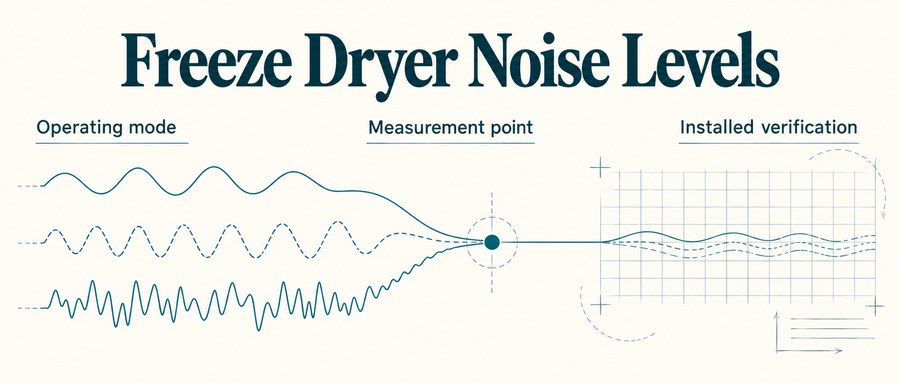
Can a quoted noise level settle the layout?
Before approving a location, the project team should send the supplier the proposed layout, nearby work positions, and intended operating schedule. Identify which noise documents are available and which questions still need an answer. A decibel figure becomes useful once you know the exact equipment, operating condition, and measurement position it describes.
A household demonstration shows only what that specific setup sounded like; it does not establish sound levels for a food-production installation. The same distinction matters when a quotation reports a vacuum pump alone: the buyer still needs to know how that component information relates to the proposed complete system running on site.
No configuration-specific acoustic test report from the company has been supplied for this guide. It therefore gives no typical freeze dryer noise range and makes no claim that a proposed installation will meet a particular sound level.
Use supplier data to narrow the equipment choice, then agree on how the delivered installation will be checked. HSE machinery purchasing guidance recommends asking suppliers about intended operating conditions as well as standard test settings, followed by checking the specification after delivery and installation. Requesting this comparable evidence prevents making layout decisions based on an isolated, unexplained number. [1]
What must the supplier’s noise report explain?
Ask the supplier to name the quantity before comparing its numerical value. The report should then connect that quantity directly to the configured equipment and the conditions used during testing. Use the checklist below as a practical purchasing inquiry to gather matching data, rather than as a substitute for selecting a project test standard.
Emission sound pressure is reported at a specified workstation or measurement position under stated conditions. Sound power describes the source rather than a reading at one chosen workstation. Workplace noise exposure concerns the person doing the work and the noise experienced over time. These quantities answer different questions, so their reported values should not be substituted for one another. [2] [3]
| Data field | What the buyer should request | Why it matters |
|---|---|---|
| Machine and supply boundary | Model, configuration, pump/refrigeration arrangement and auxiliaries included in the measurement. | A component figure does not describe every source in the installed system. |
| Quantity and units | Whether the value is emission sound pressure, sound power or an exposure metric; weighting and reported units, such as dB(A), where applicable. | Similar-looking numbers can describe different quantities. |
| Operating condition | Cycle stage, active equipment, load condition and relevant control state. | A reading must represent the duty being compared. |
| Measurement conditions | Test method/code, microphone position and distance, environment, background treatment and measurement period. | The comparison needs a reproducible basis. |
| Uncertainty and status | Reported uncertainty, test date, source document and whether the figure is measured, declared or estimated. | A declared value and an informal recording are different evidence. |
Scroll within the table on a narrow screen. This is a purchasing information request, not a completed test report or a universal legal checklist.
HSE’s manufacturer guidance supports reporting the test code or measurement method, operating conditions and relevant uncertainty. That guidance addresses the UK context. The responsible project team must establish the requirements and suitable methods for the actual destination and equipment. [2]
If the report leaves a field blank, ask for it explicitly. For example, a stated measurement distance does not identify the microphone position, operating load, or treatment of background noise. Keeping these details together ensures your team evaluates competing proposals using the same questions and matching evidence.
Can two offers be compared fairly?
Submit an identical acoustic data request to each prospective vendor. When one quote lists an isolated vacuum pump value while another cites an integrated system figure, verify the exact scope of hardware included in each test before comparing numbers. Check whether both tests match your planned production cycle and measurement conditions, because a lower decibel figure by itself does not prove a quieter installation.
Ask which sub-assemblies were active during each measurement. Describing a machine simply as “running” conceals whether the test captured refrigeration pull-down, vacuum roughing, secondary drying, or auxiliary gear. Use the operating stages below to define the physical boundaries of each quote, noting that specific plant designs may not include every event.
| State to discuss | Configuration-specific record |
|---|---|
| Cooling or freezing | Refrigeration equipment, cooling fans or water-side equipment operating, with the tested load condition. |
| Evacuation and drying | Active vacuum-pump combination, refrigeration duty and auxiliaries included; identify the stage being measured. |
| Turnaround and intermittent events | Relevant venting, defrosting, cleaning or handling events, where present in the design; keep them identifiable in the record. |
| Factory operation | Other dryers, chillers, pumps, packing equipment or processes operating at the same time. |
Operating-state evidence has limits. A published pharmaceutical freeze-dryer refrigeration case found that empty testing did not reveal a problem that appeared under product load. It supports documenting the actual test duty; it did not measure noise and supplies no sound rating for food equipment.[4]
Decide what to do with the evidence
- Compare the offers: the quantity, equipment included, operating duty, and measurement conditions match well enough for the comparison the parties have agreed.
- Ask for clarification: information is missing, or the offers describe different components, positions, or operating states. Ask both suppliers to answer the same outstanding questions before ranking the figures.
- Agree a project measurement: the available documents cannot answer the installation question. Specify what will be measured, who will do it, and how the result will be judged before treating the question as resolved.
Missing evidence leaves the answer unknown; it does not show that a machine is quieter or louder. Do not add an assumed decibel penalty or automatically convert results taken at different distances. A competent noise adviser should decide whether the source, room, and measurement method allow that comparison. [1] [6] [7]
Use the freeze dryer specification guide to identify the equipment and utilities proposed for the project. Keep those process and utility figures separate from acoustic evidence, as they do not supply a noise rating.
What should be checked at the factory and on site?
Before purchase, the supplier and buyer should agree on factory checks, the checks to repeat after installation, and who is responsible for each one. Write down the tested configuration, operating states, quantity, measurement method, measurement positions, acceptance criterion, and treatment of uncertainty. Also state how deviations will be recorded and who will confirm that follow-up work is complete. [1] [2]
Once the equipment is installed, check it where people will actually work. Supplier information helps select equipment, while the site review considers the delivered arrangement, worker locations, and other processes running nearby. HSE food-sector guidance connects supplier noise data to those work locations and to the choice of engineering controls. [5]
- Match the installed equipment to the report. Check the machine and its auxiliaries, and record any material difference from the tested configuration.
- Identify the relevant work. Include operating, loading, unloading, and other tasks, the positions people use, and other equipment running at the same time.
- Have a competent person plan the measurements. The plan should specify suitable instruments and settings, calibration checks, operating conditions, positions, and recording periods.
- Include time when assessing exposure. Record how the work and noise vary, rather than treating one spot reading as the whole shift. The estimate needs to represent the work people actually do. [3]
- Record the decision and the follow-up. Keep the results and test conditions with the agreed acceptance basis, unresolved items, responsible people, and the actions they will verify.
Keep equipment acceptance separate from worker exposure
A factory result does not establish the installed site result. Passing the machine’s agreed acoustic check also does not by itself establish acceptable exposure over a workday. The local workplace-noise assessment determines the applicable exposure requirements and controls; this guide sets no universal pass/fail level and certifies no installation. [1] [3] [6]
Keep the machine record with the agreed factory and installed checks. Keep the workplace record with the people doing the work: their tasks, positions, time near each source, and other equipment operating. The competent assessor selects a representative way to assess exposure and applies the requirements for that workplace. Keeping the records separate makes clear which question each result answers.
The installation planning guide covers wider site interfaces. Use it alongside the acoustic plan, so the equipment arrangement and workplace review refer to the same proposed installation.
Does the problem need a control review or service?
For normal operation, identify the source and path first
Ask the supplier and the site’s competent noise adviser to identify the main sound source and how sound reaches work positions before choosing a control. CCOHS recommends considering each source’s contribution and controlling the dominant source first. This helps the team choose what to investigate instead of assuming that the most obvious component is responsible. [7]
Review source selection and equipment placement first, then suitable engineering measures such as enclosure, isolation, or silencing. HSE food-sector guidance also includes maintenance to prevent avoidable noise. These are options for the responsible team to assess, not a ready-made modification for every freeze dryer. [5]
A generic enclosure or relocated pump is not an approved modification. Any proposal must retain the actual equipment’s cooling, ventilation, exhaust, service access, hygiene and process requirements. Confirm the design and verification responsibilities before changing the installation; no fixed reduction is promised.
Name who will design the proposed change and who will verify it. Before implementation, have those responsible for the equipment review the effects on cooling, exhaust, hygiene, service access, and the drying process. Afterwards, keep the operating and measurement conditions with the comparison result, so the team can tell what was actually checked. [5] [7]
For a new rattle or vibration, follow the service procedure
A new rattle, unusual vibration or a marked change from the recorded operating baseline needs a separate service review. Follow the equipment procedure, record the cycle stage and alarms, and involve qualified support. An online sound clip cannot identify the repair, and guards or interlocks must not be bypassed to quiet the machine.
Use the freeze dryer service and maintenance guide to prepare the wider service record. It complements the machine’s instructions; it does not replace them or the site’s acoustical assessment.
Send a brief the supplier can answer
Bring the equipment choice and site question together in one brief. State what is known, attach the available documents, and mark what still needs confirmation. Keep the same stated conditions when the enquiry becomes a quotation and later an installed verification record.
- Production duty: the food product, preparation, required output and intended operating schedule.
- Equipment included: the proposed freeze dryer, vacuum and refrigeration arrangement, and any auxiliaries the buyer will supply.
- Workplace layout: equipment positions, nearby workstations and the other processes expected to run at the same time.
- Available noise evidence: the acoustic documents and their measurement conditions, with missing information clearly marked as unverified.
- The question to resolve: the project’s noise target or assessment question, responsible site adviser and proposed verification scope.
Discuss the configured food-production system
Send the production duty and site brief to the engineering team. Ask which configuration-specific noise information is available and which questions require additional measurement or a specialist site assessment. Acoustic testing, site services and any guaranteed performance must be expressly agreed for the project.
References and evidence boundaries
- Health and Safety Executive. How can I choose quieter equipment and machinery? Purchasing and installed-verification guidance. Accessed 31 October 2026.
- Health and Safety Executive. Advice for manufacturers. UK machinery-noise reporting context, including methods, conditions and uncertainty. Accessed 31 October 2026.
- Health and Safety Executive. How do I assess the risks? Representative work-pattern and exposure-estimation guidance; no universal equipment limit is inferred. Accessed 31 October 2026.
- 过星. 冻干机制冷系统的典型问题及案例分析[J]. 机电信息, 2014(11):31–33. DOI: 10.19514/j.cnki.cn32-1628/tm.2014.11.007. A specific pharmaceutical refrigeration case; no acoustic measurements or food-machine sound rating are inferred.
- Health and Safety Executive. Occupational health risks in food and drink manufacturing. Noise section: worker-location information and engineering-control hierarchy. Accessed 31 October 2026.
- Canadian Centre for Occupational Health and Safety. Noise — Measurement of Workplace Noise. Measurement purpose, source surveys and representative personal exposure; Canadian settings are not universal project requirements. Accessed 1 November 2026.
- Canadian Centre for Occupational Health and Safety. Noise — Control Measures. Source contributions, transmission paths and operating constraints; no specific reduction or modification is promised. Accessed 1 November 2026.
Checklists in this guide are proposed purchasing records, not measured results from the company, acoustic certification or a completed workplace assessment.

About the Author: Zheng Wei
Founder & Freeze-Drying System Engineer
Fuzhou Xing Shun Da Refrigeration Facility Project Co., Ltd.
Zheng Wei participates in food freeze-drying trials, equipment selection, vacuum-system configuration, refrigeration planning, installation guidance, process optimization, and project handover. The project experience covers fruit, vegetables, cooked foods, seafood, meat, dairy products, herbs, and extracts.